 Expat Corner
Việt Nam, Poland establish Strategic Partnership
1.
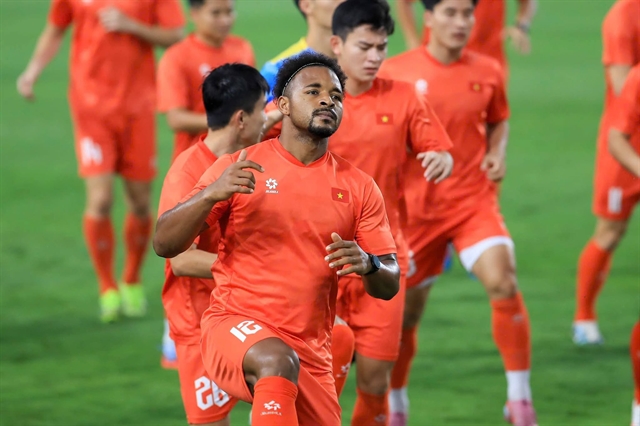 |
| Nguyễn Xuân Sơn, the only naturalised Brazilian in that squad. VNA/VNS Photo |
By Alex Reeves - @afreeves23
As you read this, you are either revelling in a second successive win over Thailand in an ASEAN Cup final, or you are miserable, having watched our boys in red capitulate and throw away a two-goal lead that has never once been overturned in the history of this final. I sincerely hope it is the former. As tempted as I was to write this as though it was hot off the press on Thursday morning, the risk of being a jinx is far too great.
In the build up to the first leg, Charnwit Pholchivin, vice president of the Football Association of Thailand, threw himself head first into the region's hottest football debate. Thailand, he suggested, were not preparing to face Việt Nam at all. They were preparing to face 'Việt Nam Plus, plus Brazil'. He went further, adding: "We have to ask where the pride is, because this is a football tournament in ASEAN."
An interesting position, given Thailand needed one of the most unsportsmanlike goals I have ever witnessed to level the last final, and lost anyway. Nguyễn Xuân Sơn, the only naturalised Brazilian in that squad, had gone off on a stretcher before half time.
It weakens further after Saturday's scoresheet. Nguyễn Hải Long and Nguyễn Quang Hải, both substitutes, both born here. Of the five naturalised players in the squad, only three arrived with no Vietnamese ancestry. 'Việt Nam plus Brazil' might have seemed a good line at the time, but it's a melodramatic one.
That said, the naturalised lads did affect the game, and his opinion is shared by sections of the Vietnamese support. If the national team cannot be improved through the domestic league, coaching and academies, then recruiting players who were nowhere near the standard required to represent the country of their birth could be seen as a slightly embarrassing shortcut.
The trouble with calling it a shortcut is that it is a remarkably slow one. FIFA still demands five continuous years of residence after the age of eighteen. Xuân Sơn arrived in 2020, Nguyễn Tài Lộc a year before that. Whatever else these players did, they waited.
Meanwhile Việt Nam is modernising, and becoming more international every year. The Nationality Law was rewritten last July and waived both the residency requirement and the language test for people of exceptional talent in sport, among other fields. This was not a loophole, it was a deliberate look to the future.
Personally, I have little issue with any of it. The future of international football is almost certainly the diaspora, teams are going to be increasingly diverse. Curaçao took twenty six players for their World Cup debut this summer. Only one was born on the island. The line that needs drawing isn’t between homegrown and naturalised but between honest and dishonest.
To the 'expat' portion of our readership, I would not start getting your hopes up. That door opened for people useful in ways most of us are not. A passport for becoming a national hero is one thing. A passport for a decade of turning up on time is quite another. VNS
Expat Corner
 Expat Corner
 Expat Corner
 Expat Corner
 Expat Corner
.jpg) Expat Corner
Expat Corner
 Expat Corner
 Expat Corner
 Expat Corner
 Expat Corner
 Expat Corner
 Expat Corner
 Expat Corner
 Expat Corner
 Expat Corner




