 Life & Style
Wood businesses face cash-flow strain over VAT refunds
1.
 |
| Students from the HCM City University of Technology – Việt Nam National University, HCM City apply technology to history and cultural projects. — VNA/VNS Photo |
HCM CITY — From vertical-screen micro-dramas to AI-assisted creations, digital technology is reshaping how literature and the arts are created, distributed and experienced, while raising new questions about artistic depth, authorship and responsibility.
Smartphones and digital platforms are opening up new ways for audiences to read stories, watch films and enjoy the arts. A work can reach viewers through a full-length version, excerpts shared on social media or a series of short episodes specifically designed for mobile screens.
This shift allows works to reach wider audiences while requiring creators to adapt their storytelling to different formats.
Episode length, pacing and endings have therefore become important considerations in maintaining audience engagement.
Micro-dramas, a form of short vertical-screen films gaining popularity on digital platforms, are one example.
According to lecturer Đặng Huỳnh Thảo Vi of the HCM City University of Economics and Finance, each micro-drama episode can be viewed as a “small story cycle” forming part of a continuous narrative rhythm.
In series spanning dozens of episodes, each episode has its own narrative beat while also encouraging viewers to continue watching.
Notably, data on audience behaviour on digital platforms can provide a basis for producers to adjust their content.
Technology is therefore no longer merely a means of distributing works but is beginning to influence how content itself is developed, from episode length and pacing to ways of sustaining audience attention.
In literature, technology is influencing the creative process itself as AI becomes involved in text generation and storytelling.
According to lecturer Nguyễn Thành Tài of the Faculty of Literature and History at Đà Lạt University, AI and machines were previously mainly subjects explored by humans in works of science fiction.
Today, AI has become a tool used to create stories and artistic works.
The shift from humans “telling stories about AI” to “AI co-telling stories” marks a change in the role of technology in creative work.
The question, therefore, is not simply whether AI-generated works should be accepted, but also at what stage AI is involved, how extensively it intervenes in the content and storytelling, and how its role should be assessed.
These changes also call for additional research methods to identify the role of AI in creative works.
Technology's involvement also extends to the way works are delivered to and received by audiences.
According to Dr Lê Thị Kim Huệ of the Phú Yên Campus of the Banking Academy, digital media, social networks and personalised algorithms are having a clear impact on how young people engage with culture and the arts.
Technology and AI can broaden access to knowledge, increase interaction and provide experiences tailored to individual users.
However, consuming content rapidly and in fragmented forms can limit audiences' ability to explore works in depth, while increasing their reliance on content selected and recommended by algorithms.
A work reaching more people does not necessarily mean it is being understood more deeply.
When a work is removed from its context and turned into short, easily shareable content, the audience's experience may also change. In the digital environment, the ability to read, watch and evaluate content actively is therefore just as important as expanding access.
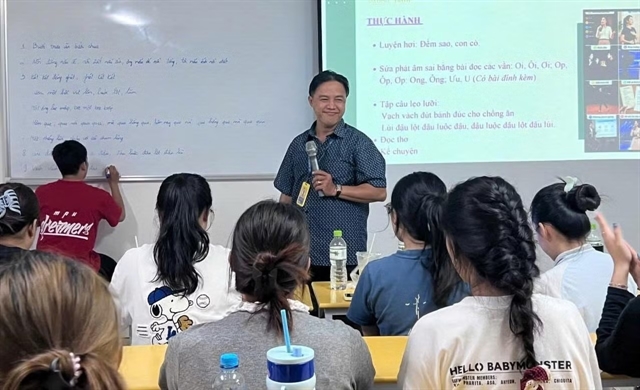 |
| Students of Gia Định University attend a lesson exploring music and cinema. — VNA/VNS Photo |
Technology reshapes creativity
As AI becomes capable of generating text, images and sound, as well as supporting film production, creators have more tools to develop ideas and express their work.
However, this involvement also makes it more complicated to determine the contribution made by humans.
For a product that uses AI, it is necessary to clarify at what stage the technology was used, what decisions the creator made, and who is responsible for the published content.
In cinema, these questions arise at every stage of filmmaking, from pre-production and production to post-production and distribution.
AI's ability to create, replace, or alter images of people raises the need to clarify image origins, obtain consent from people whose likenesses are used, and establish producers' responsibilities.
The use of technology should therefore be considered alongside copyright, image rights and transparency.
Changes in the way works are created also present new requirements for research into literature and the arts.
According to Associate Professor Dr Phan Mạnh Hùng, Dean of the Faculty of Literature and Linguistics at the University of Social Sciences and Humanities under Việt Nam National University-HCM City, AI is prompting a reconsideration of familiar concepts such as authorship, texts, readers and the right to interpretation.
When technological tools participate in creating texts or images, the roles of creators and other relevant parties need to be identified more clearly.
After determining who has contributed to a work, the next question is how to assess the value of the resulting product.
Technology can shorten production time, enable more content to be created and expand its reach, but these advantages alone do not guarantee artistic depth.
A fluent text or carefully processed image still needs to be considered in terms of its content, cultural context, identity and significance to its audience.
According to Dr Lê Hoàng Dũng, vice rector of the University of Social Sciences and Humanities under Việt Nam National University-HCM City, technological development, particularly AI, is having a profound impact on the creation, teaching and study of literature and the arts.
New opportunities are emerging alongside questions about the value and role of humans in creative work.
Therefore, the use of AI should go hand in hand with users' responsibility to verify and evaluate the resulting products.
Clarifying the origin of a work, the extent of technological involvement, and respecting copyright and image rights will give audiences a basis for understanding and evaluating the content they encounter.
In teaching and research, this requirement is also linked to understanding cultural contexts, identifying identity and analysing the significance of works.
The human role in the creative process is therefore reflected in concrete decisions: what technology is used for, which content is selected and how responsibility for the final product is assumed.
This provides a basis for AI to support creators in developing their work while preserving its cultural and artistic depth. — VNS
Life & Style
 Life & Style
 Life & Style
 Life & Style
 Life & Style
 Life & Style
 Life & Style
 Life & Style
 Life & Style
 Life & Style
 Life & Style
 Life & Style
 Life & Style
 Life & Style
 Life & Style