 Life & Style

Vietnam Post harnesses technology to transform postal-logistics network
1.
|
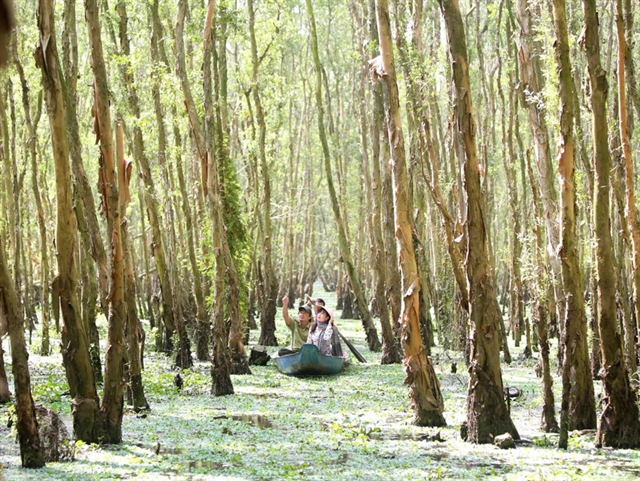
| Forest rangers work with the Trà Sư Cajeput Forest Management Board to conduct regular protection patrols. — Photo Vũ Sinh |
AN GIANG — Deep in the Bảy Núi (Seven Mountains) region, where majestic peaks melt into endless horizons, lies a sanctuary of vibrant green that gently coaxes the modern traveller to slow down: the Trà Sư Cajeput Forest. Once a barren, highly acidic wasteland, this wetland has been masterfully revived into a thriving ecological jewel of the Mekong Delta.
While An Giang Province is celebrated for the spiritual allure of the Bà Chúa Xứ Temple at Sam Mountain, the scenic vistas of Cấm Mountain and the bustling markets of Châu Đốc, Trà Sư offers an entirely different rhythm – silent, soft and breathtakingly lush.
When the annual flood season arrives, typically in the final months of the year, the forest sheds its everyday look for a stunning transformation. Water canals fill to the brim, a dense carpet of green duckweed covers the rivers and flocks of returning birds turn the wetland into a living, moving ink-wash painting.
A dream painted in green
|
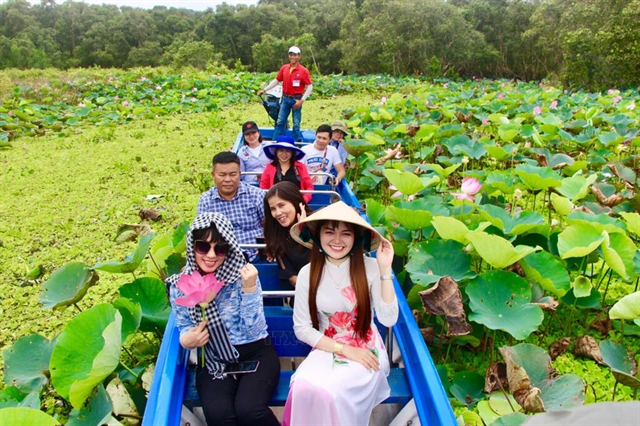
| Visitors explore the serene waterways of the Trà Sư Melaleuca Forest. — Photo Thanh Sang |
Following recent administrative adjustments, the Trà Sư Landscape Protection Area sits within the newly expanded boundaries of An Cư Commune in An Giang's Tịnh Biên Town. The entire reserve spans a total area of over 1,050 hectares as part of Việt Nam’s special-use forest system, with over 845 hectares dedicated specifically to sustainable eco-tourism development.
The greatest triumph of Trà Sư is that it is not purely primeval. In 1983, local authorities began planting cajeput to reclaim the highly acidic soil, manage upstream floods and restore the degraded environment. By 2003, the sanctuary was officialised, anchoring decades of strict conservation. Trà Sư is more than a scenic spot. It is a profound testament to human patience in restoring a difficult landscape.
During the floods, the water lanes snaking through the woods swell with life. A massive mantle of green duckweed stretches out like an endless velvet carpet. As small wooden boats glide forward, they part the green layer, which slowly stitches itself back together in the vessel's wake.
Here, the urban rush completely evaporates. The sensory landscape belongs entirely to the gentle splash of oars, the soft rustle of melaleuca leaves and the sudden, echoing calls of wild birds echoing from the canopy.
Senses awakened by the wild
Exploration of Trà Sư usually begins on a larger motorised boat along the main waterways before transferring to a small rowboat to venture deep into the narrower channels. Local rowers double as charismatic storytellers. They point out a bird dipping close to the water, a unique tree trunk or the subtle shifts in underwater flora.
As you drift deeper, engines fade entirely. Towering cajeput trees interlock above to create a natural green cathedral. Sunlight pierces the canopy, casting soft golden threads onto the water. Every so often, a flock of birds bursts from the trees, slicing across the sky before vanishing into the greenery.
To witness this landscape at its absolute peak, dawn and dusk are unmatched. Morning brings a crisp, fragile light, while sunset sees thousands of white storks dotting the sky as they return home for the evening.
For a panoramic view, visitors can walk along the famous Vạn Bước (Ten thousand step) bamboo bridge. This structural wonder weaves seamlessly through the wetlands, allowing people to immerse themselves in nature without disrupting fragile micro-habitats. From the observation tower, the green forest canopy appears boundless, melting into distant rice fields and mountain ridges.
From environmental revival to sustainable community
|
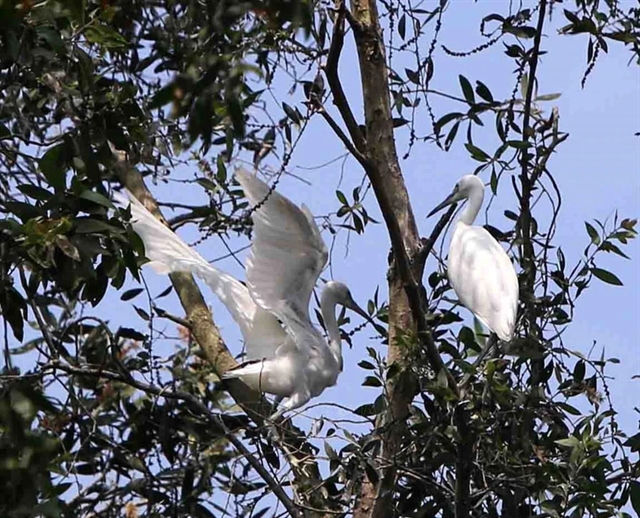
| White storks find a permanent, safe sanctuary in the dense forest canopy of Trà Sư. — Photo Vũ Sinh |
Trà Sư is far more than a backdrop for a beautiful photograph — its true value lies in its blueprint for ecological rebirth. The grand trees of today were planted over four decades ago to heal the earth, reflecting a philosophy of restoration over extraction.
Today, the forest boasts a rich biodiversity, with approximately 140 plant species belonging to 52 families, including nearly 80 species of medicinal plants. It serves as a vital sanctuary for over 70 bird species, mammals, reptiles and diverse aquatic life, many of which are tightly protected under the Việt Nam Red Data Book.
By involving local residents in tourism, forest protection has transformed from a top-down administrative task into a community livelihood. The forest has become woven into the community's memories, economy and future.
The journey extends naturally into the culinary heritage of the Bảy Núi region. Travellers can savour seasonal delicacies like canh chua cá linh bông điên điển (sour soup made with sesbania flowers and fish), grilled snakehead fish, wild honey and palm sugar treats.
Trà Sư thrives because it proves that nature can heal beautifully when treated with respect. For those looking to escape the concrete jungle, a slow boat ride through An Giang's floating season offers a powerful reminder: a truly livable countryside begins when humans choose to let nature live. — VNS
Traveller’s notes
Getting there: Trà Sư Cajeput Forest is located in An Giang Province, about 30km from Châu Đốc City and 100km from Long Xuyên City. From HCM City (about 250km away), visitors can take an overnight sleeper bus to Châu Đốc, then rent a motorbike or take a local taxi to the forest.
Best time to visit: The absolute peak period is the flood season from September to November, when the water lanes swell and floating duckweed blankets the area. Ideal daily hours are 7–9am to watch birds foraging and 5–6pm to see flocks of storks returning to their nests at sunset.
Opening hours: Daily from 6.30am to 5.30pm.
Ticket prices: Visitors can customise their experience at the central pier with the following flat rates:
Entrance only: VNĐ120,000 (US$4.60) per person
Combo (Entrance + Motorboat): VNĐ200,000 ($7.70) per person
Combo (Entrance + Rowing Sampan): VNĐ190,000 ($7.30) per person
Full Package (Entrance + Both Boat Experiences): VNĐ270,000 ($10.40) per person (Highly recommended for full exploration)
What to pack: Insect repellent, sunscreen, a wide-brimmed hat, drinking water and binoculars for birdwatching.
Life & Style
 Life & Style
 Life & Style
 Life & Style
 Life & Style
 Life & Style
 Life & Style
 Life & Style
 Life & Style
 Life & Style
 Life & Style
 Life & Style
 Life & Style
 Life & Style
 Life & Style