 Life & Style
SBV to curb property price inflation, enforce lending rate rules
1.
|
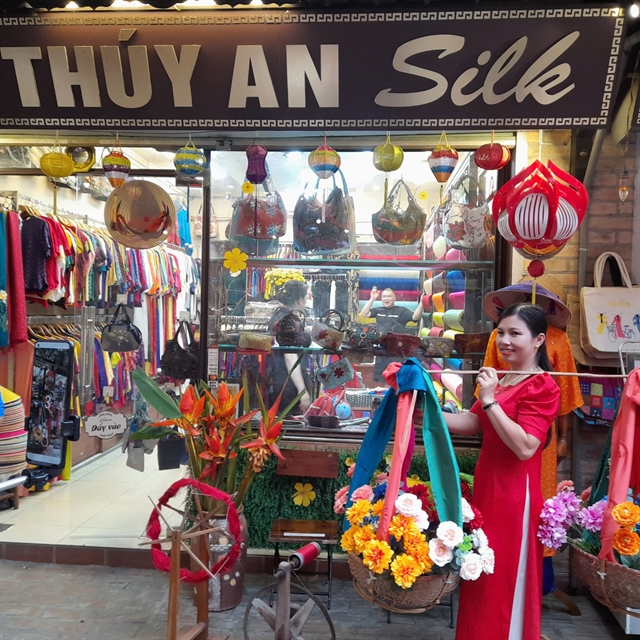
| A woman poses for a photo in front of a stall at Vạn Phúc Silk Village. — VNS Photo Thanh Nga |
HÀ NỘI — Hà Nội has selected Vạn Phúc silk village as a pilot model for digital transformation, focusing on e-commerce, product traceability, artificial intelligence (AI) and digital tourism experiences.
The move is in line with Resolution No 57-NQ/TW on breakthroughs in science and technology, innovation and national digital transformation.
The information was announced at a conference on promoting science and technology, innovation and digital transformation in Vạn Phúc silk village on August 21.
According to the Hà Đông Ward People’s Committee, the village area is home to about 14,620 people in more than 4,000 households. It has 150 production establishments and businesses employing 346 workers, including 32 facilities directly engaged in silk weaving with 116 looms.
The village produces an estimated 1.2 million metres of fabric each year, with annual revenue from production, trade, services and tourism exceeding VNĐ200 billion.
Vạn Phúc is also a popular tourist destination. Since 2021, the village has welcomed more than 454,000 visitors, including over 181,000 foreigners.
However, most visitors stay only for a short time, following a pattern of 'arrive – see – shop – leave'. Digital solutions are expected to help extend stays, increase spending and create additional income for residents.
Digitalisation has already begun in some areas. All business establishments have adopted digital payments, e-invoices and POS machines. However, only one establishment currently has a website and online shop, while fewer than five per cent of products have QR codes for origin traceability.
The Hà Đông Ward People’s Committee has proposed a 'Vạn Phúc Digital Marketplace and AI Marketing' model to help 30-50 establishments set up digital shops, sell through multiple channels, develop multilingual content and authenticate products. Sales, inventory and revenue management software are also part of the plan.
Another key component is the development of a 'digital passport' for products to verify their origins, support brand protection and safeguard copyright over traditional patterns. The village currently has 13 artisans, including one Meritorious Artisan, and 65 traditional silk patterns.
The digital transformation plan aims to support suitable production processes without replacing the village’s traditional craftsmanship. Proposed solutions include digitising silk patterns and studying the use of sensors to monitor looms and detect defects in supporting production stages.
In tourism, Vạn Phúc is expected to develop a 3D digital museum, 3D digital spaces, a Digital Passport, an AI Guide and a 60-90-minute digital tourism experience.
At the conference, Cù Ngọc Trang, Director of the Hà Nội Department of Science and Technology, said Vạn Phúc had potential to develop night tours, helping extend visitors’ stays and create greater economic value for local residents.
He called for research into experience and accommodation packages, a craft village tourism portal and attractive night tours.
The Hà Đông Ward People’s Committee has also proposed a 100-day pilot programme with measurable targets.
These include completing digital maps and profiles for 120-135 establishments; issuing digital passports for 300-500 premium products at 20-30 establishments; helping 30-50 establishments set up digital shops under the common “Vạn Phúc Silk” brand; completing a digital tourism experience route; and launching at least 10 new silk designs involving artisans and designers.
The programme’s results will be assessed through data including the number of establishments using digital platforms, authenticated products, online revenue, visitor numbers, length of stay, average spending and the number of new product designs.
If successful, the model could be reviewed and standardised for possible application in other craft villages in the capital, including Bát Tràng, Sơn Đồng, Chuyên Mỹ and Quảng Phú Cầu.
Vạn Phúc silk village was recognised as a national intangible cultural heritage in 2023 and as a World Craft Village in 2024. In 2026, Hà Nội recognised Vạn Phúc Silk Weaving Village as a tourist destination. — VNS
Life & Style
 Life & Style
 Life & Style
 Life & Style
 Life & Style
 Life & Style
 Life & Style
 Life & Style
 Life & Style
 Life & Style
 Life & Style
 Life & Style
 Life & Style
 Life & Style
 Life & Style