 Life & Style

MSM chooses AWS to accelerate next-generation technology solutions for agribusiness value chain
1.
|
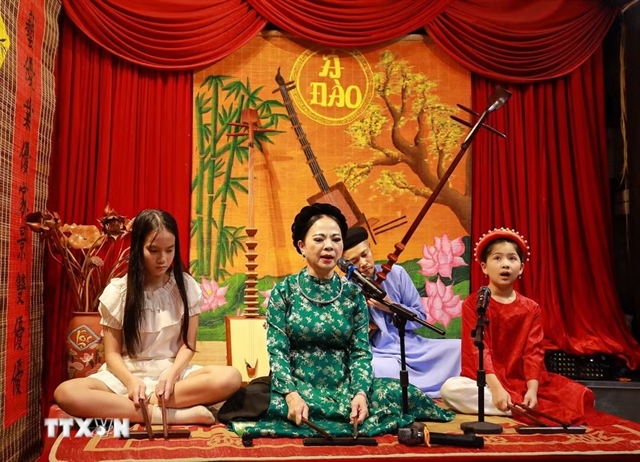
| Meritorious Artist Nguyễn Thị Vân Mai (centre) performing ca trù. Bích Câu Đạo Quán offers free ca trù singing classes for all in a bid to preserve the traditional Vietnamese art. — VNA/VNS Photos |
HÀ NỘI — Every Saturday, newcomers and veteran singers gather at Bích Câu Đạo Quán in Hà Nội to meet up, share their passion and practise the traditional Vietnamese art of ca trù, or ceremonial singing.
Founded nearly two decades ago by a married couple, Meritorious Artist Nguyễn Thị Vân Mai and her husband Trần Văn Trúc, the club has become a second home for many professional and amateur singers who love ca trù.
The club members are committed to preserving this ancient Vietnamese chamber music genre, which combines poetry, distinctive instrumental accompaniment and deep cultural heritage.
At the club's opening in 2008, one year before ca trù was recognised by UNESCO as an intangible cultural heritage in need of urgent safeguarding, there were only a handful of learners, all children of the founders' acquaintances.
|
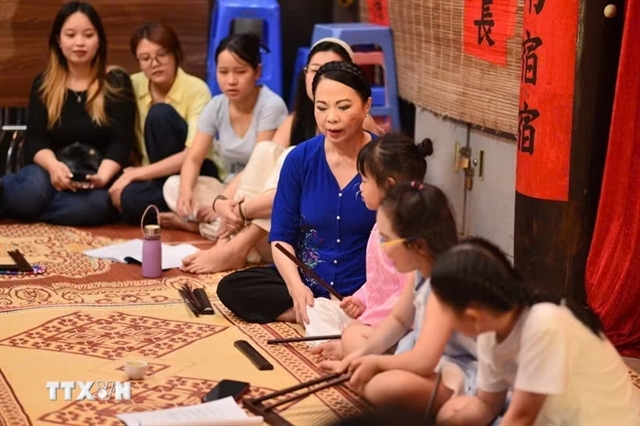
| Meritorious Artist Nguyễn Thị Vân Mai teaching a class. Ca trù learners include young children, students, working-age people and international friends. |
Now, members include pupils, students, working professionals and many international tourists, thanks to the club's efforts to promote its classes on digital platforms.
Mai said she started her classes to give more people the chance to learn this unique style of art.
"Previously, it was hard to find a learner because the craft had traditionally been passed down only within families," she said. "Once recognised as an artisan and qualified to teach, I found that it was my responsibility to pass the heritage on to the next generations."
Ca trù is a unique and traditional art form from the north of Việt Nam. It holds significance through its use in many rituals, literature and other traditions that embody the spiritual and philosophical belief system of the Vietnamese people.
|
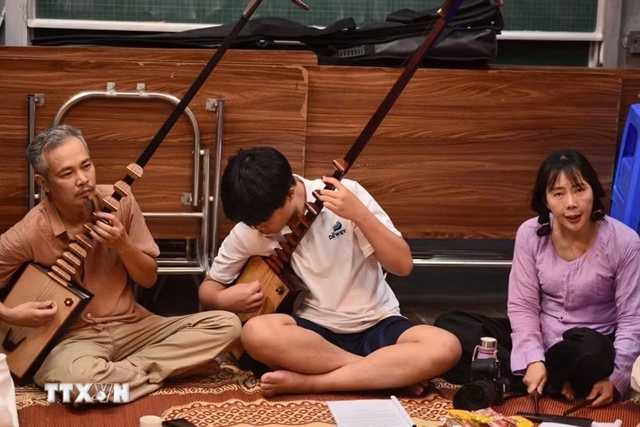
| Artists perform with plucked lutes, a key instrument in ca trù singing. |
Ca trù has a few different names, including ả đào and cô đầu. No one knows exactly when the practice started, but we do know that the genre of music flourished in the 15th century.
Associated with guilds and groups of singers, ca trù is often performed during cultural activities in villages and communes, such as for ceremonies worshipping village gods in communal houses, or in temples, shrines, places for ancestor worship and singing houses.
Historically, it was often performed at diplomatic receptions and ceremonies in royal palaces and was loved by the nobility and intellectuals.
Ca trù has a rich and diverse singing style. Its songs mainly come from Vietnamese poetic forms, and the most popular is still hát nói (recital melody), a liberal and literary style. Ca trù's lyrics are meaningful, poetic, emotional and profound, often taken from romantic, epic, philosophical or educational literature.
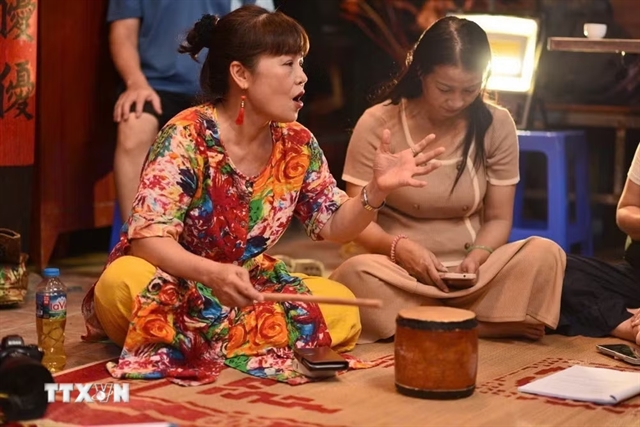
Freelancer Thúy Ngân, 26, said she had never thought of gaining a passion for this type of singing. However, after seeing a band's performance, she said she discovered its allure.
"Listening to the singing of the ca nương (female vocalist), accompanied by the đàn đáy (plucked lute) and phách (clappers) playing, I changed my mind, because of the beautiful melodies and the emotional and profound lyrics," she said.
|
| At the class, learners can exchange their knowledge and experience with each other. |
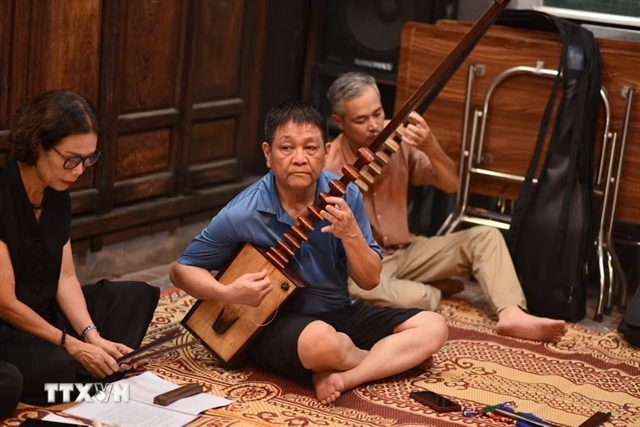
Co-founder of the Ca Trù Bích Câu Theatre Meritorious Artist Trần Koóng said many international tourists, including opera singers, have visited to learn more about ca trù and share knowledge of their own countries' traditional arts.
They were all impressed by the unadorned vocal style, the sounds of the clappers and the lute as well as the technique of the singer, according to Koóng.
He said such encounters helped promote Vietnamese heritage to the world through cultural exchange.
|
| Meritorious Artist Trần Koóng and his students in a class at Bích Câu Đạo Quán. |
He added that ca trù used to flourish more in the past, as many renowned cultural figures such as Nguyễn Công Trứ, Cao Bá Quát, Tản Đà and Dương Khuê created songs in the genre.
After suffering through the ups and downs of history, the art form nearly disappeared. Although it was recognised by UNESCO in 2009, it remains on the list of intangible cultural heritage in need of urgent safeguarding. This is due to a lack of performance spaces, a shortage of learners and the livelihood challenges faced by artisans who pursue ca trù.
According to the artists, community-based teaching is crucial solution to preserve the art.
Currently, Bích Câu Đạo Quán maintains between 10-20 learners and singers in every class.
After 18 years, many more have joined the club, and about 30 of them can sing and play the lute and clappers. Meanwhile, short-term learners also gain a deeper understanding and love for the art form, contributing to the spread of traditional cultural values.
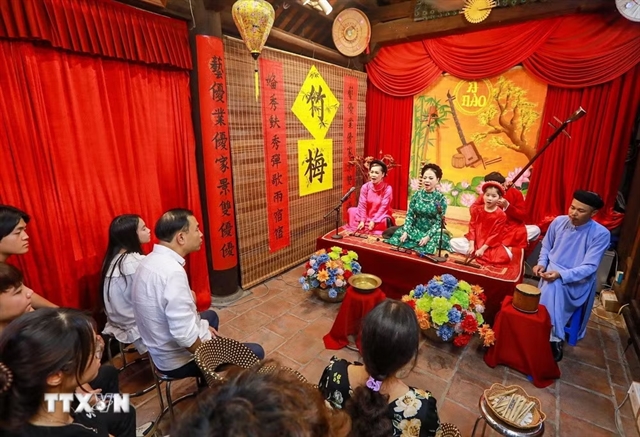
In 2017, Ca trù Bích Câu Theatre was founded as a place to popularise ca trù and a performing space for both learners and established singers, with free shows every Saturday night.
|
| A free ca trù show will be held every Saturday night at the Ca Trù Bích Câu Theatre. |
After the COVID-19 pandemic, performances have gradually resumed. Since the beginning of 2026, about 10 international groups visit the club per month.
The artists said that the revival of ca trù would require more free classes, additional performance venues and stronger promotional, cultural and experience programmes.
This approach aligns with the spirit of the Politburo's Resolution 80-NQ/TW, which states that cultural development must be grounded in the preservation and promotion of heritage values, encourage community participation and foster an environment where traditional cultural values are safeguarded and propagated within modern life. — VNS
Life & Style
 Life & Style
 Life & Style
 Life & Style
 Life & Style
 Life & Style
 Life & Style
 Life & Style
 Life & Style
.jpg) Life & Style
Life & Style
 Life & Style
 Life & Style
 Life & Style
 Life & Style
 Life & Style