 Life & Style

AXA Global Healthcare Mind Health Report reveals global differences in how cost and stigma affect access to professional mental health care
1.
By Thế Hạnh & Quỳnh Hoa
AN GIANG — There is no mistaking tung lò mò. Beneath the blazing An Giang sun, rows of deep crimson sausages sway outside Chăm homes, filling villages along the Hậu River with the rich aroma of beef, garlic and roasted rice.
For visitors to Châu Phong Commune, the sight has become as iconic as the village mosques or colourful brocade weaving workshops.
Yet behind every string of sausages lies a story that stretches back generations. For the Chăm Muslim community in An Giang, tung lò mò is far more than food.
It embodies religious beliefs, culinary traditions and the ingenuity of a community that transformed dietary restrictions into one of the Mekong Delta's most distinctive specialities.
Faith & flavour
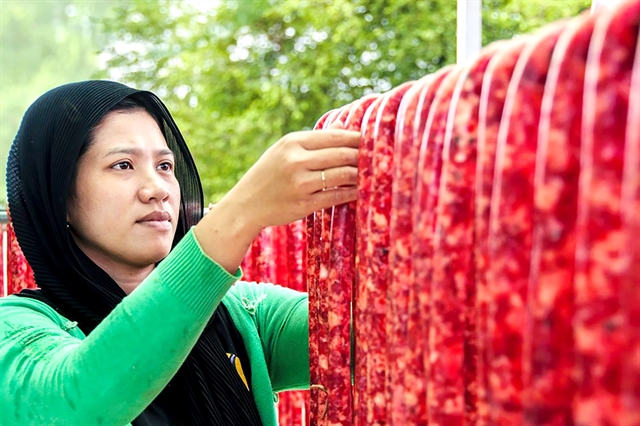 |
| A Chăm woman hangs rows of 'tung lò mò' to dry, preserving a culinary tradition passed down through generations. — Photo baovanhoa.vn |
Its name derives from the Chăm language and refers to beef stuffed into natural beef casings.
Unlike most Vietnamese sausages, which are made from pork, tung lò mò uses only fresh beef, reflecting Islamic dietary laws that prohibit pork.
Over time, what began as a festive dish prepared for family gatherings and religious celebrations has evolved into one of An Giang's best-known culinary ambassadors.
Its appeal lies in both its simplicity and patience.
Coarsely chopped beef is mixed with garlic, pepper, chilli, salt and roasted rice powder, whose nutty fragrance distinguishes the sausage from similar products elsewhere in Việt Nam. The seasoned meat is then carefully stuffed into cleaned beef intestines before being tied into short links and left to dry naturally under the sun for several days.
Unlike sweet Chinese-style or northern Vietnamese sausages, tung lò mò develops a gentle tang through natural fermentation rather than sugar. No preservatives are added, allowing the flavours to mature slowly while preserving the character of the original ingredients.
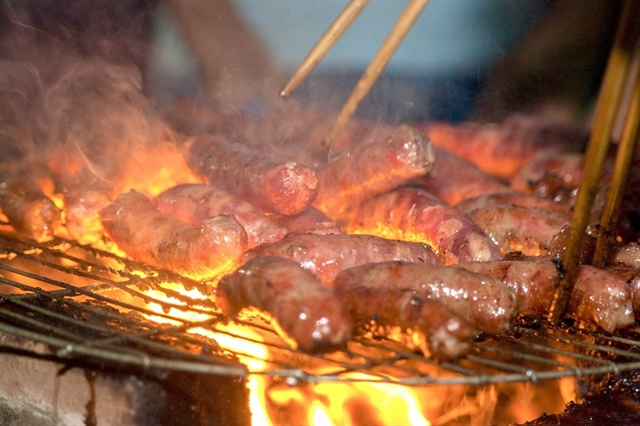 |
| Grilling over charcoal remains one of the most popular ways to enjoy 'tung lò mò', bringing out its smoky aroma and juicy texture. — Photo vinwonders.com |
The raw sausage can be grilled over charcoal, lightly fried or steamed.
As the casing blisters over glowing coals, savoury meat juices drip onto the fire, releasing an irresistible smoky aroma. The interior remains tender and succulent, with the richness of beef fat offset by peppery warmth and a delicate tang produced through natural fermentation.
Served with fresh herbs, shredded green mango or pickled vegetables and accompanied by chilli sauce or lime-pepper salt, the dish offers a harmony of flavours that surprises many first-time visitors.
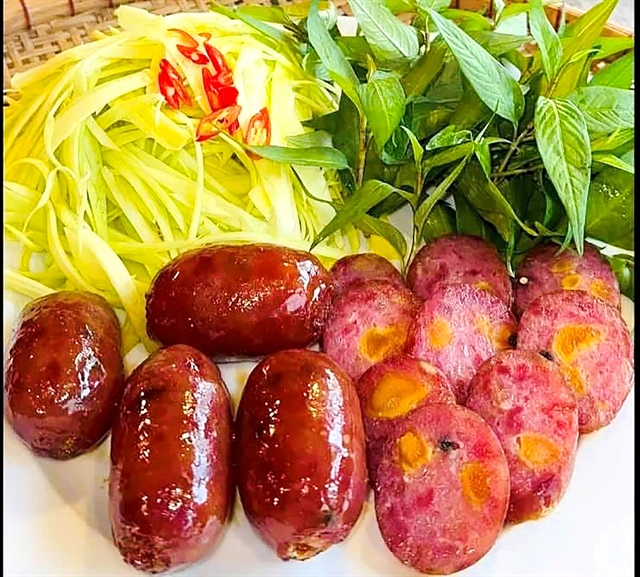 |
| Slices of grilled 'tung lò mò' are typically served with fresh herbs, shredded green mango and dipping sauces that balance their rich, smoky flavour. — Photo baovanhoa.vn |
Crafting tradition
For many Chăm families, however, the true flavour is inseparable from memory.
A family meal often centres around a plate of freshly grilled tung lò mò, shared among relatives after prayers or during festive occasions.
Recipes are rarely written down but instead passed from one generation to the next, with each household preserving its own subtle blend of spices.
The dish also carries echoes of Chăm oral tradition.
Local folklore tells of the first man, Nabi Adam, and explains why Muslims avoid pork, inspiring generations of Chăm cooks to create a beef sausage that honours both their faith and culinary creativity.
Whether viewed as legend or cultural memory, the story reinforces the close relationship between religion and everyday life within the community.
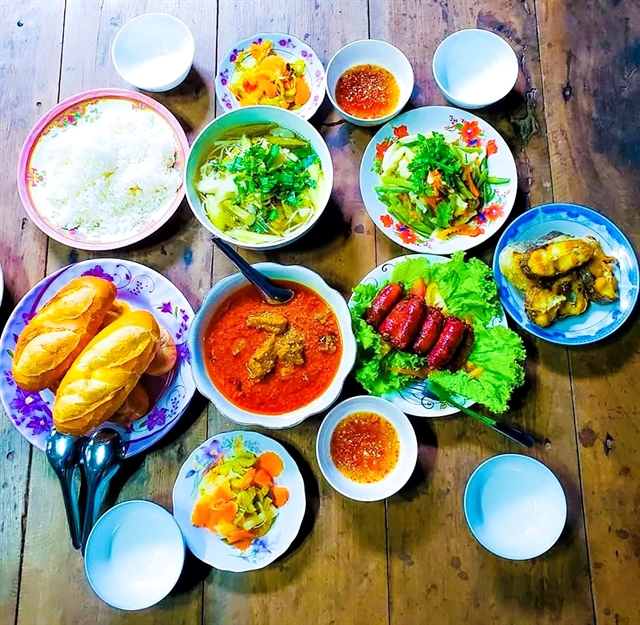 |
| A family meal in a Chăm household often features grilled 'tung lò mò', reflecting the community's enduring food traditions. — Photo baovanhoa.vn |
For decades, production remained largely confined to family kitchens in Châu Phong's Phũm Xoài Hamlet.
Sausages were made in small batches without packaging or branding, limiting their commercial reach despite growing popularity among travellers.
That began to change in 2012 when local entrepreneur Hứa Hoàng Vũ, known by his Chăm name Sa Leh, established the Anas tung lò mò production facility.
By introducing modern food safety standards while preserving traditional recipes, the business helped bring the Chăm speciality to a wider market without sacrificing authenticity.
The initiative also encouraged local households to work together, creating a village-based production network that has generated stable employment, particularly for Chăm women who remain central to the craft.
Today, Anas tung lò mò has earned a three-star OCOP rating and is sold through OCOP outlets, exhibitions and trade fairs, making the sausage one of An Giang's signature gifts for visitors.
Its reputation has spread well beyond An Giang.
In 2015, tung lò mò was named among Việt Nam's Top 50 Specialty Dishes, further cementing its reputation as one of the country's most distinctive regional foods.
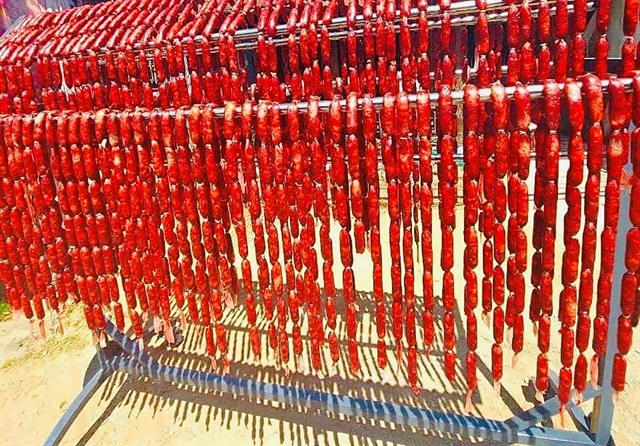 |
| 'Tung lò mò', the traditional Chăm beef sausage, was recognised among Việt Nam's Top 50 Speciality Dishes in 2015. — Photo baovanhoa.vn |
Living heritage
Increasingly, the sausage is also becoming part of a broader cultural experience.
Visitors to Chăm villages can watch the meat being seasoned, stuffed and hung beneath the sun before enjoying freshly grilled sausages alongside traditional Chăm dishes.
Many tours also introduce travellers to traditional handloom weaving, local mosques and the customs of the Chăm Muslim community, offering a richer understanding of life along the Mekong.
The combination of food, culture and community-based tourism has created new livelihoods while encouraging younger generations to remain connected with traditional crafts. It also reflects Việt Nam's broader development vision, which recognises culture as a strategic resource for sustainable national development.
By safeguarding traditional culinary knowledge while creating economic opportunities through tourism and local products, communities such as Châu Phong demonstrate how heritage can continue to thrive in modern life.
Standing beside rows of ruby-red sausages drying beneath the tropical sun, visitors quickly realise that tung lò mò is more than an unusual beef sausage.
It is a taste of history, faith and identity, carefully preserved one link at a time. — VNS
Life & Style
 Life & Style
 Life & Style
 Life & Style
 Life & Style
 Life & Style
 Life & Style
 Life & Style
 Life & Style
 Life & Style
 Life & Style
 Life & Style
 Life & Style
 Life & Style
 Life & Style