 Life & Style
Sun PhuQuoc Airways launches daily HCM City–Shanghai route
1.
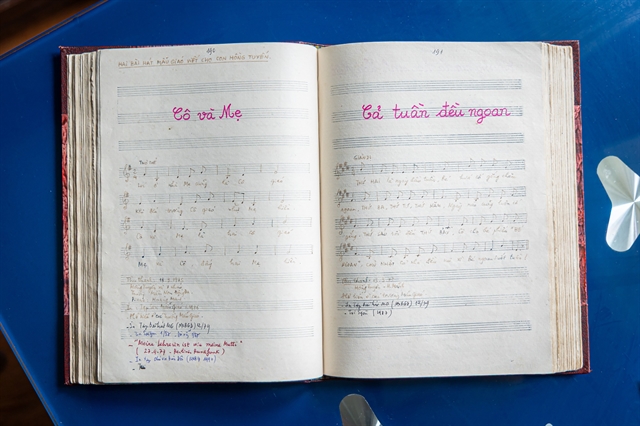 |
| Phạm Tuyên’s handwritten manuscripts offer a rare glimpse into the creative process behind one of Việt Nam's most celebrated composers. — Photo thethaovanhoa.vn |
HÀ NỘI — Veteran composer Phạm Tuyên has donated digital copies of 636 handwritten manuscripts to the National Archives Centre III, ensuring that one of Việt Nam's most treasured musical legacies will be preserved and made accessible to future generations.
More than just digitised documents, the collection captures nearly eight decades of the musician's creative journey through his handwritten scores, notes and annotations, documents that have accompanied some of the nation's historic milestones.
Journalist Phạm Hồng Tuyến, Phạm Tuyên's youngest daughter, said the centre had expressed interest in acquiring the composer's manuscripts several years ago.
However, he did not agree to the proposal at the time.
“The reason was very simple," Tuyến said. "My father did not want to part with the original materials. He cherished every page of his manuscripts, carefully preserving them through the years.
"In the future, we hope to continue restoring audio tapes and archival recordings, and possibly entrust other materials and artefacts to the centre as well.”
Tuyên's family has digitised all the works contained in the two notebooks, marking the first step in the collaboration between his family and the centre.
Unlike composers who kept their individual scores separate, Phạm Tuyên copied nearly 700 of his songs into two large notebooks, arranged chronologically by year of composition. Together, the volumes contain virtually his entire artistic life's work.
Each page was meticulously crafted. After writing the title of a newly completed song, he would often add small illustrations such as a star-shaped lantern, a traffic light or other decorative sketches to enliven the manuscript.
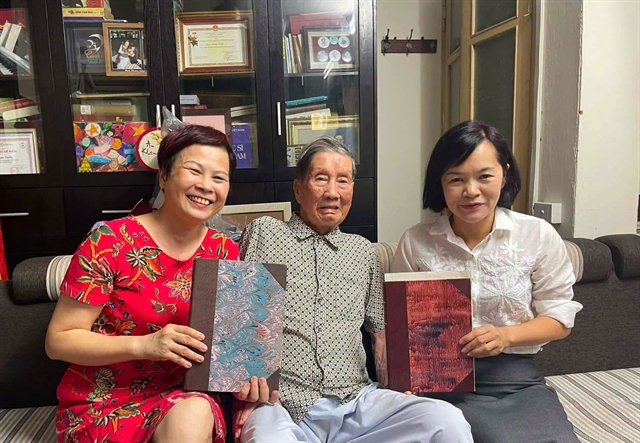 |
| Veteran composer Phạm Tuyên (centre), his daughter, journalist Phạm Hồng Tuyến (left), and National Archives Centre III Director Trần Việt Hoa at the handover ceremony for the digitised manuscript collection. — Photo thethaovanhoa.vn |
Creative legacy
Interspersed among the musical staves are notes documenting the circumstances in which each work was created, its first performance, the arranger, the singer who performed it and other details. These are more than just musical scores – they are the creative diary of a lifetime devoted to music.
Recognising the collection’s exceptional value, the family and the centre spent years in discussions before reaching an agreement on its preservation.
The two original manuscript volumes will remain in the family's care while their entire contents are digitised to ensure long-term preservation and archival storage.
Digitisation is not the end goal, but rather the beginning of a process that will enable Phạm Tuyên’s works to be accessed through new channels, bringing them closer to researchers, music enthusiasts and younger generations.
"The centre will establish a dedicated archival collection bearing the name of Phạm Tuyên, ensuring the long-term preservation of the digitised materials," said centre director Trần Việt Hoa.
"It will also explore ways to introduce his compositions through cultural and educational programmes, as well as major national events."
Living history
Phạm Tuyên is a composer whose music has been closely associated with different periods in the nation's history.
Many of his songs are very familiar to generations of Vietnamese people, including Như Có Bác Hồ Trong Ngày Vui Đại Thắng (As if Uncle Hồ Were Present on the Joyous Day of Victory), Chiếc Gậy Trường Sơn (The Trường Sơn Walking Stick) and Chiếc Đèn Ông Sao (The Star Lantern), which have touched the hearts of millions of Vietnamese people.
As if Uncle Hồ Were Present on the Joyous Day of Victory was written on April 28, 1975, two days before Sài Gòn was liberated. The song was first broadcast on Radio the Voice of Việt Nam on April 30, 1975, the day of national reunification. It was later heard in several other countries, including Russia, Germany, Cuba and China.
Phạm Tuyên, born in Hà Nội in 1930, is widely revered as a "historian through music", with a vast legacy of hundreds of patriotic and children's songs.
For his tireless contributions, he was awarded the Hồ Chi Minh Prize for Literature and Arts in 2012. At the age of 96, he remains a symbol of optimism with a passionate love for life. — VNS
Life & Style
 Life & Style
 Life & Style
 Life & Style
 Life & Style
 Life & Style
 Life & Style
 Life & Style
 Life & Style
 Life & Style
 Life & Style
 Life & Style
 Life & Style
 Life & Style
 Life & Style