 Life & Style

Việt Nam, China seek stronger substantive parliamentary cooperation
1.
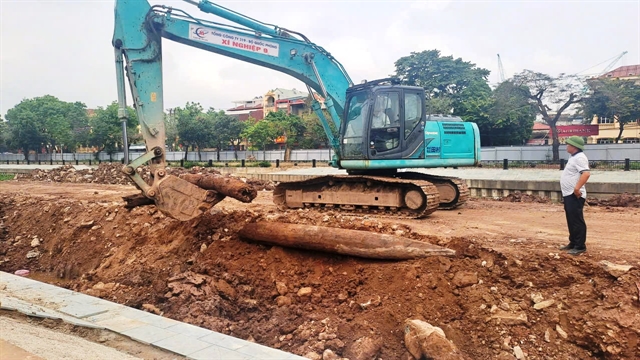 |
| Three piles are removed from the Vân River in Ninh Bình Province. They are believed military structures from the 13th century. Photo vietnamnet.vn |
NINH BÌNH — Three large wooden piles recently discovered in Ninh Bình Province are believed to be man-made structures, likely linked to military activities during the 13th-century Trần Dynasty.
Previously, workers discovered these pile protruding from the sediment while dredging the right bank of the Vân River, about 30m north of the Chà Là Bridge in Hoa Lư Ward. They then used the excavator to remove the piles from their original position before reporting to the authorities.
According to experts from the Ninh Bình Museum, all three piles were crafted from solid tree trunks with circular cross-sections. One end was sharpened while the other was decayed. They measure approximately 3.76-4.15m in length, with a circumference of 1.16-1.46m, and the pointed section is about 1.1m long. Smooth carving marks are still visible, indicating a relatively good level of craftsmanship.
At the time of discovery, the piles were driven vertically into the ground, with their pointed ends facing downward and their shafts protruding above the mud. The three piles were aligned in a north-south direction, following the flow of the Vân River. They stood about two metres apart and were arranged in two rows.
Experts say the deliberate placement and alignment of these structures indicate they are man-made rather than naturally occurring driftwood. It is highly likely that the piles were driven into place at the same time, formed part of a historical site, and served a specific function.
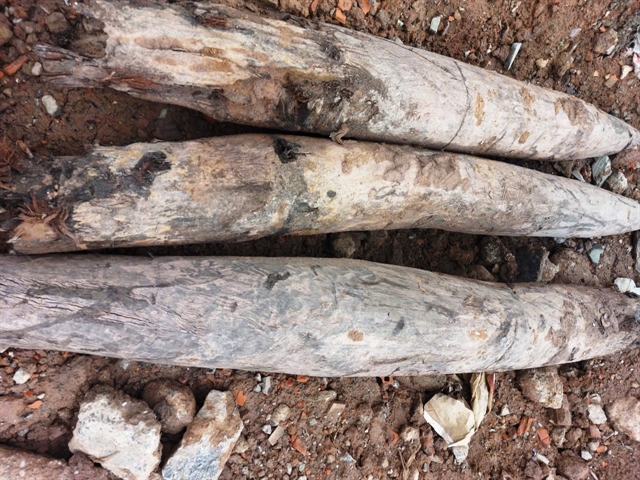 |
| A close view of three piles. |
This pile system shares many similarities – manufacturing techniques, shape, and location of the river mouth – with those previously discovered in the Sa Market area in Bắc Ninh Province which was within the Lục Đầu Giang battlefield during the resistance wars against the Yuan-Mongol army in the 13th-14th centuries. It leads to a suggestion that these piles are the remains of a defensive position or military structure from the Trần Dynasty.
Nguyễn Cao Tấn, deputy director of the Ninh Bình's Department of Tourism and vice chairman of the provincial Historical Science Association, says the Vân is an ancient river which has flowed through various historical periods. It once played a crucial role in the transportation and defence systems of the Hoa Lư ancient capital. The discovery of wooden piles here has led to the hypothesis that defensive structures once existed at the southeastern gateway to the capital.
He says the Vân River was not only a strategic waterway connecting Đáy and Vạc rivers and Thần Phù estuary but also an important shield protecting the capital through many dynasties.
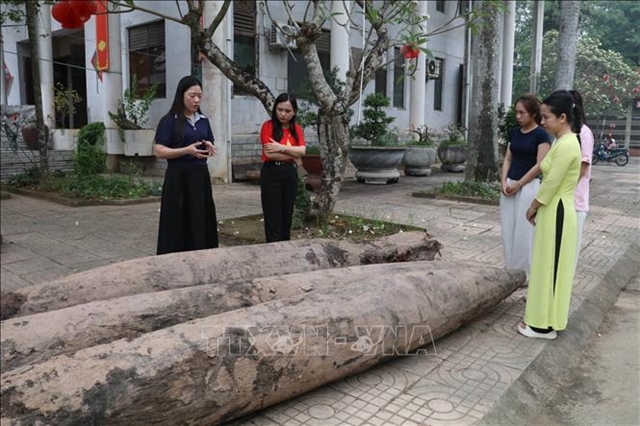 |
| The piles are kept at the Ninh Bình Museum for further study. VNA/VNS Photo |
Ninh Bình Museum Deputy Director Vũ Thị Thu says the discovery is an important archaeological document, valuable for studying the spatial structure of the ancient Hoa Lư region-today Ninh Bình within the historical development of Việt Nam.
A professional council will be established to evaluate and consult with experts for further study.
She also requests the investor of the dredging and embankment project review the entire construction area, particularly zones with topographical and sediment conditions similar to the discovery site. If additional wooden piles or related traces are found, work must be temporarily suspended, the site preserved in its current state, and the findings reported to the relevant authorities. — VNS
Life & Style
 Life & Style
 Life & Style
 Life & Style
 Life & Style
 Life & Style
 Life & Style
 Life & Style
 Life & Style
 Life & Style
 Life & Style
 Life & Style
 Life & Style
 Life & Style
 Life & Style