 Life & Style
Hà Nội industrial promotion drives rural industry development
1.
Dr Jonathan Halevy*
Stress and pain are part of our lives, and this starts at a very early age. We learn to deal with them as we mature and develop cognitively and emotionally. We learn this thanks to the guidance and support of our parents.
By hugging us, talking to us and comforting us, they help comfort us as we learn how to comfort ourselves and deal with stressful and painful situations as we grow.
Today, unfortunately, some parents turn to the 'easy way' of comforting their babies by using screens. They may be effective in the short term, but they have disastrous effects in the long term.
Giving a phone or tablet to a baby or child in stressful situations (vaccines, tantrums, waiting rooms, boredom, bedtime) repeatedly trains the brain to rely on screens for emotional regulation. Over time, babies become dependent on screens and cannot soothe themselves without them.
Why screens are uniquely risky for self-soothing
Screens are designed to hijack attention and reward systems in the brain. They are designed to be addictive. Bright colours, rapid movement, sounds and novelty trigger strong dopamine responses. For a developing brain, this is an unusually powerful regulator of mood.
When screens are used during distress, the child’s brain learns: “When I feel bad, I need a screen to feel better.”
If babies and children use screens for comfort, they do not develop internal calming skills or self-regulation.
Self-regulation develops through co-regulation, through human contact with parents: being held, hearing a calm voice, making eye contact with a loving parent, and experiencing soothing rhythmic movement in the arms of mommy or daddy.
When a screen replaces the caregiver during distress, the child’s nervous system is calmed externally, not internally. The child does not practise calming down; the screen does it for them.
Babies who are repeatedly soothed by screens do not develop emotional tolerance. They do not learn how to manage frustration or control their impulses. Screens do not help your baby process emotion; they cause the baby to avoid it.
|
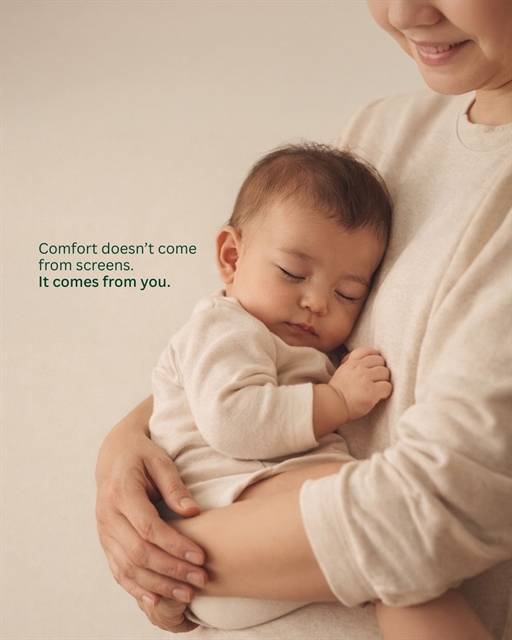
| Close physical contact, eye contact and a calm voice help children develop self-regulation and emotional resilience. — Photo courtesy of Family Medical Practice |
This addiction or dependence on screens will worsen over time.
The child will have escalating tantrums when the screen is taken away.
The child will not be able to calm down without a phone or tablet. Boredom or even minor frustration will cause the child to 'explode'.
This is not bad behaviour. This is an addiction.
When a caregiver stays present during pain or fear, the child learns:
“I am safe.”
“I can survive hard feelings.”
“My parents help me regulate.”
When a screen replaces the parent, the child learns:
“My comfort is dependent on a screen.”
“I cannot control my emotions without a screen.”
“My parents are not there to support me.”
Yes, screens work, but that is because they overwhelm the nervous system. In the long term, this is disastrous for a child’s emotional health, resilience and overall development.
What parents need to do instead:
For babies (0-12 months)
Babies regulate through the body, not logic. Use holding and skin-to-skin contact, gentle rocking, a soft and quiet voice, singing or humming, and pacifiers if appropriate. These build the brain’s ability to calm with support, which later becomes self-calming.
For toddlers (1-3 years)
Toddlers are learning emotions but cannot manage them alone.
Parents should get physically close, name the feeling (“You’re scared” or “You’re angry”), keep your voice slow and calm, breathe together and allow crying without rushing to 'fix' it. This teaches that feelings are tolerable and temporary.
For preschoolers (3-5 years)
Preschoolers can begin practising coping skills. Help them by preparing briefly before stressful events, talking through feelings afterward, using breathing or squeezing hands, and using books, toys or imagination, not screens, for distraction.
What to do during vaccines or medical procedures
Hold the child. Stay calm yourself; children’s responses are strongly influenced by their parents. If the parent is anxious, the child will be even more anxious. Validate pain or fear (“I know it may hurt. I’m here with you”), breathe together and praise effort, not 'bravery'.
Children who are supported this way show better stress recovery and emotional resilience over time.
Screens may calm children quickly, but they do not teach coping. When screens are used as a replacement for parental comfort, children become dependent on external stimulation instead of developing emotional regulation.
Presence, touch, a calm voice and validation build resilience and self-soothing skills that last a lifetime. Short-term quiet is not the goal — emotionally healthy, resilient children are.

|
| Dr Jonathan Halevy. — Photo courtesy of Family Medical Practice |
*Dr Jonathan Halevy is a paediatrician with extensive international training and experience. A graduate of Tel Aviv University’s prestigious Sackler School of Medicine, he has developed deep expertise in caring for children’s health across a wide range of paediatric conditions. Dr Halevy provides comprehensive paediatric consultations, preventive care and guidance to support children’s growth and well-being. He is known for engaging with parents through educational talks and resources to help families make informed health decisions for their children.
FMP Healthcare Group operates medical centres in major cities including HCM City, Hà Nội and Đà Nẵng, offering consultations with international doctors, check-up centres and emergency ambulance services.
To book an appointment with Dr Jonathan Halevy, please contact our FMP clinic at Diamond Plaza, 34 Lê Duẩn, Sài Gòn Ward, HCM City, via phone at +84 28 3822 7848 or email at hcmc@vietnammedicalpractice.com.
In HCM City, we have clinics in Districts 1, 2 and 7, along with the Care 1 - Executive Health Check-Up Centre and internationally accredited *9999 emergency ambulance services.
Life & Style
 Life & Style
 Life & Style
 Life & Style
 Life & Style
 Life & Style
 Life & Style
 Life & Style
 Life & Style
 Life & Style
 Life & Style
 Life & Style
 Life & Style
 Life & Style
 Life & Style