 Life & Style

NA must embody spirit of action, innovation, development: top legislator
1.
|
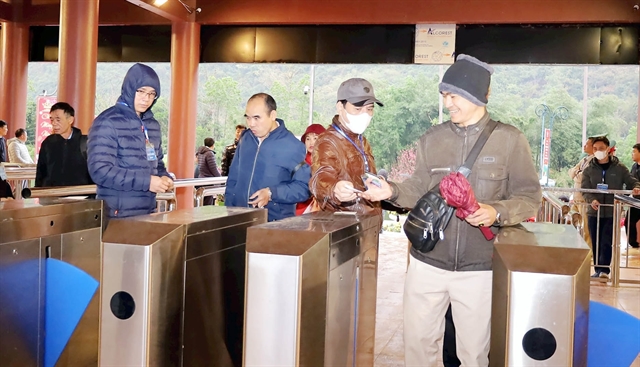
| Visitors using e-tickets at the Hương Pagoda Festival 2026. — Photo hanoimoi.vn |
HÀ NỘI — In the fast-moving era of Industry 4.0, digital transformation is no longer optional for tourism, it’s essential.
For Hà Nội, embracing digital tools is a long-term strategy to boost the city’s global image and carry out Politburo Resolution No 57-NQ/TW, which calls for breakthroughs in science, technology, innovation and national digital transformation.
Travellers are already choosing digital. A Việt Nam Report survey finds that 78.5 per cent of tourists book through travel apps like Traveloka and Booking.com, and 56.9 per cent use travel company websites - clear evidence that digital tourism is mainstream.
Hà Nội’s tourism sector is responding. The Hà Nội Department of Tourism reports that major attractions - including the Temple of Literature (Văn Miếu – Quốc Tử Giám), Thăng Long Imperial Citadel, Hỏa Lò Prison, and Hương Pagoda - now offer electronic tickets, automated tours, VR/AR experiences and QR-code access.
At the Thăng Long Imperial Citadel, the 'Memories of the Flagpole' tour replaces a traditional guide with 3D mapping that layers modern visuals, sound, and lighting over historical narratives.
Deputy Head of the Hương Pagoda Festival Organising Committee, Vương Trọng Đạo, stated that the locality has implemented electronic tickets, QR code scanning and AI camera systems, improving service quality and festival management, increasing revenue transparency and analysing visitor behaviour data to optimise operations.
Lê Xuân Kiêu, Director of the Temple of Literature’s Cultural and Scientific Activities Centre, added: “Digital transformation is an objective lever for all aspects of social life. We’ve digitised 40 monument items into QR codes and installed automatic audio guides in 12 languages.”
Hà Nội has also made progress on data. According to Trần Trung Hiếu, Deputy Director of the Hà Nội Department of Tourism, the city now links and unifies data for more than 300 tourist sites.
Destinations are digitised so visitors can learn about attractions ahead of their trip, and automated audio guides are standardised in six languages, including Vietnamese, English and Japanese.
But challenges remain. Legal frameworks lack clear incentives to spur businesses to digitise, and smaller operators often lack the capital to invest in IT, training, and process redesign.
“Digital transformation requires investment in infrastructure, software, training, and operational restructuring,” says Nguyễn Việt Đức, Director of Unica Solutions JSC.
“For SMEs with limited capital, that’s a major hurdle. Management agencies need policies that give businesses time and support to build capacity and adopt technology.”
Industry leaders call for national co-ordination. Vũ Thế Bình, chairman of the Việt Nam Association of Travel and Tourism, urges creation of a professional national website and mobile app to give tourists reliable information - a system that requires a coordinated action plan to digitise destinations and cultural resources. He points to Thailand’s national tourism platform, which supports 17 languages, as a model.
Nguyễn Mạnh Thản, Chairman of the Hà Nội Tourism Association, echoes this. National platforms should draw wide participation from provinces, cities, organisations and individuals to supply content - and authorities must implement policies that allow businesses time to innovate and invest.
At the national level, the Việt Nam National Tourism Administration aims to build a smart tourism ecosystem with a centralised, unified and synchronised database, said Deputy Director Phạm Văn Thủy.
The Ministry of Culture, Sports and Tourism’s 'Programme to promote digital transformation in smart tourism' also emphasises a digital data system as the backbone of a smart, accurate, clean, unified, and shareable tourism model.
To promote digitalisation, the Hà Nội People’s Committee issued Decision No 521/QD-UBND approving the Hà Nội Digital Transformation Strategy to 2030, with a vision to 2035.
Simultaneously, Hà Nội will review and amend legal documents to address new requirements arising from the digital transformation process and to encourage innovation and entrepreneurship. — VNS
Life & Style
 Life & Style
 Life & Style
 Life & Style
 Life & Style
 Life & Style
 Life & Style
 Life & Style
 Life & Style
 Life & Style
 Life & Style
 Life & Style
 Life & Style
 Life & Style
 Life & Style