 Economy


Symphony of the Sea Season 3: Bigger, bolder and more spectacular for Phú Quốc visitors
1.
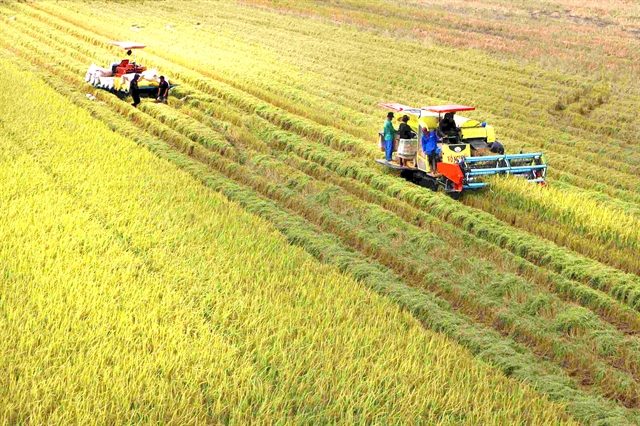 |
| Harvesting high-quality rice in Cần Thơ City. Việt Nam should build a national 'Vietnam Green Rice – Low Emission' brand for green, low-emission rice. VNA/VNS Photo |
HÀ NỘI — Việt Nam’s drive to develop one million hectares of high-quality, low-emission rice is gaining ground, but building a national brand and securing stable market outlets remain key to turning production gains into lasting benefits for farmers.
As of August 2026, more than 420,800 hectares of rice fields in the Mekong Delta and Tây Ninh had adopted all or part of sustainable production practices under the programme, with more than 175,000 farming households registered to participate, according to the Department of Crop Production and Plant Protection under the Ministry of Agriculture and Environment.
The programme, which aims to develop one million hectares of high-quality, low-emission rice cultivation linked to green growth in the Mekong Delta by 2030, is creating opportunities to shift the industry’s focus from output volume towards quality, efficiency and environmental value.
Participating models have recorded improvements in input use and production efficiency. Seed use has fallen by 30-50 per cent, chemical fertiliser use by 20-30 per cent, pesticide spraying by two to three applications per crop, and irrigation water use by 20-40 per cent.
Yields have increased by 5-12 per cent, while profits have risen by VNĐ1.5 million to VNĐ9.3 million per hectare per crop. Efforts to measure emissions reductions have also begun at participating farms.
The programme has helped establish concentrated raw material production areas, expand links between cooperatives and businesses, promote farming techniques that reduce input use and emissions, and begin connecting production with premium markets.
Despite these gains, experts say a key objective is to gradually establish a national 'Vietnam Green Rice – Low Emission' brand for Vietnamese green, low-emission rice.
To achieve this, products must not only meet quality requirements but also demonstrate their origin, cultivation methods and verified emissions reductions.
Experience from the Climate Resilient and Sustainable Rice Value Chain Transformation Project (TRVC) in the Mekong Delta, supported by Australia’s Department of Foreign Affairs and Trade through SNV Vietnam, highlights the potential to link sustainable production with businesses and markets.
By the end of its third crop season, the project had covered a cumulative area of more than 84,400 hectares across crop seasons, while reported emissions reductions reached nearly 321,000 tonnes of carbon dioxide equivalent, said Trần Thu Hà, the project’s director.
Profits for smallholder farmers increased by more than 56 per cent, she said.
More than 123,100 tonnes of rice produced by participating companies had received the 'Vietnam Green Rice – Low Emission' label, of which nearly 53,900 tonnes had been exported.
The experience highlights the need for support mechanisms that encourage businesses to invest in raw material areas, data systems and product quality. Emissions reductions must be accompanied by market access, access to finance and the ability to maintain contracts with farmers.
Phan Văn Tâm, deputy general director of Bình Điền Fertiliser Joint Stock Company, called for stronger public-private cooperation to assess production models using a common set of criteria. These should clarify production costs, farmers’ profits, rice quality and verified emissions reductions.
Businesses also proposed helping cooperatives and farmers cover initial transition costs, while strengthening soil health monitoring and region-specific nutrient management to ensure long-term farming efficiency.
Deputy Minister of Agriculture and Environment Nguyễn Hoàng Hiệp said implementing the one-million-hectare high-quality, low-emission rice programme through 2030 would be a key priority for the ministry and crucial to fundamentally restructuring rice production in the Mekong Delta.
The programme must bring about substantive changes in agricultural production, with success measured not only by the area covered but also by rice quality, production efficiency, farmers’ incomes, verifiable emissions reductions and the sector’s long-term competitiveness, he said.
Encouraging farmers to adopt low-emission farming practices must go hand in hand with mechanisms to protect their interests and prevent the transition from putting their incomes at risk, he said.
The State should develop supportive policies and risk management mechanisms while mobilising financial institutions, international organisations and development partners, Hiệp said.
Public investment would continue to play a leading role, but concessional financing, technical assistance and other suitable forms of cooperation should also be mobilised to meet the programme’s funding needs. VNS
Economy
 Economy
 Economy
 Economy
 Economy
 Economy
 Economy
 Economy
 Economy
 Economy
 Economy
 Economy
 Economy
 Economy
 Economy