 Economy



Sơn La holds second coffee festival, targeting stronger businesses in future
1.
|
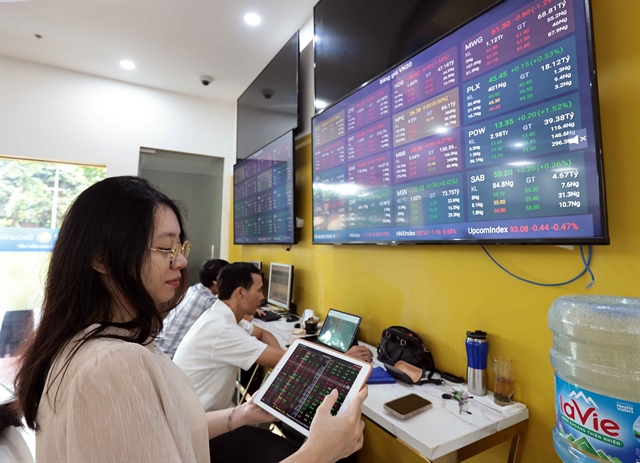
| Investors observing the market's movements in the trading room of a securities firm in Hà Nội. — VNA/VNS Photo |
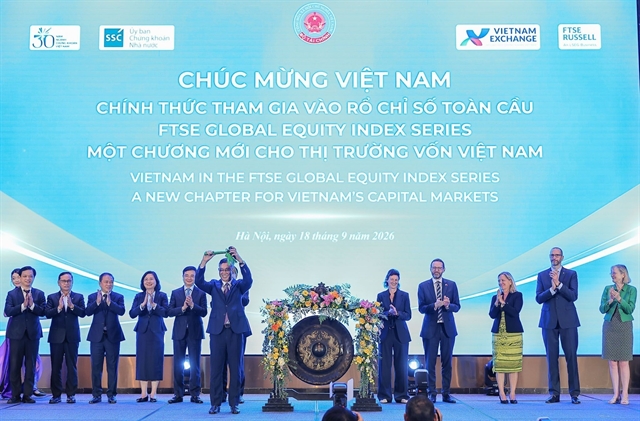
HÀ NỘI — The market enters the new week as a secondary emerging market under FTSE Russell with expectations of additional foreign inflows, although analysts say liquidity, interest rates, corporate earnings and other macroeconomic factors will remain more influential over the market's broader direction.
Việt Nam's reclassification from frontier to secondary emerging market under FTSE Russell officially takes effect from today.
Based on Việt Nam's expected weighting in FTSE emerging-market indices, passive capital inflows over the next 12 months are estimated at around US$1.5 billion, while active investment flows are expected to be larger.
In the short term, these inflows could provide additional support for the market and investor sentiment.
Dr Nguyễn Duy Phương, senior director of Financial Analysis at DG Capital, said the positive impact of the upgrade could be most visible during the initial period.
Afterwards, market movements would depend more heavily on domestic fundamentals, including liquidity, interest rates, capital flows and corporate earnings growth.
Foreign investment disbursements during the first week after the upgrade could reach around $240 million, according to the information provided. However, the inflows could support individual stocks without necessarily translating into a sustained market-wide rally.
Phương said: “In the short term, the market could perform positively for several sessions as foreign funds make purchases. Once the buying is completed, the market will return to normal, with fewer significant movements.”
Inflation, interest rates, exchange rates and the corporate earnings outlook are still regarded by market analysts as having broader and more persistent effects.
Upgrade-related capital represents an additional source of support but may not by itself offset unfavourable changes in these conditions.
Over the longer term, the upgrade is expected to broaden access to international institutional investors and improve market liquidity depth.
DNSE Securities analysts recommended that investors manage portfolio exposure and focus on individual companies rather than basing investment decisions entirely on the upgrade timetable.
They advised maintaining leverage at levels appropriate to investors' tolerance for volatility, particularly after the US Federal Reserve raised interest rates on September 16 and with the tightening cycle showing no signs of ending. Maintaining sufficient cash could also reduce the risk of being forced to sell during market corrections.
DNSE also recommended prioritising companies with strong operating cash flow, healthy balance sheets and reasonable valuations.
The overall market is trading at a price-to-earnings ratio of around 12 times, falling to approximately 10 times when the Vingroup group is excluded, which is described as a low level compared with the past decade.
For stocks expected to benefit directly from FTSE-related inflows, analysts recommended considering how much of the expectation has already been priced in and comparing projected purchases with each stock's liquidity.
Investors could also consider gradual disbursement when valuations become attractive while monitoring demand after index-rebalancing sessions, DNSE said.
Sustained liquidity and improving market breadth would be important indicators to watch, while companies with high leverage and weak cash flows could face greater pressure if inflation and interest rates rise.
Last week, the market benchmark VN-Index, representing the Hochiminh Stock Exchange (HoSE), ended at 1,815.66 points, gaining 1.14 per cent, and recovering after losing nearly 58 points in the previous week.
Liquidity improved significantly. Average matched volume on HoSE reached 734 million shares per session, up nearly 24 per cent week-on-week, while average trading value rose more than 24 per cent to VNĐ19.05 trillion ($732 million) per session.
On the Hanoi Stock Exchange (HNX), the HNX-Index also advanced, rising 0.96 per cent to 275.29 points.
Despite the recovery, trading remained differentiated, with no sector clearly outperforming apart from several mid- and small-cap stocks attracting speculative money.
Foreign capital was one of last week's most notable developments. Overseas investors recorded net purchases in four of five sessions on HoSE, with total net buying reaching VNĐ2.68 trillion. But they net sold VNĐ96.9 billion on HNX.
Across the market, foreign investors therefore recorded net purchases of approximately VNĐ2.64 trillion, reversing net selling of nearly VNĐ1.58 trillion in the previous week.
On September 18 alone, foreign net buying on HoSE exceeded VNĐ1.25 trillion. Of the 27 Vietnamese stocks included by FTSE Russell in the FTSE All-Cap index, 21 attracted foreign net buying that session, totalling approximately VNĐ1.72 trillion. — BIZHUB/VNS
Economy
 Economy
 Economy
 Economy
 Economy
 Economy
 Economy
 Economy
 Economy
 Economy
 Economy
 Economy
 Economy
 Economy
 Economy