 Economy



LOAN Foundation awards scholarships to disadvantaged students on 10th anniversary
1.
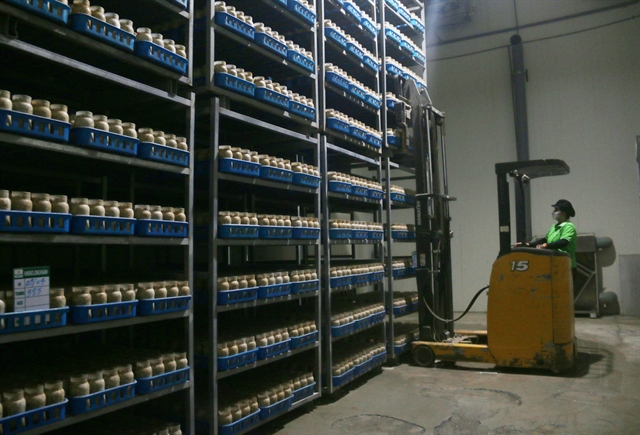 |
| A worker handles and stacks goods. Nearly 138,100 businesses were newly founded from January to August, up 7.7 per cent over the same period last year, while more than 40,800 businesses completed dissolution procedures, a jump of 125.5 per cent. — VNA/VNS Photo Lê Xuân |
HÀ NỘI — Rising business registrations alongside a sharp increase in firms completing dissolution procedures in the first eight months of 2026 showed that the corporate sector continues to face restructuring pressure.
Updates from the National Statistics Office last week showed that nearly 138,100 businesses were newly founded from January to August, up 7.7 per cent over the same period last year, while more than 40,800 businesses completed dissolution procedures, a jump of 125.5 per cent.
The divergence highlights a business environment in which expansion and market entry are continuing, but firms facing difficult operating conditions are also being forced to restructure or leave the market.
New businesses registered nearly VNĐ1.7 quadrillion (US$64.8 billion) in capital during the eight-month period, up 36.2 per cent year-on-year. Average registered capital per new business rose by 26.4 per cent to VNĐ12.4 billion.
However, registered employment fell by 15.4 per cent to nearly 657,700 workers, suggesting that stronger capital formation among new businesses has not been accompanied by a similar increase in planned employment, demonstrating the impact of technology application, digital transformation and automation.
The total number of businesses entering or returning to the market reached nearly 206,400 during the period, down 1.4 per cent from a year earlier. Of these, nearly 68,300 businesses resumed operations, down 15.8 per cent.
At the same time, more than 88,000 businesses registered for temporary suspension, down 7.3 per cent year-on-year, while nearly 28,600 stopped operating pending dissolution procedures, down 40.3 per cent.
Notably, the number of businesses completing dissolution procedures saw the sharpest increase, with more than 40,800 firms leaving the market during the first eight months, up 125.5 per cent from a year earlier.
On average, 25,800 firms entered or returned to the market each month, while 19,700 left.
By sector, services continued to account for the largest share of newly established businesses during the first eight months, with nearly 102,600 firms, up 4.1 per cent year-on-year. Industry and construction recorded nearly 34,100 new businesses, up 19.8 per cent, while agriculture, forestry and fisheries registered 1,448, up 24.1 per cent.
Sectors that saw the largest number of businesses completing dissolution procedures included wholesale and retail trade, motor vehicle and motorcycle repair, manufacturing and processing, construction, real estate, transport and storage, accommodation and food services, as well as electricity, water and gas production and distribution.
In August alone, nearly 12,200 businesses were newly established, 14.4 per cent higher than July, with registered capital of nearly VNĐ189.4 trillion, up 13.9 per cent. The number of registered workers totalled 60,400, down 26.4 per cent, however.
Compared with August 2025, the number of newly established businesses fell by 40.5 per cent, registered capital declined by 41.9 per cent and registered employment dropped 43.5 per cent.
Nearly 9,500 businesses resumed operations in August, down 6.5 per cent from July and 23.8 per cent from a year earlier.
Meanwhile, 5,322 businesses registered for temporary suspension, down 39 per cent from July and 18.5 per cent year-on-year. Another 7,566 stopped operating pending dissolution procedures, down 27.1 per cent from July but up 10.1 per cent from a year earlier.
The number completing dissolution procedures reached 9,631 in August, up 33.6 per cent from July and 151.2 per cent from August 2025.
The figures suggested that Việt Nam's business sector continues to expand in several areas, but the sharp increase in completed dissolutions and decline in registered employment pointed to continued market restructuring and consolidation, the NSO said.
Market demand, purchasing power, input costs and the outlook for new orders would remain key factors shaping businesses' decisions to enter, expand or leave the market in the final months of the year. — VNS
Economy
 Economy
 Economy
 Economy
 Economy
 Economy
 Economy
 Economy
 Economy
 Economy
 Economy
 Economy
 Economy
 Economy
 Economy

.jpg)