 Economy

Việt Nam gives top priority to relations with Laos: PM
1.
|
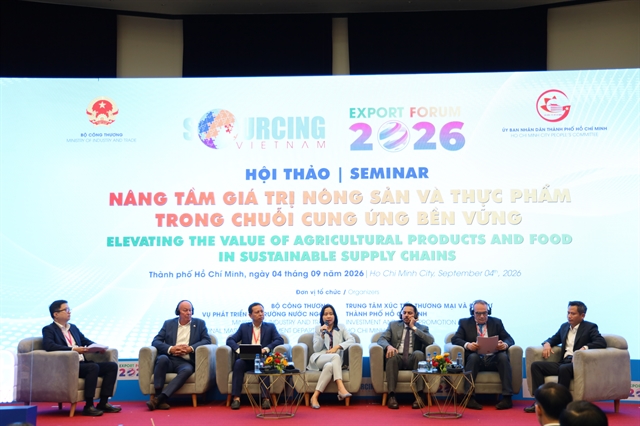
| Panelists at the seminar “Elevating the Value of Agricultural Products and Food in Sustainable Supply Chains” in HCM City on Friday. — Photo courtesy of ITPC |
HCM CITY — Vietnamese businesses need to move agricultural and food exports up the value chain, shifting from raw products and volume-driven growth towards higher-value, processed and branded goods as global standards on quality, traceability and sustainability become increasingly stringent, speakers said at a seminar in HCM City on September 4.
Speaking at the seminar “Elevating the Value of Agricultural Products and Food in Sustainable Supply Chains”, Lê Anh Hoàng, deputy director of the Investment and Trade Promotion Centre of HCM City (ITPC), said agriculture and processed food were key export sectors for Việt Nam and HCM City.
In the first seven months of 2026, Việt Nam’s exports of agricultural, forestry and fishery products reached nearly US$42.8 billion, up 7.5 per cent year on year.
New-generation free trade agreements are creating opportunities for Vietnamese agricultural and food exports, but also imposing stricter requirements on product quality, traceability and sustainable development.
Rising consumer demand for food quality and stricter international requirements on food safety, environmental protection and social responsibility are forcing the sector to change its growth model, he said.
“Competitive advantage no longer lies in export volume, but in the ability to meet market standards, increase value-added processing, and build brands not only domestically but also on the global stage,” Hoàng said.
Nguyễn Thảo Hiền, deputy director general of the International Market Development Department, said agricultural exports had become an important pillar of Việt Nam’s economy, with the country among the world’s leading exporters of rice, coffee, cashew nuts, pepper and seafood.
The export model was gradually shifting from “selling what we have” to “supplying what the market needs”, with greater emphasis on value, quality and brand recognition rather than volume, she said.
At the seminar, speakers also shared insights into market trends, consumer demand, regulatory changes and procurement strategies, while offering recommendations on tapping niche markets, accessing modern distribution channels and optimising agricultural supply chains.
Opportunities in overseas markets
Sven Dekker, co-founder of Viet Nam Food Europe BV in the Netherlands, said the EU imported about €14 billion ($16.2 billion) worth of food from ASEAN countries, with Vietnamese products accounting for around 25 per cent.
Meanwhile, the European B2B e-commerce market is growing by more than 22 per cent annually, creating new channels for Vietnamese suppliers.
“European consumers are increasingly seeking products that are clean, convenient and traceable,” Dekker said.
|
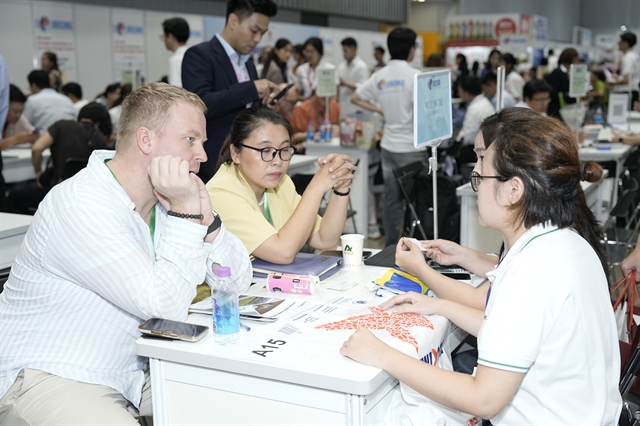
| Vietnamese firms exchange information with foreign buyers at the Vietnam International Sourcing expo. — Photo courtesy of the organiser |
His company established Miss Linh in the Netherlands in 2023 as a B2B e-commerce platform for Vietnamese food products. It now features more than 30 brands, generates annual revenue of over €500,000 ($580,000) and has recorded growth of about 150 per cent. It is targeting revenue of €16 million ($18.6 million) by 2030.
The platform has connected with more than 1,300 restaurants and major purchasing partners, paving the way for Vietnamese products to enter the market, he said.
“Europe is opening its doors to Vietnamese cuisine – the question is: are you ready to step inside?” Dekker said, stressing that sustainable supply chains from seed to table were essential for Vietnamese products to expand in Europe.
Representatives of UAE companies Lulu and Lootah also highlighted strong food import demand in the Middle East, describing the region as a promising destination for Vietnamese exporters seeking to diversify their markets.
They praised Việt Nam’s supply capacity and offered recommendations on how Vietnamese agricultural products could enter and expand through regional distribution channels.
Central Retail, which has a long-standing presence in Việt Nam, said Southeast Asia also offered considerable room for growth for Vietnamese agricultural and food products.
Jose Mestre, director of Central Retail Vietnam’s Fresh Food Academy, said the retailer had a 61 per cent share of Việt Nam’s hypermarket retail value sales, with more than 330 malls and business locations across 26 of the country’s 34 provinces and cities. About 90 per cent of products sold through its retail networks are sourced domestically.
The group applies strict food safety controls, while prioritising organic and antibiotic-free products. Meeting quality requirements and maintaining reliable supply are essential for suppliers seeking access to modern retail chains, Mestre said.
The retailer also organises an annual Vietnamese Goods Week in Thailand, providing another channel for Vietnamese products to enter the regional market.
Lê Anh Dũng, general director of Vietnam National Vegetable, Fruit and Agricultural Product Corporation, said challenges in international markets should be viewed as a catalyst for businesses to innovate, diversify export markets and pursue sustainable growth.
Vegetexco’s products are sold in 58 countries and territories, including the EU, US, Japan, South Korea and China. The company has developed integrated value chains spanning seed research, high-tech cultivation, processing and international trade, alongside specialised farming areas and modern processing facilities.
Its product portfolio includes fresh and processed fruits and vegetables, staple commodities, nuts, beverage ingredients and seafood, produced under international standards such as ISO 9001, FSSC 22000, VietGAP, GlobalGAP, BRCGS, FDA and HACCP, he said.
The seminar was organised by ITPC in coordination with the Department of Foreign Market Development as part of the Vietnam International Sourcing 2026 event series.— VNS
Economy
 Economy
 Economy
 Economy
 Economy
 Economy
 Economy
 Economy
 Economy
 Economy
 Economy
 Economy
 Economy
 Economy
 Economy