 Economy



Việt Nam national youth ice skating championships attract record 112 athletes
1.
|
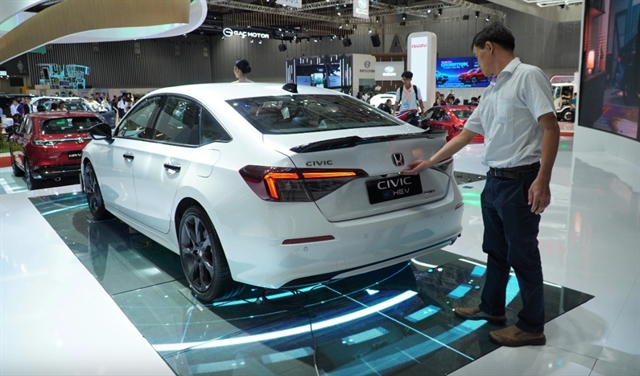
| A customer looks at a Honda Civic e:HEV at an auto exhibition in Việt Nam. Car buyers increasingly consider fuel, maintenance and resale costs when choosing a vehicle. — Photo thanhnien.vn |
HÀ NỘI — The car market is continuing to recover, while consumers are becoming more careful about the real cost of owning a vehicle, looking beyond the purchase price to fuel, maintenance, insurance and resale value.
According to the Vietnam Automobile Manufacturers’ Association (VAMA), its members sold 33,707 vehicles in July, up 8 per cent from June and 6 per cent year-on-year. In the first seven months of 2026, VAMA members sold 221,540 vehicles, up 14 per cent year-on-year.
The growth comes as fuel efficiency and running costs become more important considerations for car buyers. Instead of asking only how much a car costs at the showroom, buyers are increasingly considering how much they will have to spend on the vehicle throughout its ownership.
The change is particularly visible in the vehicle service market, where operating costs have a direct impact on drivers’ incomes.
Figures cited by automotive news website Automotive show that a B-segment petrol sedan can cost around VNĐ1,600–1,900 per kilometre in fuel, while a small EV costs about VNĐ350–500 per kilometre in energy costs, including public charging and battery rental.
At an average 6,000km a month, the difference can amount to VNĐ6.6–8.4 million (US$250-320) in monthly energy savings.
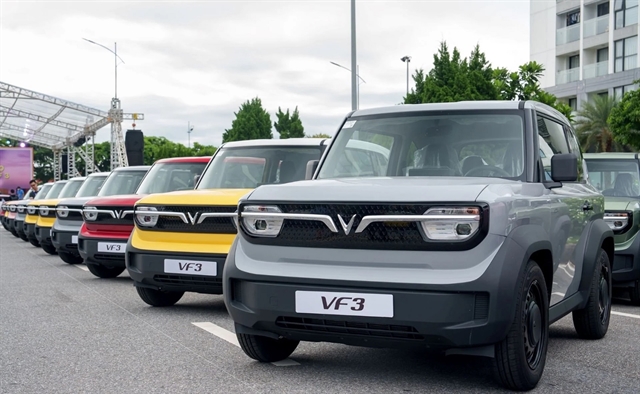
This makes small EVs attractive to drivers who mainly operate in urban areas. Their lower initial investment and running costs can reduce financial pressure and help shorten the time needed to recover the investment.
Infrastructure and ride-hailing platforms are also supporting the shift. V-Green’s expanding public charging network is making it easier for drivers to recharge between shifts, while the growth of Green SM and incentives for low-emission vehicles on ride-hailing platforms are encouraging the transition.
However, small EVs are not suitable for every type of service. Their driving range can make them less practical for long-distance trips, airport transfers or journeys involving several passengers and large amounts of luggage.
|
| Vinfast's VF3 models. Lower operating cost makes small EVs attractive to drivers who mainly operate in urban areas. — Photo otoxemay.vn |
Looking beyond the showroom price
For private buyers, the calculation is broader. A lower purchase price does not necessarily mean a lower cost of ownership, as maintenance, spare parts, insurance, financing and depreciation can all add to the cost over several years.
After-sales support is therefore becoming an important part of the buying decision. Established Japanese and Korean brands have an advantage with their extensive dealer and service networks and readily available spare parts.
Toyota Việt Nam and some Japanese brands, for example, offer factory warranties of up to 10 years or 185,000km for some key models, while other Japanese and Korean brands offer five to seven years, giving buyers greater certainty over maintenance and repair costs.
Resale value is another consideration. A model sold with a large discount when new may not necessarily retain its value in the used-car market, meaning a lower purchase price can be offset by higher depreciation.
Meanwhile, policy is adding momentum to the shift towards greener vehicles. Hà Nội has set a roadmap to phase out petrol- and diesel-powered taxis by 2030, with electric taxis expected to account for 63–64 per cent of the city’s taxi fleet in 2026 and 88–96 per cent by 2029.
The trend is also reflected in growing interest in hybrid vehicles, which offer an alternative between conventional petrol cars and fully electric vehicles. VAMA members sold 1,636 hybrid vehicles in July, up 38 per cent year-on-year, bringing sales in the first seven months to 12,501 units, up 76 per cent from 7,112 units in the same period last year.
As Vietnamese car buyers focus more on ownership costs, automakers and dealers will need to compete beyond discounts. Brands that offer reliable after-sales services, transparent maintenance costs, strong resale values and wide service networks will be better placed to win consumer trust in Việt Nam’s evolving car market. — BIZHUB/VNS
Economy
 Economy
 Economy
 Economy
 Economy
 Economy
 Economy
 Economy
 Economy
 Economy
 Economy
 Economy
 Economy
 Economy
 Economy