 Economy



Việt Nam gives top priority to relations with Laos: PM
1.
|
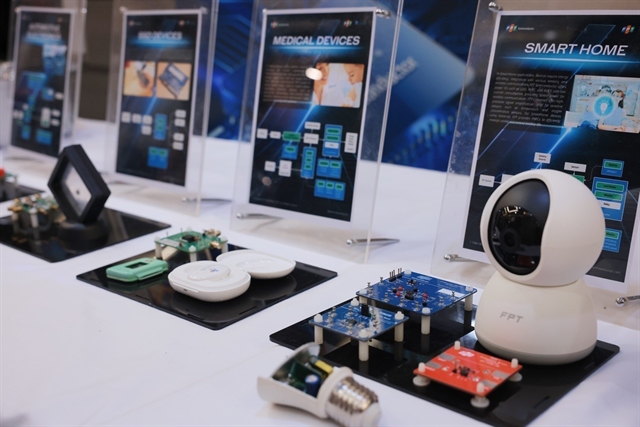
| Việt Nam’s first national centre to support semiconductor chip prototyping makes debut on June 26, 2026. — VNA/VNS Photo Hoàng Hiếu |
HÀ NỘI — Semiconductors are not entirely new to Việt Nam. The drive among local engineers and researchers to master the technology dates back decades.
In the late 1970s and early 1980s, the Ministry of National Defence’s Z181 Factory produced Việt Nam’s first semiconductor components, diodes and transistors for domestic use and export to Eastern Europe. The industry has advanced remarkably since.
The Ministry of Science and Technology (MST) said the industry generated over US$21 billion in 2025 revenue and drew more than $14 billion in foreign investment across 240-plus projects. Việt Nam has about 60 integrated circuit design firms, over 7,000 design engineers and 166 universities with relevant courses.
Yet Việt Nam lacks industrial-scale chip fabrication, and local research and pilot production infrastructure is limited. After design, chips require trial runs on actual silicon to test performance, power, temperature and process issues.
Local design houses and researchers must outsource this to foreign fabs by project, raising costs, lengthening development cycles and curbing commercialisation. Trial runs cost $30,000–200,000 with 12–24 month waits.
Assoc. Prof. Dr Trần Cao Vinh, Deputy Director of Vietnam National University, HCM City, said research groups still work in silos, spending heavily and taking much time to build foreign partnerships.
Many design concepts, research findings and promising products from institutes, universities, firms and startups have stalled at pilot production, he pointed out, adding that high tape-out costs, absent coordination and weak support for trial runs, testing and post-fabrication evaluation are blocking Việt Nam’s integrated circuit design community.
To advance in the global value chain, Nguyễn Khắc Lịch, Director-General of the MST’s Authority of ICT Industry and Communications (AITI), said Việt Nammust fix a core bottleneck: turning designs into physical chips. Authority data shows domestic pilot production demand at about 30,000 chips.
Recent policies have sharpened focus. The Politburo’s Resolution No. 57-NQ/TW, dated December 22, 2024, named science, technology, innovation and digital transformation as strategic breakthroughs.
On April 30, 2026, the Prime Minister’s Decision No. 21/2026/QĐ-TTg added “semiconductor chip technology” and “specialised chips” to the strategic technology list, alongside the industry strategy through 2030 with vision to 2050.
On June 26, AITI launched Việt Nam’s first national centre to support semiconductor chip prototyping, positioned as a critical new link to move ideas from design and simulation to tested, market-ready chips.
At the launch ceremony, Minister of Science and Technology Vũ Hải Quân said developing the semiconductor industry is central to the national competitiveness enhancement. On the institutional front, the sector now secures top priority and incentives, and the centre signals the ministry’s strong resolve to turn policy into action.
But a legal framework is only a necessary condition, Quân said, adding that for Việt Nam's semiconductor industry to achieve a breakthrough and gain a foothold on the global technology map, experts, research institutes, universities, and enterprises must join forces with the MST to address three key issues, namely workforce quality, support for domestic enterprises, and the development of flagship chip products.
|
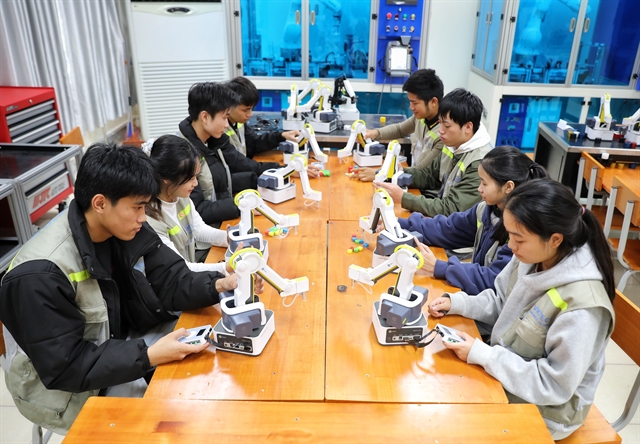
| Students at Vietnam-Korea College of Technology. — VNA/VNS Photo Danh Lam |
On workforce, beyond foreign training partnerships, universities and institutes need domestic talent roadmaps to build a contingent of engineers strong in both theory and hands-on integrated circuit design.
To integrate local firms deeper in the global semiconductor value chain, the State must create supportive conditions. Alongside foreign investment attraction, support should target enterprises, particularly small and medium-sized ones with core technology but limited capital. The State can fund shared infrastructure, testing centres and key labs while companies must specify their production chain entry points and requirements so policy can match demand, according to the official.
Viable “Make in Vietnam” flagship chips suited to current capabilities will define the industry’s future, the minister went on, adding that candidates include Edge AI chips, smart sensors for high-tech agriculture, and specialised chips for Vietnamese-language data and transaction processing.
Chairwoman of the Vietnam Semiconductor Advanced Packaging Lab (VSAP Lab) Nguyễn Thị Bích Yến, an adviser to the national centre, suggested that in the initial stage, Việt Nam should focus on three product groups with real demand, current capability fit and growth potential.
No single entity can build a strong semiconductor industry; it demands coordinated action from the State, businesses, research institutes, universities, domestic and foreign experts, international partners, investors and startups.
Quân said the MST will act as a strong bridge, ensuring research projects proceed fairly, transparently and effectively under the semiconductor industry development strategy through 2030 with vision to 2050 to rank Việt Nam among the world’s leading chip producers by the middle of this century. — VNA/VNS
Economy
 Economy
 Economy
 Economy
 Economy
 Economy
 Economy
 Economy
 Economy
 Economy
 Economy
 Economy
 Economy
 Economy
 Economy