 Economy

Police find 91 foreigners working illegally at Đồng Nai firm
1.
|
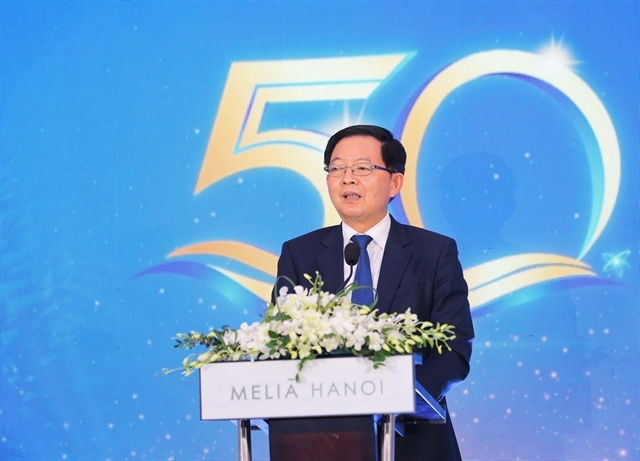
| Deputy Prime Minister Hồ Quốc Dũng delivered his speech at the ceremony. —VNA/VNS Photos |
HÀ NỘI — The Ministry of Science and Technology's Vietnam Atomic Energy Institute (Vinatom) aims to strengthen its role as a national strategic organisation for nuclear research, technology development, technical support and human resource training.
Vinatom, which marks 50 years since its establishment, has made significant advances in scientific research, nuclear technology, radiation techniques and the peaceful applications of atomic energy across a range of sectors.
The institute was established in April 1976 as Dalat Nuclear Research Institute, shortly after Việt Nam's reunification. It has since developed a network of specialised research units and expanded its work into nuclear technology, radiation techniques and atomic energy applications.
A key milestone came in 1984, when the Đà Lạt nuclear research reactor was restored, upgraded and commissioned. The institute subsequently expanded research and applications of atomic energy in medicine, agriculture, industry and environmental monitoring.
In healthcare, Vinatom has developed technologies to produce isotopes and radiopharmaceuticals used in nuclear medicine. In agriculture, it has used radiation-based mutation breeding to develop crop varieties with economic value.
Its industrial applications include non-destructive testing and radiotracer techniques for sectors including oil and gas and petrochemicals, as well as irradiation sterilisation of medical equipment and food treatment for exports.
Vinatom also operates Việt Nam's national environmental radiation monitoring and warning network, helping monitor radiation levels and support responses to potential transboundary nuclear incidents.
Speaking at a ceremony marking the institute's 50th anniversary in July, Deputy Prime Minister Hồ Quốc Dũng said its development reflected the strategic decision by the Party and State to establish a national nuclear research capability soon after reunification.
Vinatom director Trần Chí Thành said the institute's work had demonstrated that nuclear technology could be developed in Việt Nam for peaceful purposes and contribute to sustainable development.
Looking ahead, Vinatom aims to contribute to the development of advanced nuclear power technologies, including small modular reactors (SMRs), while building a new generation of nuclear specialists, Thành said.
“We aspire to contribute to mastering advanced nuclear power technology, gradually mastering small modular reactor technology,” Thành said, adding that nuclear power would play an important role in Việt Nam's future energy landscape.
New tasks for Vinatom in a new era of nuclear development
|
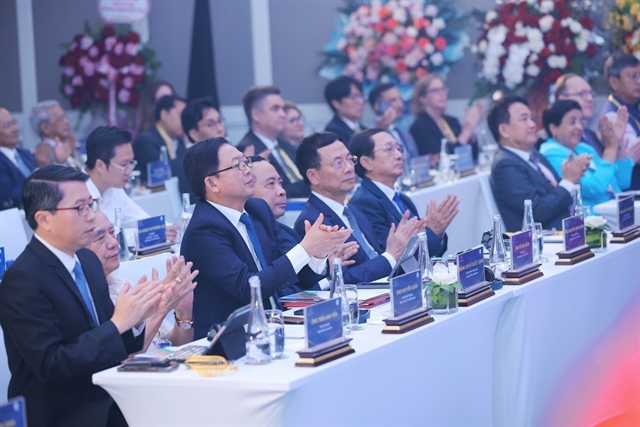
| Participants at the event. |
During the ceremony, Deputy PM Dũng said that Việt Nam has identified nuclear energy as an important part of its strategy to strengthen energy security and meet its commitment to achieve net-zero emissions by 2050.
The Government is preparing to implement the Ninh Thuận 1 nuclear power plant project and a nuclear science and technology research project in Đồng Nai, which he described as major national projects requiring significant resources from relevant agencies, including Vinatom.
The Deputy PM called on Vinatom to urgently restructure its organisation to meet the requirements of a new phase of development and aim to become a leading national organisation by 2035, with a core role in nuclear research, technology applications, technical support and incident response.
The institute should also cooperate with businesses to help them acquire and master nuclear technologies, ultimately strengthening Việt Nam's technological self-reliance, he said.
Vinatom was asked to develop a strong pool of nuclear scientists and experts, attract international specialists and prepare personnel to operate the planned national nuclear science and technology centree, as well as provide skilled workers for future nuclear power projects.
The State also wanted the institute to expand the peaceful applications of atomic energy in healthcare, agriculture, industry, environmental protection and climate change adaptation.
The institute should also expand international cooperation through technical programmes with the International Atomic Energy Agency (IAEA) and bilateral and multilateral partnerships to strengthen Việt Nam's nuclear science and technology capabilities, he said, adding that research into advanced reactor technologies should be accelerated, with a focus on small modular reactors, Generation IV reactors and modern light-water reactor technologies.
Minister of Science and Technology Vũ Hải Quân said developing a new generation of highly skilled scientists and managers was one of the biggest challenges facing the sector.
The ministry will work with leading experts to develop a strategic plan and long-term policies for nuclear human-resource development, Quân said at the ceremony.
The ministry has submitted to the Government for approval a project on training and developing human resources in atomic energy. Quân also asked Vinatom to organise a seminar with experts to gather views on strategic technologies and training programmes. — VNS
Economy
 Economy
 Economy
 Economy
 Economy
 Economy
 Economy
 Economy
 Economy
 Economy
 Economy
 Economy
 Economy
 Economy
 Economy