 Economy

Hưng Yên outlines three economic zones, two development corridors
1.
 |
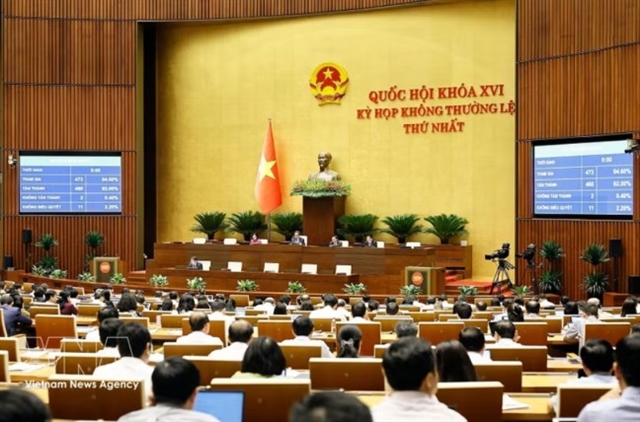
| Before the NA passed the legislation on August 24, SBV Governor Phạm Đức Ấn presented a report explaining and incorporating lawmakers' comments on the draft laws. — VNA/VNS Photo |
HÀ NỘI — The National Assembly (NA) on August 24 passed amendments to three laws governing the banking and financial sectors, adding provisions on suspicious indicators related to crypto assets to provide a legal basis for identifying, assessing and controlling money-laundering risks in the sector.
During the NA's first extraordinary session, 94.6 per cent of lawmakers voted in favour of amendments to the Law on the State Bank of Vietnam, the Law on Anti-Money Laundering and the Law on Credit Institutions.
Under the amendments to the Law on Anti-Money Laundering, which covers reporting of suspicious transactions under Article 26, reporting entities must report suspicious transactions to the State Bank of Vietnam when there are reasonable grounds to suspect that assets involved in a transaction are proceeds of crime.
Based on anti-money-laundering requirements in each period, the State Bank of Vietnam may propose that the Government add suspicious indicators for specific industries and sectors beyond those already set out in the law.
Notably, the law adds Article 33a after Article 33, setting out 15 suspicious indicators in the crypto-asset sector. These include conducting multiple high-value crypto-asset transactions within a short period without a clear business purpose; repeatedly depositing, trading and withdrawing crypto assets within a very short period immediately after establishing a customer relationship; and customers accessing a crypto-asset service provider's platform through tools that allow them to conceal their identity or Internet Protocol address.
The law also clarifies the responsibilities of the Government Inspectorate, the Ministry of Finance and other ministries and agencies in anti-money-laundering activities, as well as the principles for risk-based inspection, examination and supervision of anti-money-laundering activities.
Under the law, the Government Inspectorate is responsible for inspecting anti-money-laundering activities of reporting entities under the state management of ministries that do not have ministerial inspectorates, except for matters under the inspection authority of the Ministry of Finance.
The Ministry of Finance is responsible for inspecting anti-money-laundering activities involving reporting entities in the crypto-asset sector when assigned to do so by the government, as well as in the securities sector.
Before the NA passed the legislation, State Bank of Vietnam (SBV) Governor Phạm Đức Ấn presented a report explaining and incorporating lawmakers' comments on the draft laws.
Regarding the Law on the State Bank of Vietnam, one of the additions stipulates that the SBV is responsible for inspecting and supervising entities subject to inspection and supervision in accordance with the law.
The Governor said the provision was intended to make clear that credit institutions subject to different prudential ratios under Clause 3, Article 59 of the Law on the State Bank of Vietnam would be subject to inspection and supervision.
Regarding the removal of provisions on the Ministry of Finance's inspection function from the Law on the State Bank, Ấn said this would not affect the ministry's specialised inspection functions. Existing laws provide other oversight mechanisms, including the State Audit Office, the Government Inspectorate, internal audit and internal controls at the State Bank, so the amendment would not create a gap in management and inspection.
The Law on Credit Institutions also adds provisions allowing commercial banks to act as agents in managing collateral. The government said it would direct relevant agencies to study and refine regulations governing the rights and responsibilities of the parties, as well as conditions, criteria and the scope of collateral-management agency activities, in legal documents governing securities and enterprises, including the issuance of corporate bonds through public and private offerings.
The amendments to the Law on the State Bank of Vietnam, the Law on Anti-Money Laundering and the Law on Credit Institutions will take effect on December 1, 2026. — VNS
Economy
 Economy
 Economy
 Economy
 Economy
 Economy
 Economy
 Economy
 Economy
 Economy
 Economy
 Economy
 Economy
.jpg) Economy
Economy
 Economy