 Economy
Hưng Yên outlines three economic zones, two development corridors
1.
|
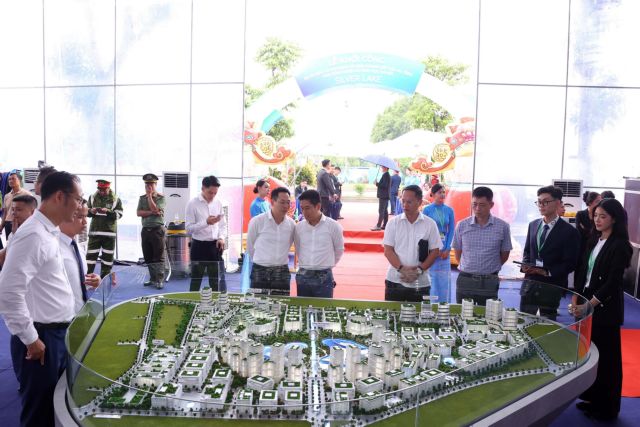
| A model of Hà Nội High-Tech Biology Park at its groundbreaking ceremony in 2025. Reshaping industrial space is becoming critical for Hà Nội to move away from a growth model based primarily on land and labour towards one driven by knowledge, technology, innovation and higher-value industries. — VNA/VNS Photo Văn Điệp |
HÀ NỘI — Hà Nội is reshaping its industrial landscape around science, technology and innovation, with the city’s 100-year master plan envisioning high-tech parks as centres for research, development and commercialisation while transforming existing industrial parks into greener, smarter and more circular ecosystems.
The shift comes as the capital city targets average gross regional domestic product (GRDP) growth of more than 11 per cent annually from 2026 to 2035, with the digital economy expected to account for about 50 per cent of GRDP by 2035.
Reshaping industrial space is becoming critical for Hà Nội to move away from a growth model based primarily on land and labour towards one driven by knowledge, technology, innovation and higher-value industries, according to the Hà Nội Department of Finance.
Under the master plan, industrial parks (IPs) will no longer be viewed simply as places for production and investment. They are expected to become spaces where research, innovation, technology development and high-value manufacturing converge.
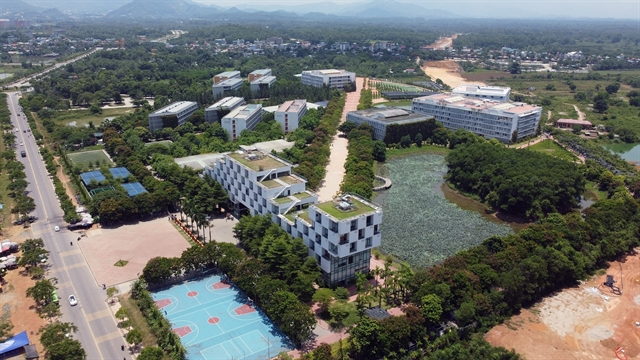
At the centre of the strategy is Hòa Lạc Hi-Tech Park, which is positioned as a hub for science, technology, innovation and digital transformation and is expected to become a new growth pole for the capital city.
Aside from Hoà Lạc, Hà Nội is planning a high-tech biology park in Thượng Cát Commune, a digital technology and mixed-use park in Tây Tựu and Phú Diễn, as well as a network of technology development along major growth corridors, including the Nhật Tân-Nội Bài axis.
In the north, including Đông Anh, Mê Linh and Sóc Sơn, Hà Nội plans high-tech IPs linked to aviation, electronics, logistics and the area around Nội Bài airport.
The city's southern area, including Phú Xuyên and Ứng Hòa, is planned as a logistics and inland container depot hub, alongside high-tech, clean and supporting industries linked to rail transport. The area is expected to gain further development space with a planned second airport serving the capital region.
The capital city also plans to restructure its existing IP network and turn them into high-tech, eco-industrial, digital and smart industrial parks.
Tô Xuân Thọ from the Hà Nội Institute for Socio-Economic Development Studies said industrial restructuring is not only an economic requirement but also a way to address challenges arising from industrialisation and urbanisation, including pollution and pressure on housing for workers.
“Transformation is mandatory. Otherwise, industrial parks will fail to meet environmental, social and governance (ESG) standards and lose their ability to attract foreign investment,” said Nguyễn Thị Ánh Tuyết from Hà Nội University of Science and Technology.
Hà Nội’s master plan and special policy mechanisms have laid the groundwork for developing new-generation high-tech and industrial parks, but implementation will determine whether these plans become genuine growth drivers.
Developing a new generation model would require a clear roadmap, sufficient resources and close coordination among Government agencies and authorities at different levels, economist Đinh Trọng Thịnh said.
“The master plan has identified the right direction, but implementation capacity will determine the pace and effectiveness of turning these plans into new growth poles for the capital,” he said.
Actions taken
|
| A view of FPT University’s campus in Hoà Lạc Hi-Tech Park, Hà Nội. Hòa Lạc Hi-Tech Park is positioned as a hub for science, technology, innovation and digital transformation. — VNA/VNS Photo Huy Hùng |
Hà Nội has moved to put its new industrial strategy into practice through a series of special mechanisms under the 2026 Capital Law.
The municipal People's Council adopted Resolution 40/2026/NQ-HĐND on management and development policies for high-tech parks.
These policies are intended to shorten investment procedures, mobilise private capital and make Hà Nội more competitive in attracting high-tech, research and development and innovation projects.
Thịnh said the resolution went beyond completing the legal framework for high-tech parks to create new institutional space for Hà Nội to take a more proactive approach to attracting investment and developing high-tech industries.
“The policy framework provides a foundation for Hà Nội to shift from viewing high-tech parks simply as production zones towards building innovation ecosystems that bring together businesses, research institutes, universities, experts and R&D activities,” Thịnh said.
The new policy framework also seeks to address one of the biggest challenges facing high-tech development: attracting and retaining skilled workers.
In a knowledge-based economy, competitiveness is no longer determined mainly by factory space or land availability, but by the ability to attract talent, technology, research and innovation, according to Thịnh.
Thịnh added: “To build an innovation ecosystem, the first requirement is an environment where experts, scientists and businesses can come to work, conduct research and stay for the long term.”
For the first time, Hà Nội has introduced a set of criteria for eco-industrial parks and industrial clusters under Decision 80/2026/QĐ-UBND, which also outlines mechanisms to support their transformation by 2045.
|
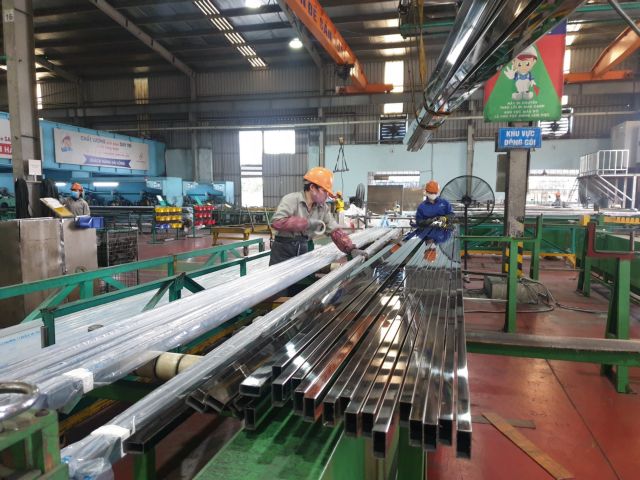
| Production at a plant in Đông Anh Industrial Park. — VNA/VNS Photo Phương Anh |
The city currently has nine operating industrial parks covering about 1,348ha, with occupancy close to 100 per cent. They have attracted 884 projects with a combined investment of nearly US$9.4 billion and created jobs for about 185,000 workers.
But many of the parks were established about two decades ago, when infrastructure, environmental and technology standards were less demanding.
Three of the nine operating parks were upgraded from industrial clusters, leaving some with outdated or incomplete technical infrastructure. Some factories have degraded and do not fully meet current requirements for fire prevention and environmental protection.
As multinational companies increasingly incorporate ESG requirements, low-carbon production and sustainability into investment decisions, traditional industrial land is becoming less competitive.
Lê Quang Linh, director of Giant Barb Science and Environment JSC, said the transition towards eco-industrial, high-tech and service-oriented parks is becoming essential for Hà Nội to maintain competitiveness and attract higher-quality foreign direct investment.
Under Decision 80, eco-industrial parks must develop integrated technical and digital infrastructure, including 5G and Internet of Things (IoT) systems, and establish monitoring systems for raw materials, energy, water and waste.
Each park must also establish industrial symbiosis models, allowing waste or by-products from one company to be used as inputs by another.
At least 20 per cent of enterprises in an eco-industrial park must apply cleaner production, energy-saving, or resource efficiency solutions, with renewable energy accounting for at least 10 per cent of total electricity consumption.
From now through 2028, the Hà Nội Management Board for Hi-Tech Industrial Parks will review, assess and classify operating IPs, prepare transformation plans and register them for eco-industrial certification.
The city aims to complete the conversion of all existing IPs and clusters into eco-industrial models by 2045.
Determination
|
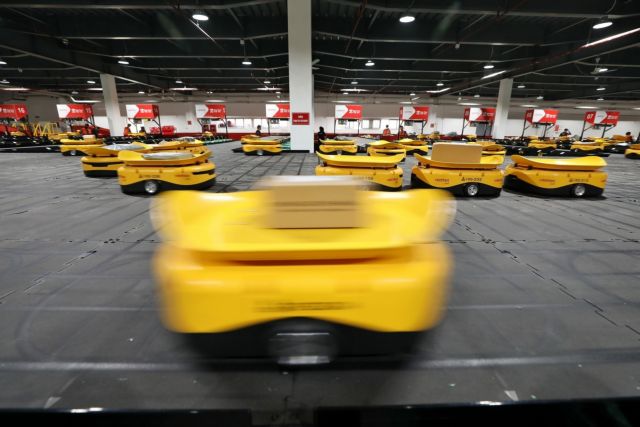
| A smart sorting technology complex operated by Viettel Post at Quang Minh Industrial Park in Me Linh District, Hà Nội. The capital city will shift focus from simply filling industrial land to maximising value generated from each hectare. — VNA/VNS Photo |
Despite the new planning framework and policy mechanisms, experts say implementation will determine whether the industrial strategy becomes a growth driver.
Linh said experience from the Republic of Korea, China and Taiwan shows that successful transformation requires strong policy commitment, long-term planning, attractive financial mechanisms, expert support and transparent assessment criteria.
He recommended that Hà Nội initially select several IPs with favourable conditions for pilot transformation rather than attempting to convert the entire network simultaneously.
According Lê Thanh Sơn, deputy head of the management board of Hanoi High-Tech and Industrial Parks, Hà Nội will shift its focus from simply filling industrial land to maximising value generated from each hectare.
“Hà Nội cannot continue competing through cheap land and cheap labour,” he said, noting that industrial land costs in the capital are already higher than in many neighbouring localities.
If the city continues attracting low-tech processing and assembly projects, it could lock valuable land into an outdated growth model, he warned.
Investor selection will increasingly be based on technology level, land-use efficiency, environmental standards and added value, accompanied by post-investment inspections to ensure projects continue upgrading technology throughout their operating lives.
The city also plans to expand the use of digital infrastructure, including 5G and IoT in existing industrial parks through 2030, to encourage enterprises to deepen investment rather than expand through greater land consumption.
The management board also proposed that Hà Nội create a green lane for strategic investment projects, allowing planning, land, environmental and investment procedures to be shortened and processed in parallel, with clear deadlines and accountability mechanisms.
Standards for new-generation IPs covering digital infrastructure, energy, wastewater treatment and real-time environmental monitoring should be issued early to accelerate the transformation and enhance the competitiveness of Hà Nội’s industrial parks system, he said.
For Hòa Lạc, the management board proposed incentives to be raised for strategic R&D and technology projects, including land-rent exemptions, support for site clearance and infrastructure fees and tax incentives, along with the development of shared research infrastructure such as laboratories and testing facilities, technology incubation programmes and housing and social infrastructure for experts.
For Hà Nội Biotechnology Hi-Tech Park, the board has issued a call to support land-rental costs for priority projects to attract strategic investors at an early stage. — VNS
Economy
 Economy
 Economy
 Economy
 Economy
 Economy
 Economy
 Economy
 Economy
 Economy
 Economy
.jpg) Economy
Economy
 Economy
 Economy
 Economy