 Economy

Top Vietnamese leader meets with Belgian Senate Speaker, House President
1.
|
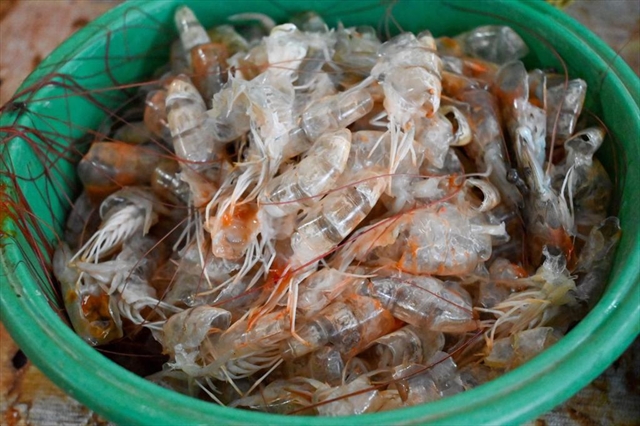
| Shrimp by-products contain valuable nutrients and bioactive compounds that can be used in aquaculture feed, agriculture, water treatment, and biomedical applications. — Photo courtesy of VASEP |
HCM CITY — The seafood processing industry generates large volumes of by-products that could be converted into higher-value products, creating new economic opportunities, reducing waste and supporting the development of a circular bioeconomy.
This potential was highlighted by Associate Professor Nguyễn Văn Minh, deputy head of the office of science and technology at Nha Trang University, in a presentation titled “Valorization of Fisheries By-products: A Driving Force for Việt Nam’s Circular Bioeconomy” at a conference in HCM City last week.
Việt Nam’s total aquatic production increased by 15.2 per cent between 2020 and 2025 to nearly 9.95 million tonnes, Minh said, citing figures from the Directorate of Fisheries.
The growth was driven mainly by aquaculture, with production rising 29.1 per cent to 6.12 million tonnes in 2025.
But capture fisheries declined marginally to 3.83 million tonnes.
A large share of fisheries ends up as by-products during processing, Minh said.
In catfish, they account for 61.3 per cent of the weight, including head, frame, fins, tail, viscera, belly fat, skin, liver and other parts.
With pangasius production reaching 1.67 million tonnes in 2025, the estimated quantity of by-products was 1.02 million tonnes, he said.
Shrimp output and by-products in 2025 totalled 1.29 million tonnes and 520,000-650,000 tonnes, respectively.
For shellfish, the numbers were 470,000 and 366,600-399,500 tonnes.
For squid and octopus, they were 130,000-165,000 tonnes and 39,000-66,000 tonnes.
For tuna, they were 200,000 tonnes and 100,000-120,000 tonnes.
Minh said the by-products contain proteins, lipids, collagen, minerals, pigments, chitin and other bioactive compounds that can be recovered and converted into higher-value products.
Shrimp waste, for example, can be processed into protein hydrolysates, carotenoids and chitosan, fish waste can be converted into protein hydrolysates and hydroxyapatite, and squid waste provides protein hydrolysates and chitin/chitosan.
Minh’s presentation also highlighted potential applications beyond traditional fishmeal and fish oil.
Shrimp by-products can be used to produce chitosan and carotenoid-protein products, while chitosan-based composites developed from seafood by-products have potential for wastewater treatment because of their high porosity and adsorption capacity.
Chitosan derived from seafood waste has also shown potential in post-harvest applications. Research presented in the study found that water-soluble chitosan could help inhibit fungal growth in post-harvest chili peppers, while chitosan from squid pens showed antibacterial activity against bacteria associated with soft rot in tomatoes.
Additionally, protein hydrolysate produced from shrimp heads could be used as a nutrient supplement in rainbow trout diets at levels of up to 5 per cent, with potential benefits for growth, survival and feed conversion, he said.
The presentation identified a range of potential products from seafood by-products, including fish silage, fishmeal, fish sauce, protein hydrolysates, fish biodiesel and fish oils.
Tuna by-products, for instance, can be processed through enzymatic hydrolysis into fish oil, protein hydrolysate powder, and nanohydroxyapatite.
Fish oils and omega-3 products also have applications in supplements, functional foods, infant and clinical nutrition, animal feed, and pharmaceuticals.
The findings suggest that Việt Nam’s seafood industry has an opportunity to move beyond simply reducing processing waste towards greater valorisation of raw materials.
By extracting more value from each tonne of seafood, the industry could develop new products for food, feed, health, agriculture and environmental applications while improving resource efficiency and supporting a more circular and sustainable seafood economy.
“The effective valorisation of tuna by-products could help produce high-value products, improve economic efficiency, and contribute to sustainable development in the aquaculture industry,” Minh said. — VNS
Economy
 Economy
 Economy
 Economy
 Economy
 Economy
 Economy
 Economy
 Economy
 Economy
 Economy
 Economy
 Economy
 Economy
 Economy