 Economy

Market extends gains on bank stocks
1.
|
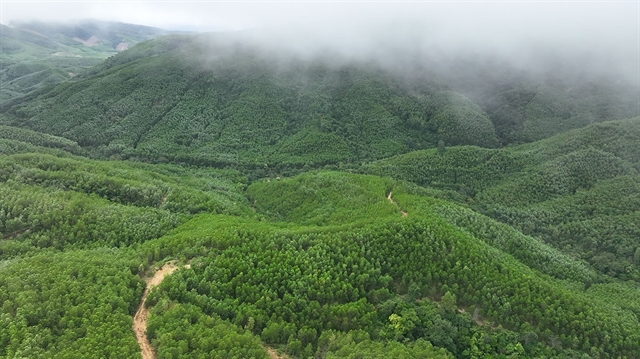
| Large-timber plantations in Vân Canh commune, Gia Lai province. Việt Nam aims to increase total area of production plantations for large timber to about 1 million hectares by 2030. VNA/VNS Photo |
HÀ NỘI — Efforts are being stepped up to expand plantations for large timber production to secure a stable domestic supply of legally sourced raw materials, as the country's forestry exports continue to grow, the Ministry of Agriculture and Environment said.
Forestry exports reached US$18.3 billion in 2025, up 5.6 per cent from a year earlier, and totalled $10.8 billion in the first seven months of 2026, up 4.6 per cent from the same period last year.
To sustain growth and contribute to the country's economic growth targets in a new phase of development, securing a domestic supply of legally sourced, high-quality timber from plantations managed for large-diameter trees is an urgent priority, the ministry said.
In 2024, the former Ministry of Agriculture and Rural Development, now the Ministry of Agriculture and Environment, issued Decision 31/QĐ-BNN-LN approving a plan to develop plantations for large-timber production in 2024-2030. The plan aims to bring the country's total area of production plantations for large timber to about 1 million hectares by 2030.
Deputy Minister of Agriculture and Environment Nguyễn Quốc Trị said the area of production plantations for large timber had reached about 625,000 hectares nationwide after more than three years of implementation, equivalent to 62.5 per cent of the target.
Many localities have made progress, but a number have yet to give sufficient attention to implementing the plan, with results falling short of their potential, he said.
To meet the 2030 target, the ministry has asked provincial and municipal people's committees to focus on a range of key tasks.
First, they should set clear annual and 2030 targets for large-timber plantations and regularly monitor and assess implementation progress.
Local authorities should review available forestry land and existing production plantations to identify areas suitable for new planting and replanting of large-timber forests, as well as small-timber plantations that can be converted to large-timber production, the ministry said.
"Priority should be given to developing concentrated and stable large-timber raw-material areas linked to processing facilities, transport networks and market demand," Deputy Minister Trị said.
The ministry also called for greater use of science and technology in forestry production and the use of officially recognised forestry planting materials with clear origins, high productivity and quality, resistance to pests and diseases, and adaptability to climate change.
Local authorities should strengthen quality controls covering the production, distribution and use of planting materials, while selecting tree species and varieties suited to local ecological conditions and market demand.
They should also apply intensive-forestry techniques in a coordinated manner, including vegetation clearance, soil preparation, fertilisation, adjustment of planting density, tending, stand management, thinning, pest and disease control, and forest fire prevention and suppression. The aim is to improve the productivity and quality of large timber and investment efficiency.
On financing, the ministry called on local authorities to effectively implement existing mechanisms and policies, integrate relevant programmes and projects, allocate local budget funds and mobilise capital from businesses, households, credit institutions, international organisations and other lawful sources.
Local authorities were also encouraged to study and propose appropriate support mechanisms to promote the development of plantations for large-timber production.
The ministry also stressed the need to organise production along value chains linked to sustainable forest management and forest certification. It called for the development of forestry producer groups and cooperatives to link forest growers with businesses across the chain, from seed production and planting to harvesting, processing and sales.
Local authorities should also strengthen oversight of the purchase, preliminary processing and processing of plantation timber. They also need to inspect processing facilities to ensure compliance with regulations on investment, land use, environmental protection, fire prevention and firefighting, and the legal origin of forestry products.
The ministry urged local authorities to curb the purchase of immature timber and strengthen oversight of the sourcing and processing of plantation wood. Those would help stabilise raw-material supplies and raise the value of Việt Nam's wood-processing exports. — VNS
Economy
 Economy
 Economy
.jpg) Economy
Economy
 Economy
 Economy
 Economy
 Economy
 Economy
 Economy
 Economy
 Economy
 Economy
 Economy
 Economy