 Economy

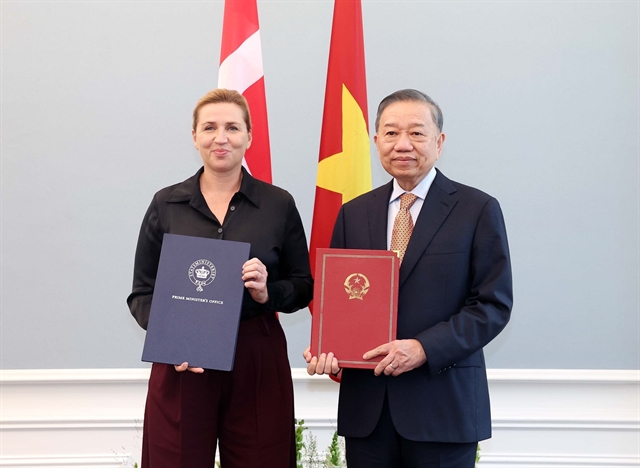
Việt Nam, Denmark elevate ties to Comprehensive Strategic Partnership
1.

|
| Dhanawat Suthumpun, Managing Director of Thailand and Emerging Markets, including Việt Nam, at Microsoft shared its 2026 Work Trend Index. — Photo courtesy of the firm |
HÀ NỘI — Việt Nam is emerging as the country with one of the most AI-ready workforces in the region, with employees rapidly adopting artificial intelligence (AI) to improve productivity and create higher-value work, according to Microsoft’s 2026 Work Trend Index.
The report shows that Việt Nam has the highest proportion of 'Frontier Professionals' in ASEAN - employees who are among the most advanced AI users - at 39 per cent, well above the global average of 16 per cent.
Việt Nam also ranks ahead of the global average in terms of AI leadership alignment, with 48 per cent of AI users saying their leaders are clearly and consistently aligned on AI strategies, compared with 26 per cent globally.
Microsoft Vietnam released the findings on June 24, based on an analysis of trillions of Microsoft 365 productivity signals and a survey of 2,000 full-time employees and self-employed knowledge workers in Việt Nam.
The study highlights a major shift in the workplace: as AI agents increasingly handle routine execution, people are taking on greater responsibility in decision-making, problem-solving and directing work.
The challenge is no longer simply individual capability, but how organisations redesign workflows, systems and leadership models to maximise AI’s potential.
AI expands human potential
Vietnamese workers are developing a more mature approach to AI, using the technology not as a replacement for human judgment but as a tool to enhance creativity, analysis and decision-making.
The report found that 89 per cent of AI users in Việt Nam, compared with 86 per cent globally, view AI-generated results as a starting point rather than a final answer and continue to take responsibility for the thinking behind their work.
The country’s workforce is also moving beyond basic AI adoption. With 39 per cent classified as Frontier Professionals, Việt Nam leads ASEAN and exceeds the global average. These workers are using AI to analyse information, solve complex problems, make better decisions and generate new ideas.
The impact is already visible. Some 76 per cent of Vietnamese AI users said they are producing work they could not have created a year ago, compared with 58 per cent globally. Among Frontier Professionals in Việt Nam, the figure rises to 83 per cent.
Importantly, advanced AI users are not relying entirely on technology. Compared with Non-Frontier Professionals, they are more likely to deliberately complete certain tasks without AI to maintain their skills (57 per cent versus 41 per cent), and more likely to pause before starting work to decide which tasks should be handled by humans and which by AI (62 per cent versus 50 per cent).
While employees are rapidly building AI skills, many organisations globally are still struggling to adapt their structures and processes.
Microsoft’s research shows that only 19 per cent of organisations worldwide qualify as 'Frontier organisations', where both employee AI capability and organisational readiness are high. Many others remain in an early stage of adoption, where AI use is increasing but leadership alignment, operating models and workplace practices are still evolving.
Việt Nam, however, shows stronger momentum. Nearly half of AI users in the country (48 per cent) say their leadership teams are clearly aligned on AI, almost double the global average.
Meanwhile, 32 per cent of Vietnamese respondents said they have been recognised or rewarded for experimenting with new AI-enabled ways of working, even when immediate results were not guaranteed. The figure is significantly higher than the global average of 13 per cent.
Despite this progress, pressure to adapt remains high. More than four in five AI users in Việt Nam (82 per cent), compared with 65 per cent globally, said they are concerned about falling behind if they do not adopt AI quickly.
This reflects what Microsoft calls the 'Transformation Paradox' where employees feel the need to rapidly embrace AI to remain competitive, while many organisational systems, incentives and processes continue to follow traditional approaches.
“Việt Nam’s rapid adoption of AI underscores the immense potential of its workforce and economy. However, technology alone does not drive transformation,” said Dhanawat Suthumpun, Managing Director of Thailand and Emerging Markets, including Việt Nam, at Microsoft.
“As employees embrace new AI capabilities, leaders have a critical responsibility to ensure organisational systems keep pace.
"AI leaders will be the organisations that connect their goals with business priorities and empower people to rethink how work gets done - unlocking new productivity breakthroughs and delivering greater value to employees and customers.”
The report’s key message is that organisational factors have a greater influence on AI success than individual behaviour alone. Workplace culture, manager support and talent development practices contribute more than twice the impact of personal attitudes and AI usage habits.
Frontier organisations are moving beyond simply adopting AI to fully absorbing it into everyday operations. They are redesigning workflows, capturing insights and turning individual experiences into shared knowledge.
When knowledge, processes and standards are embedded across an organisation, they become what Microsoft describes as 'Owned Intelligence' - a form of institutional capability that grows over time and becomes difficult for competitors to replicate.
Frontier Professionals in Việt Nam are already demonstrating this approach. Compared with other AI users, they are more likely to report that AI workflows, human handoffs and quality standards are documented and repeatable across teams and organisations.
As AI becomes an increasingly important layer of workplace execution, competitive advantage will belong to organisations that successfully combine human expertise with AI capabilities.
The next stage of transformation, Microsoft said, will depend on leaders building systems that allow people and AI agents to work together effectively, supported by connected data, clear governance and a culture of continuous learning. —VNS
Economy
 Economy
.jpg) Economy
Economy
 Economy
 Economy
 Economy
 Economy
 Economy
 Economy
 Economy
 Economy
 Economy
 Economy
 Economy
 Economy