 Economy



Việt Nam fosters comprehensive cooperation with Uruguay
1.
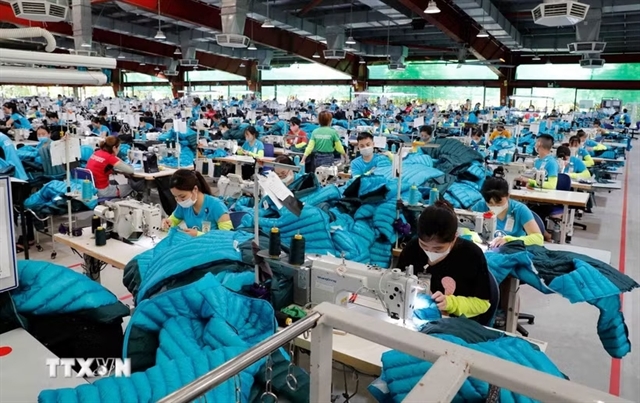 |
| The current green transformation trend is no longer an option, but has become a mandatory requirement for Vietnamese goods. — VNA/VNS Photo |
HÀ NỘI — As competition for textile and garment exports has entered a new phase in which price and production scale are no longer advantages, Vietnamese businesses must embrace current trends to retain market share, including digital and green transformation, Shinhan Securities Vietnam analysts say in a recent report.
In the report on the textile and garment industry, the analysts note that global textile and garment demand is projected to slow down to a rate of 2-3 per cent per year.
This means that global market share is unlikely to grow significantly, so anyone wanting a larger share will have to take it from others. The export growth of each country will depend primarily on its ability to compete and gain market share from rivals.
The scaling up and increasing production strategy that once helped develop Việt Nam's textile industry is no longer effective, as the playing field has changed.
Competitors like Bangladesh, India, Indonesia and Ethiopia are claiming much of the market in the low-tech segment. Meanwhile, buyers are increasingly tightening requirements for small orders, fast delivery, short life cycles and stringent standards on traceability, emissions and labour, which have become mandatory conditions for signing contracts.
Given this context, traditional production strategies are gradually revealing their limitations. According to Shinhan, the focus for Việt Nam's textile and garment industry in the next few years will no longer be on expanding production scale, but on improving core quality through transformation and boosting competitiveness.
To achieve this, Vietnamese textile and garment businesses must shift from an expansion mindset to value optimisation. Specifically, businesses need to increase production of niche products with high added value and focus on upgrading their product portfolio.
At the same time, they need to invest in solar power for their factories to meet environmental, social and governance (ESG) standards and reduce capital costs, along with applying AI in production to shorten lead times, meet the increasingly stringent requirements of international customers and strengthen competitiveness.
The Shinhan analysts said that export prospects for textiles and garments in the second half of 2026 will continue to lean towards the high-value segment. Competition in low-tech product categories, such as T-shirts, shirts and children's clothing, is intensifying. Shifting to niche markets, especially sportswear, is thus seen as a way for Vietnamese businesses to expand market share and improve profit margins.
This trend is driven by the projected growth of the global sportswear market, estimated at around 6 per cent per year between 2026 and 2030. Furthermore, there is still significant growth potential in Việt Nam, particularly as brands like Nike, Adidas and Lululemon continue to diversify their supply chains away from China.
Alongside product diversification, Shinhan pointed out that textile and garment exports need to accelerate the application of AI to gain a competitive advantage. With increasingly shorter delivery times, a rise in smaller orders and increasingly diverse requirements, AI has become a crucial tool for improving productivity and quality control.
Faced with this pressure, chairman of the Vietnam Textile and Apparel Association Vũ Đức Giang said that digital transformation and the application of AI would no longer be just a trend, but a vital requirement.
Many factories still operate based on experience, while data between stages is fragmented and lacks real-time connectivity, according to Giang. This may increase production but reduce profit margins, and quality control is difficult to achieve consistently. Smart factories that use data in their operations have thus become mandatory for maintaining competitiveness.
Hồ Thị Quyên, deputy director of the HCM City Trade and Investment Promotion Centre, emphasised the need for a dual transformation in production.
“Digital transformation and green transformation are no longer two separate processes, but are converging into a ‘dual transformation’ strategy," she said.
"In this strategy, digital technology becomes a tool to promote green growth and enhance the competitiveness of businesses. The current trend of green transformation is no longer an option, but has become a mandatory passport for Vietnamese goods."
She said that businesses needed to simultaneously embrace ESG trends and green transformation, along with applying technologies such as Enterprise Resource Planning, Manufacturing Execution Systems, Internet of Things and AI to optimise operations and management and develop smart factory models.
"Faced with increasingly stringent technical barriers from the EU and the US, the comprehensive implementation of the dual transformation model is seen as a solution to help businesses optimise resources," Quyên said.
"According to the Ministry of Industry and Trade, this model can help businesses save 10-15 per cent of operating costs, increase productivity by 20 per cent and reduce carbon emissions by 5-8 per cent annually." — BIZHUB/VNS
Economy
 Economy
 Economy
 Economy
 Economy
 Economy
 Economy
 Economy
 Economy
 Economy
 Economy
 Economy
 Economy
 Economy
 Economy