 Economy


Outstanding Vietnamese women honoured for remarkable achievements
1.
|
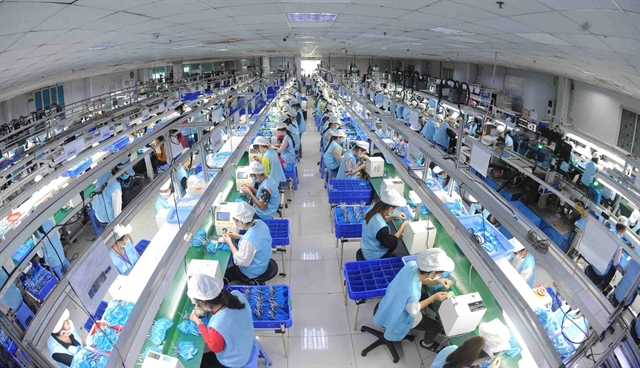
| An electronic production line at Suntech Company in Bắc Ninh Province. The electronics sector's exports are projected to reach $200 billion in 2026. VNA/VNS Photo |
HÀ NỘI — Việt Nam is seeing new opportunities to strengthen its position in the global smart electronics supply chain, as global technology supply chains undergo a restructuring driven by artificial intelligence (AI), sustainability requirements and shifting manufacturing patterns.
In recent years, Việt Nam has steadily established itself as a major electronics manufacturing hub in Asia, attracting expanding investment from leading global technology companies.
The electronics sector now represents a key contributor to the country’s exports, generating about US$164 billion in 2025, a figure that is projected to reach $200 billion in 2026.
As multinational technology firms accelerate efforts to diversify their supply networks, Việt Nam is increasingly being viewed as a strategic link in Asia.
The country benefits from a favourable geo-economic location, political stability, a growing technology workforce and rising investment in semiconductors, AI and supporting industries.
According to Đỗ Thị Thúy Hương, vice chairwoman and secretary general of the Vietnam Electronic Industries Association (VEIA), Việt Nam possesses several competitive advantages amid the ongoing reconfiguration of global supply chains.
Foremost among them is the country’s strategic location in the Asia-Pacific region, in close proximity to some of the world’s largest electronics manufacturing centres, providing significant logistics and supply chain connectivity advantages.
Việt Nam also offers a stable investment environment and an extensive network of next-generation free trade agreements, factors that have strengthened investor confidence and encouraged long-term expansion plans.
In addition, the country benefits from a young workforce, a strong capacity to adapt to emerging technologies and competitive production costs.
The Government’s commitment to developing AI, semiconductors, digital transformation and high-tech industries has further enhanced Việt Nam’s attractiveness to international investors.
If Vietnamese companies could seize this opportunity to upgrade their technological and management capabilities, they could move beyond the role of an assembly base and become higher-value technology partners within global supply chains, Hương said.
Công Tằng Tôn Nữ Thùy Trang, general director of ITO Vietnam, said the electronics industry had become a fundamental pillar of the digital economy. However, increasingly stringent requirements related to environmental, social and governance (ESG) standards, international compliance, data security, automation and innovation were creating new challenges for domestic enterprises.
According to Trang, building a highly adaptable smart electronics supply chain ecosystem while strengthening links between local firms, foreign-invested enterprises and international partners has become an urgent priority.
ESG considerations are also rapidly becoming a new benchmark across global supply chains. To gain access to carbon credits, green financing and international supply networks, companies are under growing pressure to reduce carbon emissions, invest in advanced technologies and strengthen sustainable governance practices.
According to Hanam Group founder and chairman Thái Trần, companies do not necessarily need to comply with every global ESG requirement. Instead, they should focus on meeting the standards of their target export markets and customers, while developing implementation roadmaps aligned with their current capabilities.
Industry experts agree that deeper integration into global value chains will require Vietnamese electronics manufacturers to move beyond traditional contract manufacturing and assembly operations. Companies will need to develop technological capabilities, strengthen management practices and foster innovation.
As AI, semiconductors and digital transformation reshape the global electronics industry, businesses are being encouraged to invest more heavily in automation, smart manufacturing systems, research and development (R&D) and training highly skilled workers.
At the same time, firms are expected to gradually expand into higher value-added segments, such as product design, integrated circuit design, embedded software, applied AI solutions and high-tech supporting industries.
To strengthen the competitiveness of Việt Nam’s electronics industry, VEIA is advocating policy measures that prioritise the development of supporting industries and a national semiconductor ecosystem, with the goal of increasing localisation rates and boosting domestic value creation.
The association has also urged the Government to support businesses in technology upgrading, digital transformation, green manufacturing and automation through preferential credit schemes, technology support funds and trade and investment promotion programmes.
At the same time, workforce development is becoming an increasingly pressing challenge as the electronics, AI and semiconductor sectors face a shortage of highly skilled technical talent.
VEIA has proposed the formulation of a national strategy for technology workforce development, including closer collaboration between businesses, universities, research institutes and innovation centres.
In parallel, the association continues to promote initiatives that connect Vietnamese enterprises with foreign-invested companies, enabling local firms to participate more directly in the supply chains of major global technology corporations and expand their reach into international markets. — VNS
Economy
 Economy
 Economy
 Economy
 Economy
 Economy
 Economy
 Economy
 Economy
 Economy
 Economy
 Economy
 Economy
 Economy
 Economy