 Economy


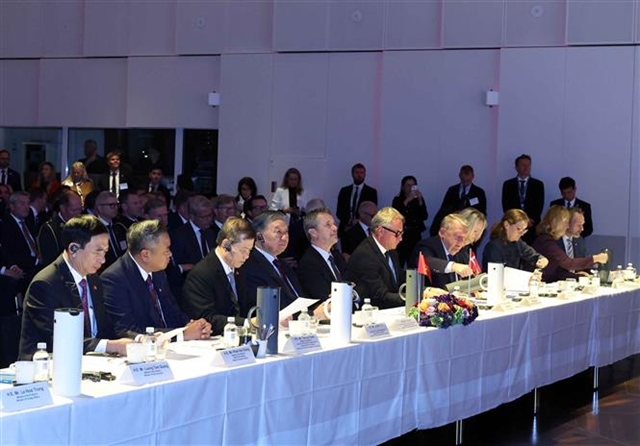
General Secretary and President Tô Lâm witnesses exchange of Việt Nam-Denmark cooperation agreements
1.
|
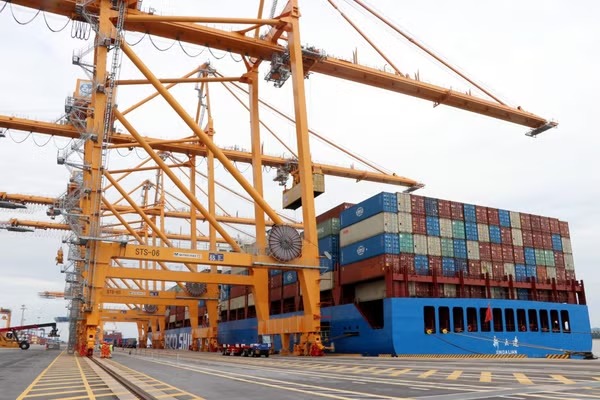
| Containers are loaded at TIL Port Hải Phòng International Container Terminal. VNA/VNS Photo |
HÀ NỘI — Việt Nam has emerged as an increasingly important driver of regional economic integration over the past three decades, with two-way trade with ASEAN soaring to approximately US$91 billion in 2025 from only $3.26 billion in 1995.
As Southeast Asia accelerates economic connectivity, digital transformation and green growth, the country is strengthening its position as a key manufacturing, logistics and digital trade hub, helping to create new growth space for the region.
Lê Quốc Phương, former Deputy Director of the Industry and Trade Information Centre under the Ministry of Industry and Trade, said Việt Nam's accession to ASEAN in 1995 and participation in regional free trade agreements (FTAs), including the ASEAN Free Trade Area (AFTA), the ASEAN Trade in Goods Agreement (ATIGA) and the Regional Comprehensive Economic Partnership (RCEP), have provided a strong impetus for trade growth.
ASEAN is now one of Việt Nam's largest trading partners, behind only the US, China and the Republic of Korea. Deep tariff reductions within the bloc have facilitated Vietnamese exports while promoting the country's deeper integration into regional production networks.
The bloc is also an important source of investment. Statistics from Việt Nam Customs show that eight ASEAN member states have invested in all the 18 economic sectors in Việt Nam, with manufacturing and processing industries attracting more than 1,000 projects worth about $22.2 billion.
Việt Nam has become an increasingly important link in ASEAN supply chains, importing components and materials from Thailand, Malaysia and Singapore for production, assembly and export. Cooperation is also expanding into the digital economy, green transition, renewable energy and logistics.
One promising area is the ASEAN Power Grid (APG). With its strategic location and significant offshore wind potential, Việt Nam is emerging as a key hub in the bloc's energy security strategy. According to the ASEAN Centre for Energy, full APG connectivity could contribute up to $3 trillion to regional GDP by 2040 and create around 1.45 million jobs.
Lê Phương Hoa, Deputy Director of the Institute for Asia-Pacific Studies under the Việt Nam Academy of Social Sciences, stressed that maintaining ASEAN centrality is essential for safeguarding the region's development space and strengthening cooperation based on international law.
Expanding cooperation space
Beyond traditional trade, the digital economy is becoming a new growth engine for ASEAN, with Việt Nam among the region's most dynamic markets.
According to the e-Conomy SEA 2025 report, ASEAN's digital economy could reach $305 billion in gross merchandise value (GMV) this year, up 17 per cent year-on-year. E-commerce remains the key growth driver, with Việt Nam among the fastest-growing markets in the region.
Việt Nam is also promoting cooperation in the digital sector through efforts to conclude the ASEAN Digital Economy Framework Agreement (DEFA), which is expected to facilitate cross-border data flows, digital trade and greater participation of small and medium-sized enterprises in the regional digital ecosystem.
Meanwhile, green transition is opening up new avenues for cooperation. Việt Nam's electric vehicle adoption rate has reached about 33 per cent of total vehicle sales, significantly above the ASEAN average.
Despite strong growth, experts believe there remains substantial room for deeper cooperation, as intra-ASEAN trade accounts for only about 20–22 per cent of the bloc's total trade.
To make better use of regional FTAs, Vietnamese enterprises need to enhance competitiveness, strengthen brands, increase technological content in exports, and meet higher standards in green transition, digitalisation and sustainable development.
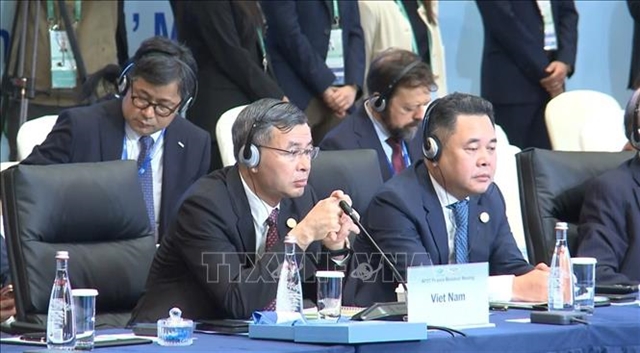
At the 27th ASEAN Economic Community Council Meeting, Deputy Minister of Industry and Trade Phan Thị Thắng affirmed Việt Nam's readiness to work closely with other ASEAN members to enhance the resilience of the regional economy. — VNA/VNS
Economy
 Economy
 Economy
 Economy
 Economy
 Economy
 Economy
 Economy
 Economy
 Economy
 Economy
 Economy
 Economy
 Economy
 Economy