 Economy


Vietnamese Prime Minister meets Cambodian National Assembly President
1.
|
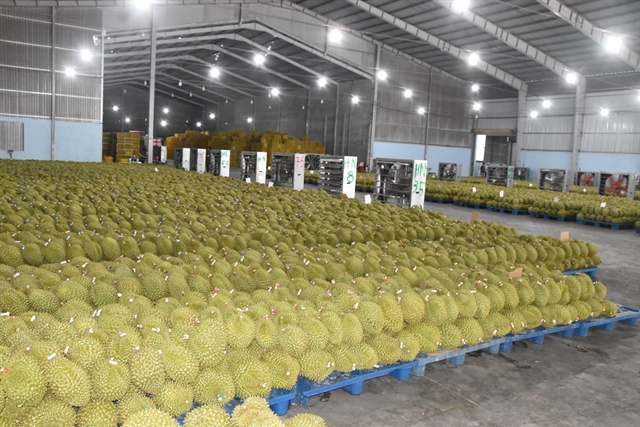
| Durians at a warehouse in Đồng Tháp Province. — VNA/VNS Photo Công Trí |
HÀ NỘI — Việt Nam’s durian export sector is under pressure as testing delays and stricter residue inspections disrupt shipments, prompting the Ministry of Agriculture and Environment to order urgent corrective measures to keep trade flowing.
In Official Dispatch No. 4423/BNNMT-CCPT issued on May 7, the ministry instructed local authorities, testing centres and relevant agencies to accelerate procedures to support the export of durian and other agricultural products.
The ministry said durian and several key farm exports have recently faced difficulties due to delays in testing, traceability requirements and compliance with importing market standards.
Local authorities were urged to work closely with businesses and cooperatives to ease bottlenecks in harvesting, pre-processing, packaging and transport.
The ministry also called for tighter management of growing areas and packaging facilities to ensure compliance with traceability rules and food safety standards required by importing markets.
Testing centres were instructed to mobilise maximum resources, including staff and equipment and apply flexible working arrangements, including overtime where necessary, to shorten testing times while maintaining accuracy and regulatory compliance.
The Department of Crop Production and Plant Protection has been tasked with working with China to seek approval for additional Vietnamese testing laboratories and to request the reinstatement of suspended facilities once corrective measures are completed.
The ministry also plans to identify growing areas at high risk of cadmium contamination and guide local authorities on farming practices to reduce residue risks and meet import requirements.
The move comes as southern provinces face mounting congestion in durian exports due to extended testing procedures and stricter inspections by China.
In the domestic market, prices have fallen sharply in recent weeks as export disruptions continue. Ri6 durian is currently being purchased at orchards for VNĐ20,000–25,000 (US$0.77–0.96) per kilogramme while Monthong durian is selling for just over VNĐ60,000 per kilogramme.
Growers say production costs currently range from VNĐ30,000–40,000 per kilogramme, meaning many farmers are losing between VNĐ10,000 and VNĐ15,000 per kilogramme sold.
In Đồng Tháp Province, one of the country’s largest durian-growing areas, local authorities are rolling out measures to support farmers and exporters.
Vice Chairman of the provincial People’s Committee Nguyễn Phước Thiện said the province is reviewing all growing area and packaging facility codes to identify zones at high risk of cadmium contamination while strengthening oversight of production, testing and traceability processes.
The ministry warned that increasingly strict requirements from importing markets, particularly regarding cadmium residues, Auramine O and traceability, mean the industry must quickly standardise production, testing and quality management systems to ensure sustainable growth.
Durian remains one of Việt Nam’s key agricultural export products in early 2026. Customs data showed exports reached $146 million in the first two months of the year, up 177 per cent, driven by strong demand from China.
However, ongoing bottlenecks linked to testing procedures and tighter import requirements are weighing on shipments and adding pressure on growers and exporters.
Việt Nam aims to earn $4.5 billion from durian exports this year. — VNS
Economy
 Economy
 Economy
 Economy
 Economy
 Economy
 Economy
 Economy
 Economy
 Economy
 Economy
 Economy
 Economy
 Economy
 Economy