 Economy



Project to build big-data legal database approved
1.
|
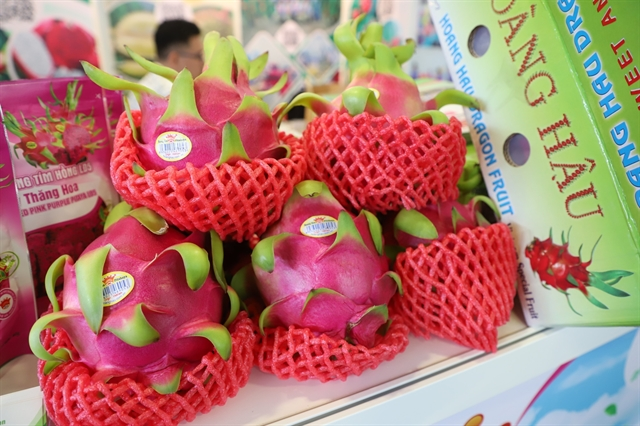
| Vietnamese dragon fruits are displayed at Fruit Logistica 2024 held in Messe Berlin Exhibition Centre, Germany. —VNA/VNS Photo |
HÀ NỘI — Amid intensifying global competition and increasingly stringent import requirements, Việt Nam’s fruit and vegetable sector is shifting its focus from simply maintaining existing markets to expanding and upgrading its export strategy in a more sustainable direction.
A key priority is improving product quality and ensuring food safety consistently and substantively, said Vinafruit Chairman Nguyễn Thanh Bình, speaking to Hà Nội Mới (New Hà Nội) online newspaper.
Strict control over inputs, standardised production processes and compliance with residue limits are essential to enhancing both value and competitiveness, he said.
To fully leverage opportunities from newly signed export protocols, businesses are being urged to standardise cultivation practices while farmers are encouraged to gradually reduce chemical inputs and adopt more organic and biological fertilisers.
However, the sector is also facing structural challenges. Heavy reliance on a few key markets and products, rising logistics and input costs and global trade uncertainties are putting pressure on profit margins.
Regarding solutions for exporters, agricultural expert Hoàng Trọng Thuỷ said that beyond quality issues, global uncertainties, especially conflicts in the Middle East, have driven up oil prices.
Domestic transportation costs have risen by 30-40 per cent while input costs such as fertilisers have increased by 20-30 per cent, directly impacting production costs.
Meanwhile, domestic demand is showing signs of weakening, he said.
Although export value and turnover are increasing, profit margins are shrinking due to rising costs. Buyers and sellers often have to share transportation expenses, creating difficulties for both sides and affecting consumption.
In this context, businesses urgently need to streamline operations and cut basic costs to improve margins, he said.
Thuỷ also recommended that trade promotion efforts require timely support from the Government. Expanding independently into international markets poses significant cost challenges for businesses without backing from national programmes.
Support from state agencies is a crucial foundation that helps enterprises confidently explore new and promising markets, he said.
Vinafruit is currently stepping up international engagement and trade connectivity. Two national trade promotion programmes in Germany and Hong Kong (China) are being actively implemented.
At the same time, the association advises businesses to closely monitor and adapt to new import policies, especially China’s Decree 280, to maintain official export channels.
According to the Ministry of Agriculture and Environment, fruit and vegetable exports reached nearly US$2.06 billion in the first four months of this year, up 22 per cent year-on-year.
China remains the largest market, accounting for 54 per cent of total export value, followed by the US and South Korea.
Notably, Cambodia has recorded strong growth while new market openings, such as Vietnamese pomelo entering Australia and expanded access to China have created additional opportunities.
If current momentum continues, export turnover for the whole year is projected to reach between $9.5 billion and $10 billion, supported by peak harvest seasons and the effective implementation of export protocols. — VNS
Economy
 Economy
 Economy
 Economy
 Economy
 Economy
 Economy
 Economy
 Economy
 Economy
 Economy
.jpeg) Economy
Economy
 Economy
 Economy
 Economy