 Economy



Quy Nhơn Dialogue on Climate and Transition to provide platform for open discussion
1.
|
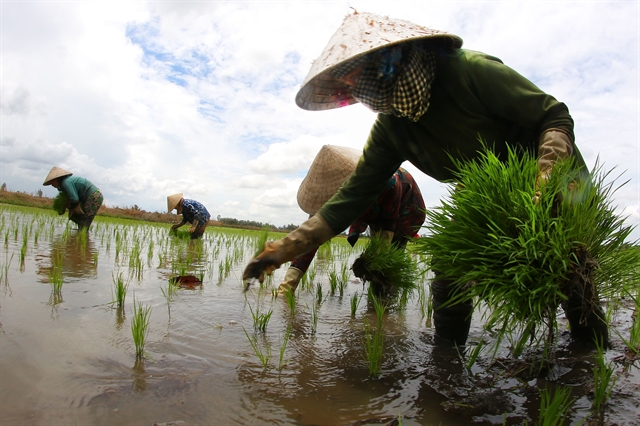
| Farmes are planting paddy in a field in Cần Thơ Province. Degraded land was estimated at 11.8 million ha, accounting for nearly one-third of the country’s total natural area. — VNA/VNS Photo Duy Khương |
HÀ NỘI — Placing soil health at the centre of agricultural policy is becoming critical as land degradation poses a growing threat to productivity and the sustainable development of the agricultural sector, experts said at a workshop on May 5.
Nguyễn Đình Công from the Food and Agriculture Organisation of the United Nations (FAO) cited statistics from the Ministry of Agriculture and Environment showing degraded land is estimated at 11.8 million ha, accounting for nearly one-third of the country’s total natural area. Of this, about 1.2 million ha are classified as severely degraded.
Roughly 5 million ha of agricultural land, or nearly 40 per cent of the country’s total farmland, have seen declining quality. In addition, about 5 million ha of forestry land, or 30 per cent, is also affected.
The northern midland and mountainous regions are the hardest hit, with about 1.4 million ha of land degraded while the north-central region, central coast and Central Highlands each report around 1.1 million ha. The Mekong Delta faces relatively lower levels of degradation.
Soil erosion is a key manifestation of land degradation, he said.
He pointed out that in Sơn La Province, for example, maize cultivation on sloping land without protective measures can result in soil losses of 100 to 150 tonnes per ha annually, equivalent to 1 to 1.5 cm of nutrient-rich topsoil.
If this rate continues, arable soil could be significantly depleted within five to seven years, Công said, warning that the complete loss of topsoil could occur within decades. In some upland areas in the northern region and Central Highlands, land has already become rocky and largely unproductive.
By contrast, soil formation can take thousands to millions of years, highlighting the severity of current erosion rates.
The causes of degradation stem from both natural and human factors, with erosion on sloping terrain exacerbated by unsustainable farming practices such as excessive tillage, lack of ground cover and overuse of fertilisers and pesticides, Công said.
He said that while desertification is a major concern globally, Việt Nam faces distinct challenges, including soil erosion, declining organic matter, salinisation, acidification and drought linked to climate change.
He stressed that land degradation is becoming a pressing issue for Việt Nam as agriculture remains a key pillar of the economy, contributing about 12 per cent of GDP, employing roughly 60 per cent of the rural workforce and generating around US$70 billion in annual agro-forestry-fishery trade.
However, past growth in the agricultural sector has largely relied on expanding cultivated areas and intensifying production, which has placed increasing pressure on land resources and resulted in land degradation, Công said.
With the target of annual growth at 5 to 6 per cent, nearly doubling the current rate of 3 to 4 per cent, even as land quality continues to decline, the agricultural sector is facing both pressure and an opportunity to shift towards more sustainable practices, Công said.
Soil health at the centre
|
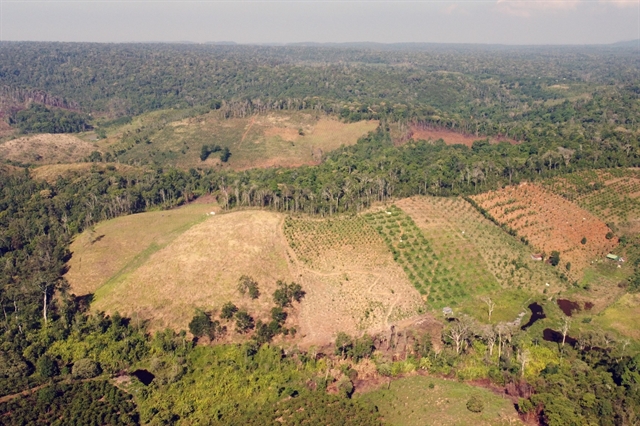
| A forest land in Lâm Đồng Province. Placing soil health at the centre of agricultural policy becomes critical. — VNA/VNS Photo Ngọc Minh |
In the context of severe land degradation, placing soil health at the centre of agricultural policy has become critical, requiring a shift from resource exploitation to ecosystem-based management to enhance its role in improving productivity, regulating water, protecting the environment and adapting to climate change.
It is necessary to improve institutional frameworks, strengthen inter-agency coordination, advance digitalisation and build comprehensive land data systems, Công said.
Planning should be reviewed to incorporate soil protection criteria and strengthen oversight, particularly for farming on sloping land. At the same time, stricter control is needed over the use of fertilisers and pesticides alongside the rollout of soil restoration programmes.
Greater investment in science and technology is also needed to identify and scale up farming models suited to specific ecological zones, together with developing markets for green agricultural products linked to soil protection standards to encourage a switch to more sustainable practices, Công said.
Công also proposed financial tools such as tax incentives, credit schemes, public-private partnerships and agricultural insurance to support the transition.
Tô Xuân Phúc, an expert at Forest Trends, said that for decades the value of land has not been fully or properly accounted for in agricultural production.
“It is time to reassess the role of land and act now, before it is too late,” he said, emphasising the need to better reflect the true value of land in agricultural production to enhance long-term competitiveness.
Amid increasingly stringent international standards, particularly requirements on sustainability and traceability such as the EU Deforestation Regulation (EUDR), land can no longer be treated as a given but has become a critical factor in the value chain, Phúc said.
The ability to maintain soil quality will directly determine the competitiveness of Việt Nam’s agricultural products in global markets as well as ensure long-term livelihoods for farmers, experts said at the conference, adding that land degradation is not only an environmental issue but also a development challenge.
Coordinated solutions across institutions, science and technology, finance and markets will be key to protecting land resources and laying the foundation for sustainable agricultural growth in the long term. — VNS
Economy
 Economy
 Economy
 Economy
 Economy
 Economy
 Economy
 Economy
 Economy
 Economy
 Economy
 Economy
.JPG) Economy
Economy
 Economy
 Economy