 Economy



European higher education week opens new opportunities
1.
|
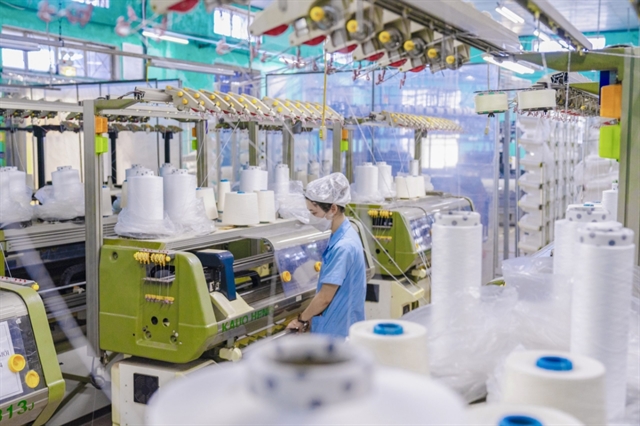
| In March alone, textile and garment export turnover gained a strong surge of 36 per cent compared to February. — Photo vneconomy.vn |
HÀ NỘI — Despite uncertainties in the international market, export revenue from the textile and garment industry increased by nearly 3 per cent year-on-year to more than US$10.6 billion in the first quarter of 2026, the Vietnam Textile and Garment Association (VITAS) reported.
In March alone, textile and garment export turnover surged 36 per cent compared to February.
In the sector’s export structure, garments continued to play a pivotal role, bringing in $8.18 billion, while fibre accounted for nearly $1.1 billion, fabric $719 million and textile accessories $382 million.
Vũ Đức Giang, chairman of VITAS, said that although there was a slight decline in the first two months of 2026, due to seasonality and pressure from trade instability, the clear recovery in March reflected the resilience and ability of domestic businesses to adapt quickly.
Giang cited the textile and garment corporation Vinatex as a typical example. Vinatex’s first-quarter 2026 financial statement was seen as clear evidence of effective management in the new context. In the first quarter of 2026, Vinatex achieved net revenue of nearly VNĐ4.5 trillion, an increase of 5.1 per cent, while pre-tax profit grew 31 per cent to VNĐ355 billion.
Vinatex’s positive difference between revenue and profit was mainly driven by the core performance of its yarn and garment segments. The garment segment maintained a stable order volume with favourable pricing from late 2025 while the yarn segment also saw a strong recovery in selling prices.
This result stemmed from businesses’ timely adaptation to global cotton and fibre price fluctuations, due to geopolitical changes in the Middle East, while also effectively leveraging demand from the Chinese market as China’s textile industry lost its cost advantage.
In addition, the United States’ imposition of an additional 10 per cent global tariff, replacing previous higher tariffs, has inadvertently created a buffer, significantly increasing the competitive advantage of the Vietnamese textile industry.
Despite these positive results, the localisation rate of the textile industry currently stands at only about 51–52 per cent. Heavy reliance on imported raw materials remains a barrier preventing businesses from fully utilising tariff preferences from agreements such as CPTPP and EVFTA.
In addition, pressure from international regulations on supply chains and sustainable development is increasing.
Trương Văn Cẩm, vice president and general secretary of VITAS, said requirements for supply chain auditing, fibre traceability and ESG reporting are no longer optional but have become mandatory. Businesses need to be more proactive and systematic in their preparation to meet the stringent standards of key markets.
To achieve the export target of $49 billion in 2026, VITAS recommends that businesses implement a comprehensive set of solutions. Alongside market diversification, investment in technology and artificial intelligence and transition towards a green and circular economy are considered crucial for survival.
Regarding concerns about environmental pollution in the textile dyeing industry, Giang affirmed that current wastewater treatment technologies can be systematically controlled, removing psychological barriers to the development of the domestic textile dyeing industry, thereby increasing the localisation rate and building a strong Vietnamese textile brand in the international arena.
Vietnamese textile and garment products have so far been exported to 138 markets, with the United States remaining the largest market. — BIZHUB/VNS
Economy
 Economy
 Economy
 Economy
 Economy
 Economy
 Economy
 Economy
 Economy
 Economy
 Economy
 Economy
 Economy
.jpeg) Economy
Economy
 Economy