 Economy



Sơn La holds second coffee festival, targeting stronger businesses in future
1.
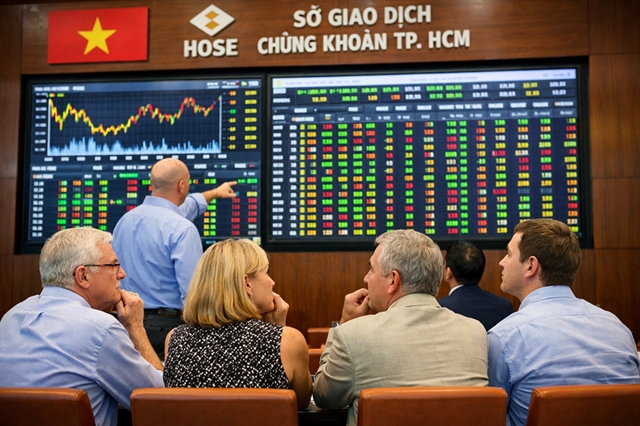 |
| Foreign investors watch stock movements at the Hochiminh Stock Exchange (HoSE). — VNA/VNS Photo |
HÀ NỘI — The confirmation by FTSE Russell of Việt Nam’s roadmap to upgrade its stock market to Secondary Emerging status by September is being seen as a milestone in the country’s financial market development following a series of regulatory reforms aimed at improving market accessibility.
The announcement, released after the mid-term review on April 8, acknowledged significant progress in enhancing market access through global intermediary institutions while maintaining the planned transition from Frontier Market to Secondary Emerging Market classification.
The development comes after the issuance of Circular No. 08/2026/TT-BTC on February 3, which amended key regulations related to trading, information disclosure and market operations.
The circular is considered a pivotal legal framework designed to facilitate foreign investor participation and address long-standing bottlenecks, including the removal of pre-funding requirements for transactions.
Coordination among regulators, domestic and international securities firms, and custodian banks has created the operational foundation for the FTSE Russell Index Governance Board to confirm the phased inclusion of Vietnamese equities into global indices, starting from Monday, September 21.
According to Lưu Chí Kháng, head of Proprietary Trading Department at Vietnam Construction Securities JSC, the upgrade could trigger a new wave of foreign capital inflows estimated at between US$5 billion and $7 billion, primarily from exchange-traded funds (ETFs) and other passive investment vehicles.
The structure of capital flows in the market will change fundamentally, with foreign institutional investors playing a more prominent role, thereby improving liquidity and the sustainability of trading dynamics, he said.
Kháng noted that such capital typically favours companies with large market capitalisation, high liquidity, sufficient foreign ownership room and strong corporate governance with stable earnings. This trend, he said, would require domestic investors to adjust strategies towards fundamentally strong companies that meet international standards.
Sharing a similar view, Nguyễn Minh Hoàng, head of the Analysis Department at VietFirst Securities Corporation, said the upgrade could attract around $1.7 billion in passive capital alongside an additional $5 billion to $8 billion from active global funds.
He added that these inflows are likely to be disbursed in phases at ratios of 10 per cent, 20 per cent, 30 per cent and 35 per cent to mitigate potential volatility in the domestic market.
The participation of new capital flows will place greater demands on Vietnamese companies to enhance transparency and standardise reporting in line with international practices, he added.
From an international perspective, Christine Le, president of the Vietnam Investment and Finance Association in the UK, described FTSE Russell’s recognition as clear evidence of the effectiveness of Việt Nam’s macro-economic reforms and policy consistency.
She emphasised that the removal of key barriers, such as pre-funding requirements and improvements in transaction processes via global intermediaries, has strengthened institutional investor confidence by optimising operational costs and risks.
The most important implication is the repositioning of Việt Nam as part of long-term strategic asset allocation in global portfolios, she said, noting that once upgraded, the market is expected not only to attract larger capital inflows but also improve the quality of capital towards more stable and sustainable investment.
The roadmap to upgrading the market is the result of coordinated efforts led by the Government alongside the Ministry of Finance, the State Securities Commission and market participants aimed at aligning Việt Nam’s capital market with international standards.
In the next phase, market participants are expected to focus on consistent implementation of legal reforms, improving operational procedures for foreign investors and enhancing corporate governance standards among listed companies.
Modernising trading infrastructure and strengthening risk management capacity are also seen as essential to ensuring smooth market operations under the pressure of large-scale capital inflows.
With regulatory groundwork and corporate capacity continuing to improve, Việt Nam’s stock market is entering a new stage of development, positioning itself as an increasingly important medium- to long-term capital channel for the economy. — BIZHUB/VNS
Economy
 Economy
 Economy
 Economy
 Economy
 Economy
 Economy
 Economy
 Economy
 Economy
 Economy
 Economy
 Economy
 Economy
 Economy