 Economy


Quy Nhơn Dialogue on Climate and Transition to provide platform for open discussion
1.
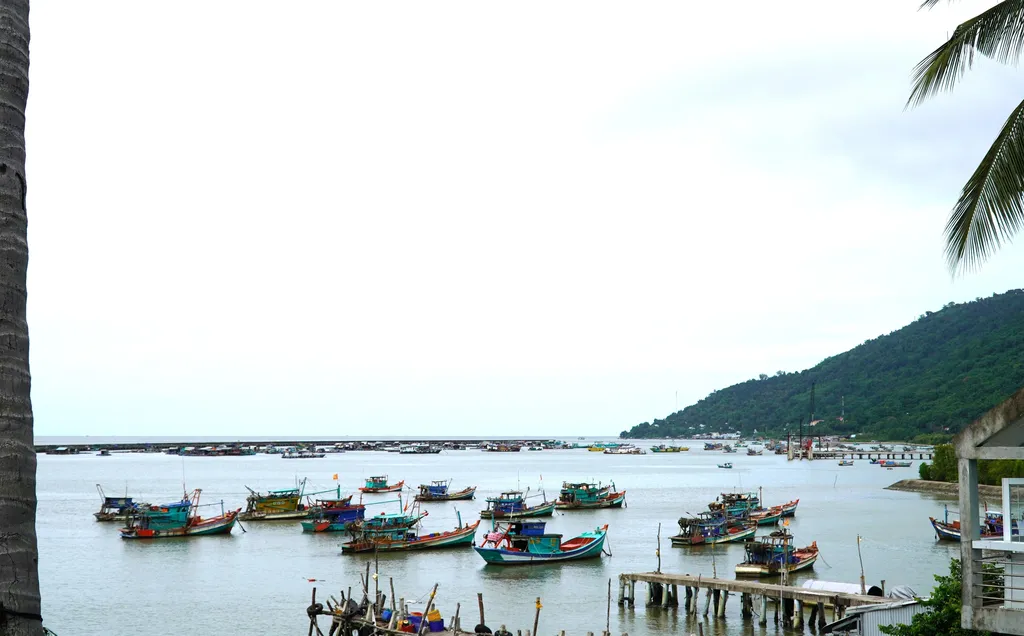 |
| Marine cage fish farming on Hòn Tre Island in An Giang Province’s Kiên Hải Special Zone. — VNA/VNS Photo Văn Sĩ |
AN GIANG — With ambitious output targets and a push for high-tech farming, An Giang Province is restructuring its marine aquaculture sector to boost exports and build a modern marine economy.
The Cửu Long (Mekong) Delta province is stepping up efforts to unlock its vast maritime potential and move towards becoming a national hub.
With a coastline of more than 200km, over 140 islands and a sea area exceeding 63,000sq.km, it has evident advantages.
Marine aquaculture has been identified as a key pillar supporting a sustainable economic shift linked to processing and exports, but the sector faces multiple challenges ranging from technical limitations to unstable markets.
In the Kiên Hải Special Zone, cage fish farming has long been a main livelihood, but farmers have faced difficulties in recent years.
Tô Diễm Thúy, a member of the Hòn Tre Aquaculture Co-operative in the special zone, said efficiency has declined sharply over the past five years.
She said that with 20 floating cages raising fishes such as grouper, cobia and golden pompano, her family used to earn VNĐ700 million (US$26,500) a year until 2021, but profits have fallen to VNĐ300–400 million ($11,400–15,200) in recent years.
She blamed this on unfavourable weather, declining water quality and the poor quality of fingerlings, saying these have reduced the fishes’ rates to 50–60 per cent from 70–80 per cent.
Besides, the output depends heavily on traders, while prices remain volatile, increasing farmers’ risks, she said.
“I hope authorities will get businesses to invest in the province to supply fingerlings, build stable purchasing links and develop processing to ensure reliable outlets and better prices for farmers.”
She also called for solutions to help fishermen access loans to invest in high-density polyethylene (HDPE) plastic cages, which improves farming efficiency.
Compared with traditional wooden cages, plastic cages help reduce wave impact and minimise feed loss, thus lowering costs.
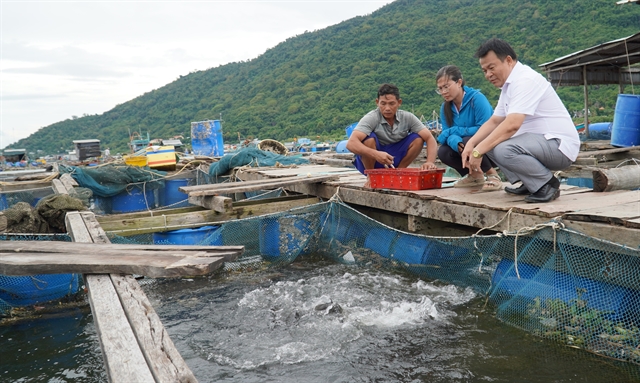 |
| Officials from the Kiên Hải Special Zone Economic Division in An Giang Province, visit a local marine cage fish farming model. — VNA/VNS Photo Văn Sĩ |
Lăng Mạnh Hùng, deputy head of the Kiên Hải Special Zone Economic Division, said the area has more than 500 fish cages that produce over 1,000 tonnes annually, mainly in Hòn Sơn, Hòn Tre and Hòn Lớn islands.
In addition to fish, farmers also raise molluscs such as oysters, mussels, babylon snails, and pearls.
“Marine spaces across several islands in Kiên Hải Special Zone still have great potential, and so the locality hopes higher authorities will soon implement approved marine farming plans and projects to create favourable conditions for the sector to grow, generate jobs, increase incomes for farmers, and support local economic development,” Hùng said.
Lê Hữu Toàn, director of the Provincial Department of Agriculture and Environment, said: “Marine aquaculture is becoming one of the province’s key development directions in the fisheries sector, contributing to a shift towards a more sustainable production structure, increasing added value and providing stable livelihoods for people in coastal and island areas.”
Expanding scale
Under its marine economic development strategy, An Giang is gradually shaping a new direction, promoting multi-species marine farming, increasing added value and ensuring sustainable development.
Phú Vĩnh Thái, deputy head of the Fisheries and Fisheries Resources Surveillance Sub-Department, said An Giang targets total marine aquaculture output of more than 133,000 tonnes this year, including around 20,000 tonnes from cage fish farming and over 113,000 tonnes from molluscs.
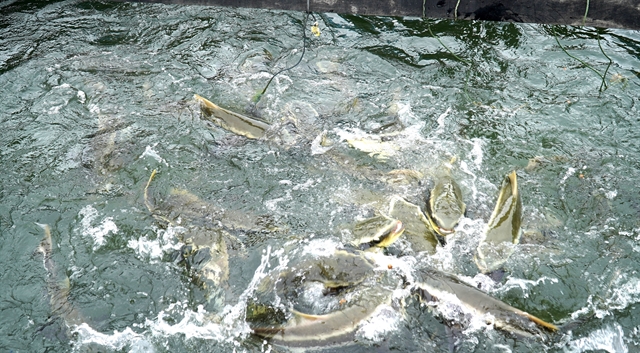 |
| Cobia, a high-value marine fish, is widely farmed by coastal and island fishermen in An Giang Province. — VNA/VNS Photo Văn Sĩ |
The province is shifting from small-scale farming to multi-species, high-value marine aquaculture.
Alongside traditional species such as cobia, grouper and seabass, it plans to expand into high-value species including squid, crab, babylon snails, sea urchins, and pearls.
It is also promoting advanced technologies such as environmental monitoring systems to improve efficiency and reduce risks.
The province is encouraging businesses to invest in high-tech marine farming and lead the shift in production models.
Meanwhile, the agricultural sector is strengthening links between farmers, co-operatives, processing firms, and distributors to increase added value and stabilise output markets.
The province targets average seafood export growth of 4 per cent a year to enhance the sector’s role in the economy.
By 2030 An Giang plans to develop industrial, modern marine aquaculture using high technology and form large-scale farming zones.
Kiên Hải and Phú Quốc special zones are expected to become key centres for industrial marine farming linked to value chains from seed production to commercial farming, processing and export. — VNS
Economy
 Economy
 Economy
 Economy
 Economy
 Economy
 Economy
 Economy
 Economy
 Economy
 Economy
 Economy
 Economy
 Economy
 Economy