 Economy



Quy Nhơn Dialogue on Climate and Transition to provide platform for open discussion
1.

|
| Deputy Prime Minister Hồ Quốc Dũng chaired a meeting in Hà Nội on Monday. — Photos baochinhphu.vn |
HÀ NỘI — Deputy Prime Minister Hồ Quốc Dũng on Monday called for urgent and decisive action to finalise Việt Nam’s list of strategic technologies and products, saying innovation must become a key driver of future economic growth.
Speaking at a government meeting in Hà Nội, the Deputy Prime Minister said strategic technologies would play a critical role in the country’s next phase of development, acting as a key engine for socio-economic expansion.
Ministries and agencies have recently reviewed and proposed revisions to the list of key technologies and products issued under Decision No 1131/QD-TTg in June 2025, in line with directives from Party General Secretary and President Tô Lâm, who led the Central Steering Committee for Science and Technology Development, Innovation and Digital Transformation.
While initial progress has been made, he said, significant challenges remain, including unclear accountability, the absence of clear criteria for identifying strategic products, financial bottlenecks and a shortage of skilled personnel.
Without breakthroughs and strong action, the task cannot be completed, he said, adding that achieving Việt Nam’s ambitious double-digit growth target would depend heavily on advances in science, technology and innovation.
He instructed authorities to complete revisions to the strategic technology list by April based on three criteria: market demand, national competitive advantages and the ability to form value chains.
An inter-ministerial working group will be established, with ministries required to promptly implement assigned tasks and propose funding once the list is approved, he said.
The Deputy Prime Minister also called on the ministries of science and technology, finance, and education and training to improve financial mechanisms and strengthen the development of high-quality human resources, including special policies to promote training in high-tech fields.
The Ministry of Industry and Trade was tasked with studying the integration of strategic technology development into revisions of the Law on Key Industries.
He said the entire system must urgently review and update the list to ensure coordinated and effective implementation, laying the groundwork for long-term national development.
|
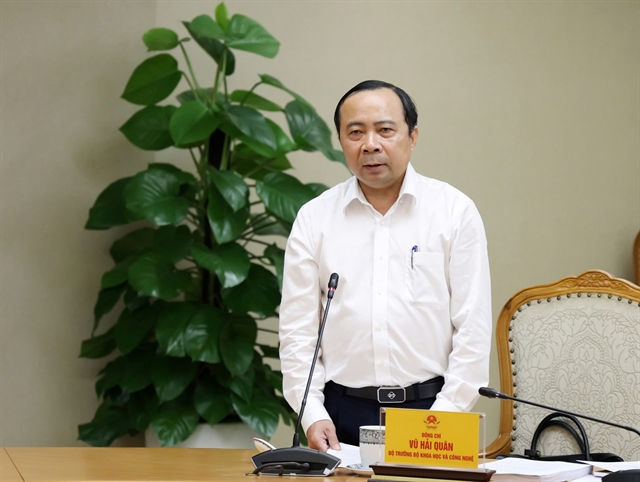
| Minister of Science and Technology Vũ Hải Quân delivered his speech at the event. |
Separately, Minister of Science and Technology Vũ Hải Quân said the development of the list aims to implement Government directives and provide a legal foundation for high-tech industry development, including incentive policies for businesses.
The list is being designed around three factors: economic demand and competitiveness, sectoral advantages and the ability to form value chains and markets, Quân said.
He added that the national framework distinguishes between two groups of technologies: those with established markets and immediate economic impact, such as agriculture, manufacturing and energy; and emerging foundational technologies including quantum technology, small nuclear reactors, satellites and unmanned aerial vehicles, which could drive future growth and support national security.
According to the ministry, implementation of Decision 1131 has been carried out nationwide, helping to establish an initial legal framework and development orientation for key technologies.
Ministries and local authorities have begun rolling out action plans and innovation roadmaps through 2030 and 2035, while funding for science and technology has increased to tens of trillions of đồng.
Initial results include the development of digital tools such as virtual assistants, blockchain-based agricultural traceability systems and digital mapping of raw material zones.
Việt Nam has also made early progress in mastering key technologies, with research institutions establishing core centres in areas such as artificial intelligence, semiconductors and new energy, the ministry said.
Some domestic firms have begun to develop core technologies, including 5G networks, autonomous robotics and unmanned aerial vehicles, contributing to a growing high-tech ecosystem and narrowing the gap with more advanced economies.
However, Quân cautioned that these achievements remain at an early stage, with the ecosystem still fragmented and lacking a unified national model. Challenges persist in legal frameworks, financing mechanisms, human resources, research infrastructure and enterprise capacity, he said. — VNS
Economy
 Economy
 Economy
 Economy
 Economy
 Economy
 Economy
 Economy
 Economy
 Economy
 Economy
 Economy
 Economy
 Economy
 Economy