 Economy



Quy Nhơn Dialogue on Climate and Transition to provide platform for open discussion
1.
|
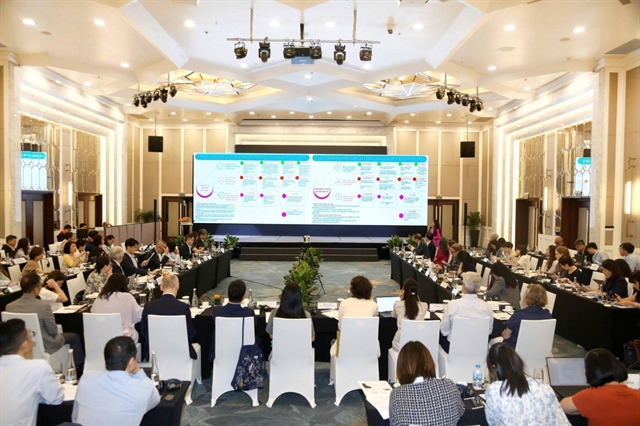
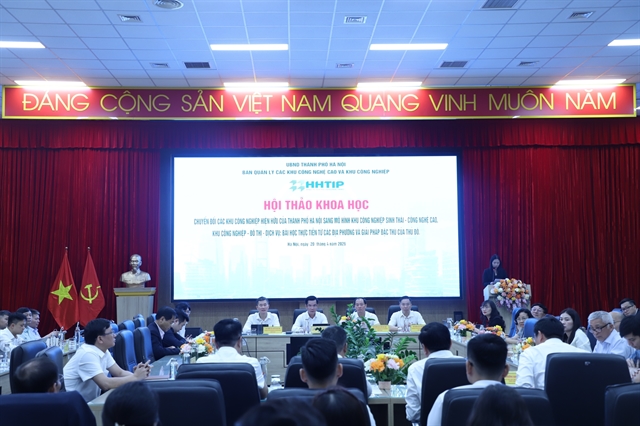
| A view of the workshop. —Photo thoibaotaichinhvietnam.vn |
HÀ NỘI — Việt Nam's total amount of official development assistance (ODA) capital and foreign preferential loans in the 2026-2030 period is expected to reach approximately US$38.2 billion, enabling the country to meet its socio-economic development targets, financial officials said.
A workshop to disseminate amended Decree 119/2026/NĐ-CP dated April 3 on ODA capital and foreign preferential loans and Decision 441/QĐ-TTg dated March 16 on attracting and managing the funds in the next five years was held by the Ministry of Finance (MoF) in Hà Nội on Monday.
Nguyễn Quốc Phương, director of the MoF’s Department of Debt Management and External Economic Relations, said at the workshop that the new regulations will be implemented effectively, helping to ensure public debt safety and promoting rapid and sustainable socio-economic development.
According to Phương, the issuance of Decree 119 is a concrete step towards institutionalising the Party's policy on boosting the effectiveness of public debt management to address major practical bottlenecks. These include lengthy and overlapping procedures for negotiating and signing international treaties; delays in appraising and approving loan proposals; and limitations on the autonomy and accountability of localities.
The revised decree aims to shorten processing times by clearly defining responsibilities and strengthening decentralisation according to capacity, while ensuring consistency with related legal systems, including the Law on Public Debt Management, the Law on International Treaties and the Law on State Budget that took effect early this year.
As for Decision 441/QĐ-TTg, Phương noted that 2026-2030 is a crucial period for implementing the socio-economic development strategy, aiming for rapid and sustainable double-digit GDP growth, restructuring the economy and enhancing resilience.
The need to raise ODA and concessional loans in the next five years will thus remain high, especially in strategic infrastructure, digital transformation, innovation, climate change adaptation, green growth, workforce development and social security.
Based on the achievements of the last five-year period and forecasts of future needs, the estimated $38.2 billion in total ODA and foreign preferential loans will go a long way towards these goals. However, effective disbursement will present many challenges, requiring close coordination among ministries, sectors and localities.
According to the decision, fundraising and management of resources in the next five years must meet the investment and development needs of the nation as well as for each sector and locality.
Priority will be given to key projects with spill over effects, especially in socio-economic infrastructure, environmental protection, climate change adaptation, science and technology, innovation, green transformation and digital transformation.
The use of foreign loans will be based on careful assessment of loan conditions, effectiveness, solvency and public debt safety.
Foreign preferential loans are identified as a crucial supplementary capital source, after maximising the mobilisation of domestic resources and more favourable sources of funding.
To ensure effective implementation, the decision identifies five key tasks and solutions: perfecting institutions and policies; strengthening cooperation with development partners; improving the quality of project preparation and implementation; innovating financial mechanisms and risk management; and maximising non-financial value, such as technology transfer, knowledge sharing and capacity building.
Phương confirmed that the MoF will promptly issue guiding documents, establish regular channels to receive and address difficulties and continue to review and streamline policies according to international practices and reform orientations. — BIZHUB/VNS
Economy
 Economy
 Economy
 Economy
 Economy
 Economy
 Economy
 Economy
 Economy
 Economy
 Economy
 Economy
 Economy
 Economy
 Economy