 Economy


LANDMARK Launches ‘Destination CENTRAL’: A District-Wide Invitation to Explore the Dynamism, Luxury, and Soul of Central
1.
|
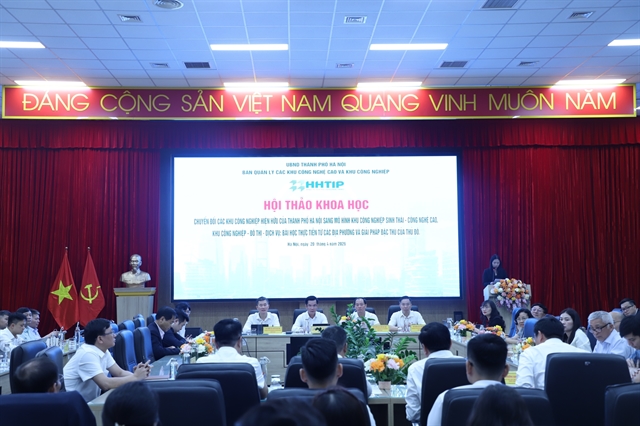
| The Hanoi High-Tech and Industrial Parks held a scientific workshop titled “Transforming existing industrial parks in Hà Nội into eco, high-tech, urban and service models” on Monday. — Photo tapchikinhtetaichinh.vn |
HÀ NỘI — Hà Nội is accelerating plans to transform its existing industrial parks into eco, high-tech and urban–service models, as city officials and experts highlight the urgent need to upgrade quality, strengthen value chains and align with global sustainability standards.
The Hanoi High-Tech and Industrial Parks held a scientific workshop titled 'Transforming existing industrial parks in Hà Nội into eco, high-tech, urban and service models' on Monday.
In his opening remarks, Lê Thanh Sơn, deputy head of the management board of Hanoi High-Tech and Industrial Parks, stated that the board directly manages two high-tech parks, one IT park, and 24 industrial parks as of February this year.
There are currently 999 valid projects, 115 in Hòa Lạc High-Tech Park and 884 in other industrial parks.
The total number of experts and workers in these zones is approximately 200,000, including about 1,350 foreign workers. Alongside notable achievements, Sơn also highlighted existing limitations and proposed several discussion directions for the workshop.
Addressing the current situation, Trần Anh Tuấn, deputy head of the board, noted that only about 20–25 per cent of enterprises are genuinely high-tech, while most remain focused on processing and assembly.
In addition, supply chain linkages were weak, domestic value-added remained low, supporting industries were underdeveloped, and Vietnamese enterprises had limited participation in global value chains, he noted.
To address the growing tensions between industrial development and urbanisation, Hà Nội is formulating a comprehensive plan to transform existing industrial parks while simultaneously developing 14 new ones under four key models.
The high-tech industrial park group will focus on zones such as Thăng Long Industrial Park and Nội Bài Industrial Park, which are currently fully FDI-funded, to tap the potential for transitioning toward eco-industrial models.
Eco-industrial parks, including Phú Nghĩa and Quang Minh, are set to adopt circular economy principles, emphasising resource efficiency, reuse, and stronger value-chain linkages among enterprises.
The industrial–urban–service park group will undergo functional conversion to help ease population pressure. Hà Nội–Đài Tư Industrial Park has been approved by the Government for transformation, while parks such as Sài Đồng B and Nam Thăng Long are on the roadmap to develop into urban service and innovation-oriented models.
Hà Nội is also developing evaluation criteria and financial mechanisms for green transformation, establishing legal frameworks for industrial–urban–service models, and prioritising social infrastructure (housing, healthcare, education) within IPs.
Dr Nguyễn Trâm Anh, an expert from the Foreign Investment Agency (FIA), Ministry of Finance, said that Việt Nam was gradually shaping a new generation of industrial parks that are smarter, greener and more human-centred, drawing on successful models such as Hiệp Phước in Hồ Chí Minh City and Nam Cầu Kiền in Hải Phòng.
However, challenges remain, including legal and technical gaps, complex environmental licensing for industrial symbiosis, and a lack of standards for smart infrastructure and carbon-neutral industrial parks. The '15-minute distance' concept is also not yet fully integrated into planning.
Future industrial parks will go beyond 'eco' to become 'smart and innovation-driven', applying IoT and big data for real-time monitoring of energy, water, and emissions and integrating closely with educational and research institutions. — VNS
Economy
 Economy
 Economy
 Economy
 Economy
 Economy
 Economy
 Economy
 Economy
 Economy
 Economy
 Economy
 Economy
 Economy
 Economy