 Economy



LANDMARK Launches ‘Destination CENTRAL’: A District-Wide Invitation to Explore the Dynamism, Luxury, and Soul of Central
1.
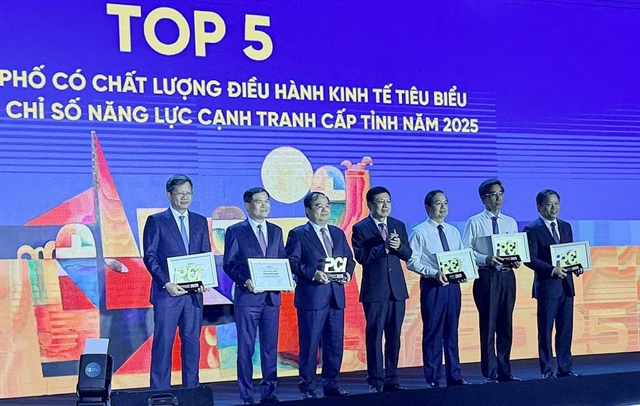 |
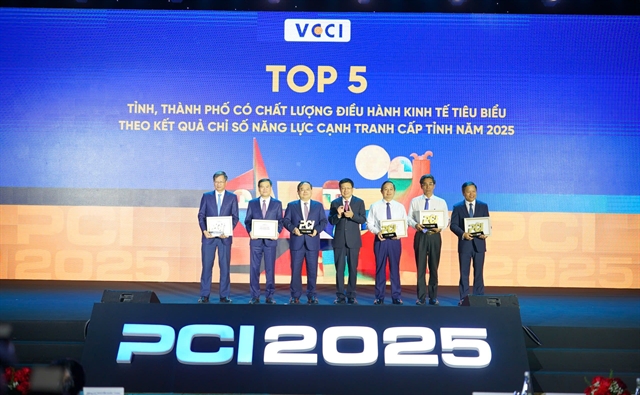
| Representatives of the top localities for economic governance quality nationwide. — VNS Photo |
HÀ NỘI — Phú Thọ Province has been ranked among the five localities with the best economic governance quality nationwide.
The result was announced in the Provincial Competitiveness Index 2025 (PCI 2025) released by the Vietnam Chamber of Commerce and Industry (VCCI) on Friday in Hà Nội.
The northern province was grouped alongside Bắc Ninh, Đà Nẵng, Hải Phòng and Quảng Ninh in the top tier of localities recognised for outstanding economic governance.
The result reflects positive progress in administrative reform, improvements in the investment and business environment, and the province’s support for enterprises in recent years.
In particular, Phú Thọ ranked second nationwide in access to resources and fifth in proactive governance, while also placing among the national leaders in business support policies and low informal costs.
The PCI 2025 announcement took place as Việt Nam is implementing major policies aimed at private sector development and administrative reform.
The event also marked one year since the Politburo issued Resolution No. 68-NQ/TW on private sector development, which seeks to make the private sector a key driver of the national economy.
VCCI noted that PCI 2025 marked an important transition with the first implementation of the PCI 2.0 framework and the introduction of the Business Performance Index (BPI).
PCI 2.0 was redesigned with nine component indices and 98 evaluation criteria, including market entry, access to resources, transparency, administrative compliance costs, informal charges, fair competition, business support policies, legal institutions, and proactive governance.
VCCI’s assessment showed that the five leading localities all demonstrated balanced governance structures, with at least five of the nine component indices ranking among the country’s top 10.
Phú Thọ stood out for its ability to unlock resources for businesses and maintain a proactive administration that closely accompanies the business community.
Speaking at the event, Phan Trọng Tấn, vice chairman of the People’s Committee of Phú Thọ Province, said the PCI 2025 results were an important recognition of the province’s efforts to improve the investment and business environment, particularly as Phú Thọ had recently completed administrative restructuring and implemented a two-tier local government model.
According to Tấn, being among the country’s top five localities was not the final goal but rather motivation for the province to continue innovating its governance model, placing businesses and citizens at the centre of public service delivery.
The province is currently implementing an investment environment improvement project for the 2026–30 period under the principle of “clear responsibilities, clear tasks, clear accountability and clear timelines,” while also linking the responsibility of local leaders to PCI targets.
Phú Thọ has also identified administrative reform as a key priority. The province plans to further expand its “24-hour green channel” mechanism, aiming to cut processing times by at least 50 per cent for many procedures directly related to investment, land, construction, taxation and business registration.
In addition, the province is focusing on resolving obstacles related to land access, site clearance, planning and industrial park infrastructure in order to create greater room for investment attraction in the coming period. Business dialogue activities will continue to be maintained regularly through “business coffee” meetings, hotlines for feedback, and task forces supporting enterprises through proactive early engagement.
According to provincial leaders, digital transformation is also one of the key solutions for improving governance quality and reducing costs for businesses.
The province will accelerate digitalisation of records, online payments and data connectivity among management agencies in order to minimise informal costs and create a more transparent and business-friendly investment environment. — VNS
Economy
 Economy
 Economy
 Economy
 Economy
 Economy
 Economy
 Economy
 Economy
 Economy
 Economy
 Economy
 Economy
 Economy
 Economy