 Economy



LANDMARK Launches ‘Destination CENTRAL’: A District-Wide Invitation to Explore the Dynamism, Luxury, and Soul of Central
1.
HÀ NỘI — Raising the tax-free revenue threshold for household businesses to VNĐ1 billion (US$38,000) dominated discussions at the legislature on Thursday, with lawmakers broadly backing the proposal as a timely measure to support small traders amid economic headwinds.
During debate at the National Assembly of Việt Nam on draft amendments to several major tax laws, deputies said doubling the current threshold from VNĐ500 million would help ease pressure on business households facing rising input costs and weakening demand.
Many described the move as a supportive policy that could reduce immediate tax burdens while encouraging informal businesses to expand and gradually formalise.
Minister of Finance Ngô Văn Tuấn said the proposed threshold was “appropriate under current conditions”, estimating it could reduce budget revenue by about VNĐ7 trillion ($269 million) but provide meaningful support to small businesses.
He added that tax policy should be designed to ensure neutrality and efficiency, while minimising both tax administration costs and compliance costs for taxpayers.
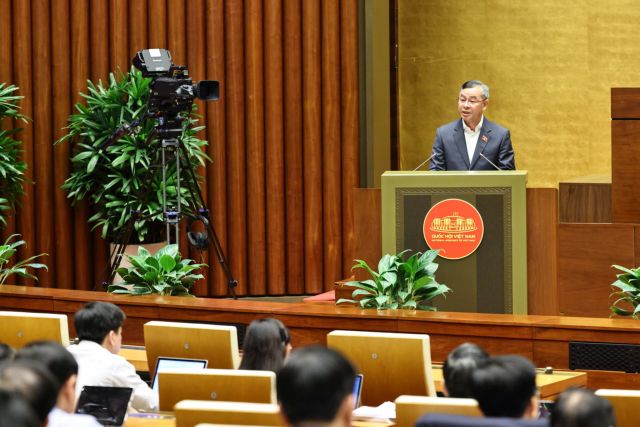 |
| Minister of Finance Ngô Văn Tuấn addresses and clarifies issues raised by deputies. — VNA/VNS Photo Minh Đức |
Despite broad support, lawmakers warned of potential loopholes.
Nguyễn Thị Việt Nga, a deputy from Hải Phòng, said businesses might split operations or revenue streams to stay below the threshold, calling for anti-avoidance rules and regular monitoring to prevent abuse and revenue losses.
Other deputies stressed the need to maintain fairness. A tax-free threshold set too low could burden small enterprises, while one set too high might distort competition with formally registered enterprises.
Deputy Trịnh Thị Tú Anh from Lâm Đồng Province said the law should clearly define principles and limits for setting the threshold, rather than granting full discretion to the Government. She argued that tax should apply only when income exceeds the social average after costs, warning that taxing very small businesses could be counterproductive due to high compliance costs.
She also proposed setting a clear review cycle for adjusting the threshold, for example every two years or when key economic indicators move beyond defined limits, to prevent the policy from becoming outdated as conditions change.
Nguyễn Duy Thanh, a deputy from Cà Mau Province, also supported assigning the Government to set the threshold, saying this would allow more flexible policymaking given wide differences in business scale. However, he proposed considering a higher threshold of up to VNĐ3 billion and warned that full delegation without a clear legal framework could create uncertainty for taxpayers.
He suggested either setting a fixed range in the law or linking the threshold to indicators such as per capita income or inflation to ensure transparency and predictability.
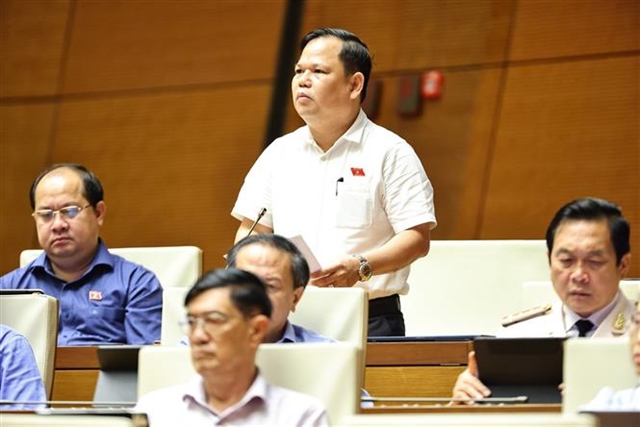 |
| Nguyễn Duy Thanh, a deputy from Cà Mau Province, speaks at the session. — VNA/VNS Photo |
Providing an overview of lawmakers’ views, National Assembly Vice Chairwoman Nguyễn Thị Hồng said there was general consensus on allowing the Government to set tax-free revenue thresholds in line with socio-economic conditions, especially amid ongoing economic challenges.
She said the approach would create a legal basis for the Government to act proactively and flexibly in adjusting tax policies to support growth while maintaining macro-economic stability. At the same time, some deputies called for further review to ensure the policy balances flexibility with stability for taxpayers and consistency within the legal system.
Hồng noted that many deputies emphasised the need for careful impact assessment to ensure the threshold aligns with real conditions and supports the development of household businesses and small- and medium-sized enterprises. She added that the threshold should also be considered alongside personal income tax deductions for salaried workers to ensure fairness across taxpayer groups.
Lawmakers also supported adding corporate income tax exemptions for small enterprises to promote the transition from household businesses to formal companies, while calling for safeguards to prevent policy abuse and ensure differentiation across sectors.
On other issues, deputies urged a cautious review of extending preferential excise tax rates for battery-powered passenger vehicles, alongside broader measures such as charging infrastructure and technical standards to support the shift to greener transport.
The National Assembly Standing Committee will consolidate feedback and work with the Government to refine the draft law before submission for approval. — VNS
Economy
 Economy
 Economy
 Economy
 Economy
 Economy
 Economy
 Economy
 Economy
 Economy
 Economy
 Economy
 Economy
 Economy
 Economy