 Economy



LANDMARK Launches ‘Destination CENTRAL’: A District-Wide Invitation to Explore the Dynamism, Luxury, and Soul of Central
1.
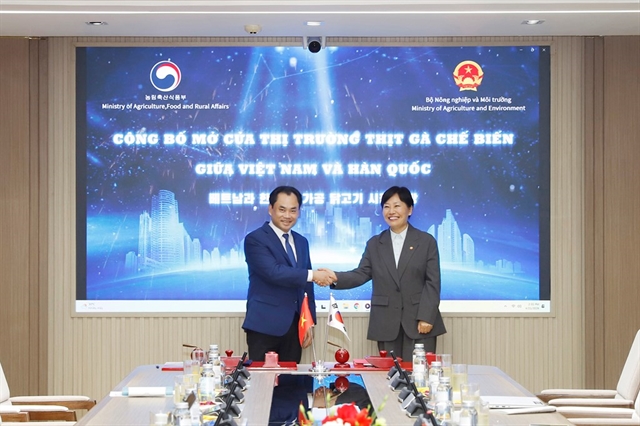 |
| Vietnamese Minister of Agriculture and Environment Trịnh Việt Hùng and RoK Minister of Agriculture, Food and Rural Affairs Song Miryung at the signing ceremony. — Photo Ministry of Agriculture and Environment |
HÀ NỘI — Việt Nam and the Republic of Korea (RoK) have agreed to open their markets to processed chicken products, marking a significant step forward in bilateral agricultural cooperation.
During the state visit of RoK’s President Lee Jae Myung and his spouse Kim Hae Kyung, Vietnamese Minister of Agriculture and Environment Trịnh Việt Hùng and RoK Minister of Agriculture, Food and Rural Affairs Song Miryung signed a Memorandum of Understanding on veterinary and animal quarantine cooperation.
The signing establishes a framework for tightening bilateral coordination in animal health and inspection, while officially allowing processed chicken to be traded between the two countries.
Initially, each country will permit two companies to export processed chicken, Hùng said.
He expected that more businesses would be eligible to participate in exports, helping to increase the value of the livestock and food processing industry.
The ministry will instruct relevant agencies to work closely with Korean counterparts on inspection, evaluation and product quality monitoring, Hùng said.
Song said the outcome reflected years of negotiations and effective cooperation between technical agencies from both sides.
The two countries plan to further technical exchanges to facilitate broader market access for other products, including Vietnamese pork and South Korean beef, she added.
Pawalit Ua-Amornwanit, director general of C.P. Vietnam Livestock Corporation, said the market opening demonstrated the production and processing capability of Vietnamese firms.
He expressed hope that the agricultural trade between the two countries would expand further to benefit both producers and consumers.
Poultry exports are expected to contribute to the goal of increasing bilateral trade volume to $150 billion by 2030, up from $94.5 billion in 2025. — VNS
Economy
 Economy
 Economy
 Economy
 Economy
 Economy
 Economy
 Economy
 Economy
 Economy
 Economy
 Economy
 Economy
 Economy
 Economy