 Economy



Việt Nam, China seek stronger substantive parliamentary cooperation
1.
Alexandra Smith*
Investment flows from the UK into Việt Nam are entering a new phase - defined not merely by steady commitments, but by structural expansion and capital deepening.
Over the past decade, UK investors have strengthened their footprint across Việt Nam’s financial services, logistics, manufacturing, and technology sectors. What distinguishes the current phase, however, is not only the number of newly licensed projects, but the scale of reinvestment and capital adjustments by existing firms - a sign of growing operational confidence.

|
| Alexandra Smith - Bristish Consul General in HCM City. — Photo Courtesy of Bristish Consul General |
An acceleration over the past decade
By the end of 2016, UK investors had accumulated 298 projects in Việt Nam with total registered capital of approximately US$3.75 billion. By the end of 2025, that figure had risen to 623 projects and nearly $4.70 billion in registered capital.
Between 2016 and 2025 alone, an additional 334 UK projects were licensed in Việt Nam, bringing in nearly $1.0 billion in newly registered capital and contributing to the creation of approximately 11,800 jobs.
Notably, more than 50 per cent of UK investment projects currently operating in Việt Nam were licensed within the past decade. This points to a sustained pipeline of new investment activity, rather than a legacy investment base. In 2024, the United Kingdom ranked 15th among foreign investors in Việt Nam; however, the UK’s investment impact is more clearly reflected in the depth of its capital, the scale of reinvestment, and its long-term commitment to the Vietnamese economy.
Taken together, these figures underscore that UK investment in Việt Nam is not merely a historical presence carried forward. Instead, a substantial share of the UK investment footprint has been established in recent years, reflecting renewed engagement, strategic recalibration, and a shift toward deeper, embedded capital.
2025 signals reinvestment momentum
Data from 2025 provides further insight into the evolving nature of UK capital in Việt Nam. During the year, 36 new projects were licensed with $37.5 million in newly registered capital. More significantly, capital adjustments by existing projects reached approximately $196.5 million.
The scale of capital adjustments - more than five times the value of newly registered capital - is particularly noteworthy. It suggests that established UK investors are scaling up operations, expanding facilities, and deepening market integration rather than simply maintaining their initial commitments.
In practical terms, this shift indicates a transition from market entry to operational expansion. Capital adjustment reflects reinvestment decisions made by firms already embedded in Việt Nam’s business ecosystem - often linked to increased production capacity, service expansion, or integration into regional and global supply chains.
Such reinvestment patterns are typically interpreted as a signal of medium- to long-term confidence in the host economy.
|
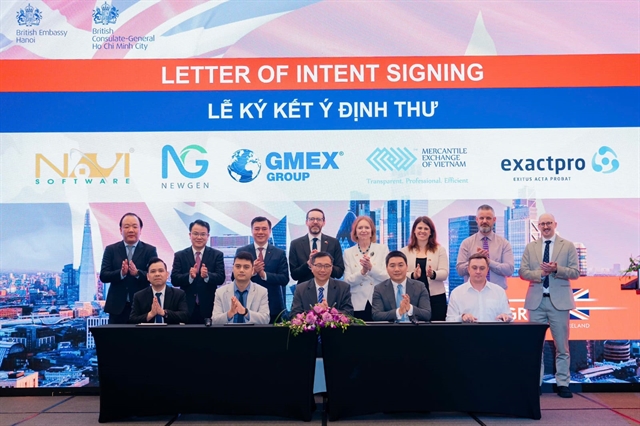
| The signing ceremony of signing of multiple Letters of Intent between UK firms and Vietnamese partners. Between 2016 and 2025 alone, an additional 334 UK projects were licensed in Việt Nam. — Photo Courtesy of British Embassy Hanoi |
Sector diversification and capital intensity
While financial services have long been a cornerstone of UK investment in Việt Nam, recent years have seen broader diversification across sectors aligned with Việt Nam’s economic transformation.
In recent years, sectors such as transportation and logistics, software and IT services, advanced manufacturing, and energy-related industries have attracted growing interest from UK firms. This diversification reflects Việt Nam’s evolving role within global value chains, as well as its increasingly prominent position as a regional production and logistics hub.
Importantly, the data suggest that average capital intensity per project has increased over time. Even where project counts remain moderate, the scale of capital deployed - particularly through adjustments - indicates that investors are committing larger sums per project compared to earlier phases.
This evolution points toward quality and scale rather than sheer numerical expansion.
From registered capital to embedded capital
Registered capital remains the standard metric used in official foreign direct investment statistics, serving as a measure of commitment at the time of licensing. However, capital adjustments and reinvestment provide a more nuanced indicator of operational confidence.
The 2025 figures - where adjusted capital significantly exceeded newly registered capital - illustrate a shift from initial entry toward embedded, expanding operations. In many emerging markets, reinvestment by existing investors is often regarded as a more reliable indicator of investment climate stability than new project announcements alone.
In this context, the UK's investment trajectory in Việt Nam appears to be transitioning from exploratory growth to consolidation and scaling.
Strategic context
The deepening investment relationship also unfolds against a backdrop of strengthened bilateral ties. Elevated political and economic c-ooperation frameworks have created additional momentum for business engagement, particularly in high-value and sustainability-linked sectors.
UK firms are increasingly active in areas such as digital services, green finance, infrastructure support, and technology-enabled logistics - sectors aligned with Việt Nam’s longer-term development priorities, including productivity enhancement and energy transition.
The cumulative data from 2016 to 2025 suggests that the UK – Việt Nam investment corridor is evolving in structural terms. Over 50 per cent of total UK projects in Việt Nam today have been licensed within the past decade, and recent capital adjustments demonstrate a willingness among investors to expand their operational footprint.
The UK – Việt Nam partnership is deeper than ever. British investors are increasingly choosing Việt Nam for its economic dynamism, skilled workforce, and the opportunities created by the UK – Việt Nam Free Trade Agreement (FTA) and the Comprehensive and Progressive Agreement for Trans-Pacific Partnership (CPTPP) membership.
Looking ahead
As Việt Nam continues to position itself as a key node in regional supply chains and as an innovation-driven economy, UK investors appear to be responding not only with new market entries but with sustained reinvestment.
The trajectory observed over the past decade - particularly the acceleration in project approvals and capital deployment since 2016 - indicates that UK investment is moving beyond initial commitments toward deeper economic integration.
Rather than episodic capital inflows, the emerging pattern suggests embedded participation in Việt Nam’s long-term growth story.
If reinvestment trends persist, the next phase of UK engagement in Việt Nam may be defined less by the number of projects announced and more by the scale, sophistication, and strategic depth of capital deployed on the ground.
(Data source: NSO, FIA (MOF) and fDI Markets)
*Alexandra Smith is Bristish Consul General in HCM City.
Economy
 Economy
 Economy
 Economy
 Economy
 Economy
 Economy
 Economy
 Economy
.JPG) Economy
Economy
.jfif) Economy
Economy
 Economy
 Economy
 Economy
 Economy