 Economy



Việt Nam fosters comprehensive cooperation with Uruguay
1.
|
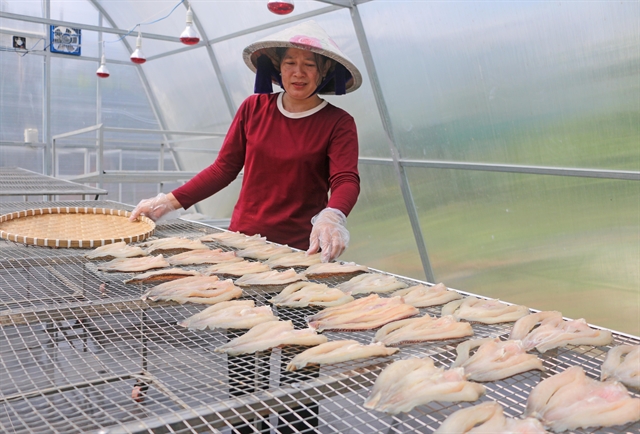
| Hồ Thị Xuân Mai, Ngọc Nhi Dried Snakehead Fish Company in Bình An 2 Hamlet, Bình Hòa Commune, An Giang Province, checks the quality of fish processed using a solar-powered drying system. VNA/VNS Photo |
AN GIANG — An Giang Province, which has hundreds of products rated three stars or higher, is stepping up efforts to bring its OCOP (One Commune, One Product) goods into the digital economy to enable them to reach wider markets beyond traditional distribution channels.
No longer confined to local markets, these products are increasingly sold via e-commerce platforms and social media, allowing producers to connect directly with consumers across the country.
Hồ Thị Xuân Mai, owner of Ngọc Nhi Dried Snakehead Fish Company, who used to only farm fish, began transforming her business during a price slump in 2013, when many farmers suffered heavy losses.
But instead of completely abandoning farming, she switched to making dried snakehead fish while maintaining staggered farming to ensure steady supply of raw materials.
She now has eight fish ponds covering more than 17,000 square metres, but the move into processing has helped stabilise her livelihood and reduce dependence on traders to buy her fish.
She expanded her business to online platforms such as Shopee and TikTok Shop, significantly widening its customer base.
She sells nearly one tonne of dried fish a month and provides jobs for dozens of people, each earning VNĐ3-5 million (US$120-200) a month.
Mai says adapting to digital platforms was initially challenging due to unfamiliar systems and operating methods, but continuous learning has helped the business gradually build an effective online presence.
On digital channels, it focuses on product transparency, allowing customers to follow the production process and ensuring compliance with food safety standards.
“Product quality remains the key factor. We have improved packaging, standardised production and diversified sales channels to reach more customers,” she says.
A shift towards digitalisation is also taking place among other OCOP owners in Bình Hòa Commune, where products such as herbal tea and noni juice are being promoted through livestreaming and online platforms.
Nguyễn Viết Thanh, vice chairman of the Bình Hòa Commune People’s Committee, says OCOP recognition has encouraged producers to adopt new approaches, including improving packaging and applying digital tools in marketing and sales.
According to provincial data, An Giang has 582 OCOP products rated three stars or higher, including 14 with five and 52 with four products, and as of March was reviewing a further 31 products for rating.
Lê Văn Phước, vice chairman of the province People’s Committee, says agriculture remains central to development and closely linked to economic restructuring, promotion of rural industries and expansion of eco-tourism.
He adds that digital transformation and the circular economy play an important role in supporting sustainable rural development while preserving natural resources and the environment.
The province aims to have at least 50 more OCOP products rated three stars or higher this year and 250 more by 2030, including five meeting five-star standards.
It also plans to ensure that all OCOP products are available through modern distribution channels and e-commerce platforms by 2030, with digital tools applied across production, management and trade promotion.
Phước says digital transformation is not only about sales channels but also about improving management and expanding market access for products.
Importantly, the OCOP programme is also expected to foster inclusive rural development, with a focus on women and ethnic minority participation, and the integration of traditional craft villages into tourism-linked value chains. —VNS
Economy
 Economy
 Economy
 Economy
 Economy
 Economy
 Economy
 Economy
 Economy
 Economy
 Economy
 Economy
 Economy
 Economy
 Economy