 Economy


Viên dives again to popularise swimming passion
1.
|
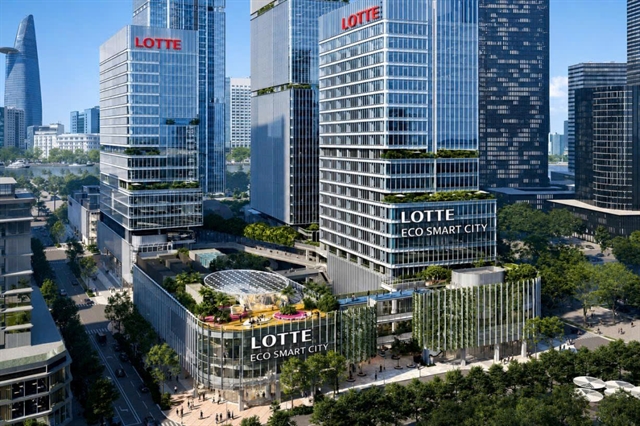
| Through landmark developments in Seoul and Hà Nội, the group has consistently pursued a development model that brings shopping, offices, accommodation, entertainment and services together within a single destination. — Photo courtesy of the firm |
HÀ NỘI — Starting as a consumer goods company, South Korea’s Lotte has evolved into one of the country’s largest diversified conglomerates, with businesses spanning retail, hospitality, construction and real estate.
Through landmark developments in Seoul and Hà Nội, the group has consistently pursued a development model that brings shopping, offices, accommodation, entertainment and services together within a single destination.
From consumer brand to diversified conglomerate
Lotte began in the consumer goods sector before steadily expanding into a wide range of industries. According to the group’s latest corporate profile, as of the end of 2025, Lotte had total assets of approximately KRW143.3 trillion (around US$95 billion) and operated 92 affiliated companies across multiple sectors.
Its business portfolio covers food and beverages, retail, chemicals, hospitality, tourism, construction, infrastructure, services and finance. As a result, the Lotte brand has become a familiar presence in daily life, from consumer products, supermarkets and shopping malls to hotels, entertainment facilities and large-scale urban developments.
What distinguishes the group is not merely the breadth of its operations but its ability to integrate businesses that might otherwise operate independently. A retail complex, for example, can be seamlessly connected with a hotel, office space, serviced apartments, dining venues and leisure facilities.
Rather than developing standalone projects, Lotte has focused on creating multifunctional destinations where different activities reinforce one another. This approach has become a defining feature of the group’s urban development strategy.
From Lotte World Tower to integrated urban complexes
Few projects illustrate Lotte’s ambitions more clearly than Lotte World Tower & Mall in Seoul. Rising 555 metres above the city with 123 floors, the tower is the tallest building in South Korea and forms the centrepiece of a vast mixed-use complex.
The development combines a luxury hotel, premium office space, retail facilities, restaurants, entertainment venues and the Seoul Sky observatory. Visitors can work, stay, shop, dine and enjoy leisure activities without leaving the complex.
Its significance therefore extends beyond its height. Rather than standing as an isolated landmark, the tower functions as the focal point of a destination that remains active throughout the day and into the evening.
In Việt Nam, a similar approach can be seen at Lotte Centre Hanoi. The 272-metre tower comprises 65 above-ground floors and five basement levels, with a total floor area of more than 253,000sq.m.
The development houses Grade A offices, serviced apartments, a hotel, retail space, a supermarket, restaurants and the Hanoi Sky observation deck. By bringing multiple functions together under one roof, the project serves a variety of needs, from business and accommodation to shopping and tourism.
The interaction between these different functions helps generate a steady flow of visitors and creates a vibrant environment that supports the long-term performance of the entire development.
Lotte Mall West Lake Hanoi represents the next stage of this strategy on an even larger scale. Covering more than 380,000sq.m, it is one of Lotte’s largest mixed-use developments in Việt Nam.
The project includes a shopping mall with more than 120,000sq.m of retail space, a five-star hotel, premium serviced apartments and Grade A offices. Rather than catering to a single purpose, the complex offers a broad range of experiences encompassing shopping, dining, entertainment, accommodation and business activities.
The integration of these functions broadens the customer base and helps sustain activity beyond office hours, attracting visitors in the evenings and at weekends as well as during the working day.
Although the projects in Seoul and Hà Nội differ in scale and context, they reflect a common philosophy: creating destinations where multiple uses coexist and complement one another rather than developing isolated facilities.
The strength of the Lotte ecosystem
In a single-purpose development, each user group is typically associated with one primary need. Residents live in residential buildings, office workers occupy office space, shoppers visit retail centres and hotel guests stay in accommodation facilities.
In a mixed-use project, however, these user groups generate demand for one another. Residents use retail and service facilities. Office workers provide a stable daytime customer base. Hotel guests contribute demand for dining, entertainment and premium services. Retail and leisure offerings, in turn, attract visitors from surrounding areas.
This interaction helps maintain activity throughout the week rather than relying on a single customer segment or usage pattern.
Lotte’s advantage lies in its experience across multiple parts of the value chain. In retail, the group operates brands such as Lotte Department Store and Lotte Mart. In hospitality, it manages Lotte Hotels & Resorts. In construction and real estate, it is backed by subsidiaries including Lotte E&C and Lotte Property & Development.
Not every business line is present in every project. However, the expertise accumulated across different sectors gives the group a strong foundation for delivering large-scale developments, where success depends not only on construction but also on managing visitor flows, integrating services and maintaining long-term operational performance.
As a result, Lotte’s stature is measured not only by the scale of its assets, the number of affiliates it operates or the height of its landmark buildings. Equally significant is its ability to connect diverse businesses and create urban destinations that remain vibrant, attractive and commercially sustainable over the long term. — VNS
Economy
 Economy
 Economy
 Economy
 Economy
 Economy
 Economy
 Economy
 Economy
 Economy
 Economy
 Economy
 Economy
 Economy
 Economy