 Economy


University of Economics HCM City hosts international student research conference
1.
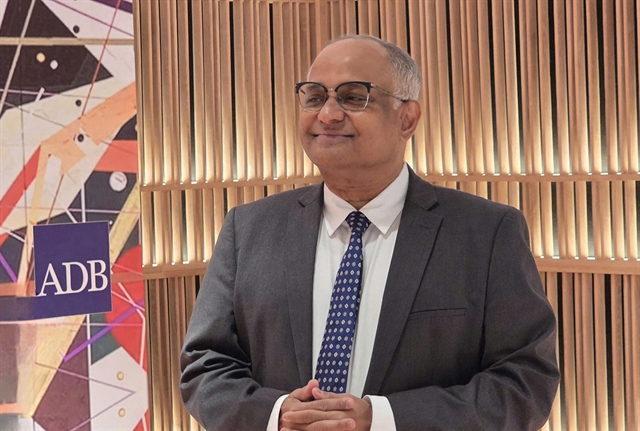 |
| Shantanu Chakraborty, country director at ADB Vietnam. —VNS Photo Ly Ly Cao |
HÀ NỘI — Việt Nam's economy is expected to remain one of Southeast Asia's strongest performers in 2026, but sustaining that momentum will require faster reforms to raise productivity, deepen capital markets and accelerate the transition to cleaner energy.
Speaking to reporters on the sidelines of a recent conference, Shantanu Chakraborty, country director at Asian Development Bank Vietnam, shared insights into Việt Nam's macroeconomic prospects and development in the short term.
How does ADB assess Việt Nam's macroeconomic outlook for 2026?
Under the early stabilisation scenario, we are projecting about 7.2 per cent growth for Việt Nam in 2026 and about 7 per cent for 2027.
These figures underpin the very strong economic fundamentals, the strong boost in public investment and also essentially the strong export-orientated action taken by the country last year.
However, maintaining such high growth will depend on whether the country can improve the quality of its growth rather than rely solely on low-cost manufacturing and external demand.
To sustain this high and resilient growth, the country needs to focus on raising productivity and efficiency of its production, strengthening the financial and capital markets to ensure access by investors to long-term capital and, most importantly, focusing on energy security and transitioning towards green and clean energy.
How does ADB view Việt Nam's role in global and regional supply chains?
Việt Nam is already deeply integrated into global value chains, particularly through its manufacturing sector. We have seen for decades how the country has built up its strong manufacturing base.
However, the level of domestic value addition remains limited.
The advantage that Việt Nam has provided in terms of low labour costs is not a long-term sustainable advantage. The country needs to increase its value-added contribution within supply chains.
Four key areas were identified to support Việt Nam's transition to higher value-added growth.
The first is improving the business environment to attract higher-quality investors and give businesses more confidence.
You need a much stronger business-enabling environment and a high degree of transparency in the ease of doing business so that quality investors can come.
The second is greater access to long-term financing. You need a stronger deepening of the capital markets, both equity and debt, and that also requires regulatory action.
The third is better infrastructure, especially as Việt Nam competes for investment in regional supply chains. Despite improvements through public investment and private participation, more remains to be done in transport, logistics and energy.
The final requirement is a more skilled workforce. The availability of skilled labour is very important as the country seeks to move up the value chain, especially as there is strong government focus on AI, fintech and green growth.
How is Việt Nam approaching energy transition and green growth? And what challenges are slowing the energy transition?
As a major consumer of fossil fuels, Việt Nam plays a very important role in Southeast Asia and has been taking the right steps to transition towards a sustainable and green growth model.
Green growth is a central pillar of ADB's engagement with Việt Nam, alongside the country's commitment to net-zero emissions by 2050 and participation in regional energy initiatives.
We are seeing early signs of success in terms of the number of projects that are becoming financeable.
Nevertheless, policy uncertainty, infrastructure bottlenecks and limited financing remain the three biggest barriers.
For example, renewable energy in the southern part of Việt Nam requires robust transmission and distribution networks to move electricity to the country's main demand centres in the north.
Investment in renewable energy has also slowed after an earlier boom under the country's previous power development plan.
We saw a flurry of investments in the clean energy generation space, but that again seems to have slowed slightly and we need to rejuvenate investment in the clean energy sector.
To accelerate progress while keeping electricity affordable, we need stronger planning and a more predictable regulatory environment. We need greater mobilisation of private investment.
Energy diversification will be essential. There should be more focus on offshore wind and battery energy storage systems.
How can Việt Nam mobilise more private investment for infrastructure and climate projects?
Improving project preparation and reducing delays will be essential.
We have seen on both the public and private sector sides that while there are many projects being announced and many moving forward, when it comes to ensuring bankability and best-in-class practices in terms of risk-sharing and structuring, there are shortcomings on both sides.
So I would say that, to attract more capital, the focus should be on expediting project preparation.
What reforms are most urgent to improve productivity and growth quality?
Recent policy changes have already made progress in improving the business environment and governance.
We had Resolution 68, which put the private sector at the centre of the country's growth, along with reforms to streamline official development assistance procedures.
Ongoing administrative restructuring and decentralisation are seen as factors affecting decision-making and project implementation.
There is also a need to strengthen human capital and expand public-private partnerships (PPP).
PPP is another area where there is significant scope for further work, particularly in infrastructure sectors such as transport and energy.
Moreover, additional capacity is needed to train people in areas such as AI, science and technology, biotech and fintech.
The setting up of an international financial centre (IFC) is a very positive step in that direction because it helps create an ecosystem that can attract long-term private capital. — BIZHUB/VNS
Economy
 Economy
 Economy
 Economy
 Economy
 Economy
 Economy
 Economy
 Economy
 Economy
 Economy
 Economy
 Economy
 Economy
 Economy