 Economy


HCM City seeks stronger port connectivity, green transition
1.
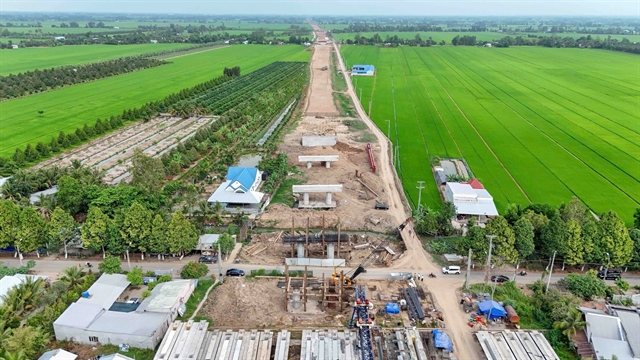 |
| Construction of an overpass on the Châu Đốc–Cần Thơ–Sóc Trăng Expressway, which is expected to be completed later this year. — VNA/VNS Photo |
CẦN THƠ — The Mekong Delta property market is shifting from speculation to long-term, value-driven investment, with Cần Thơ at the centre of the transition.
This year is seen as a turning point for Cần Thơ as major transport projects move from planning into construction and completion.
The shift is expected to act as a key catalyst, pushing the city’s property market out of a prolonged lull and into a phase of real value creation.
Cần Thơ is no longer just a standalone connector within the Mekong Delta.
By 2026 the city is set to become a strategic intersection of both North–South and East–West expressway corridors.
The Châu Đốc–Cần Thơ–Sóc Trăng Expressway, expected to achieve technical completion by the end of 2026, will form a vital east–west axis linking international border gates in An Giang Province with the city’s Trần Đề Port.
Prime Minister Phạm Minh Chính instructed that the Cần Thơ–Cà Mau Expressway be completed soon to ensure full connectivity of the national North–South expressway from Cao Bằng to Cà Mau.
This will position Cần Thơ as the largest logistics hub in the delta.
Further reinforcing this role, the Cần Thơ Bridge 2 is expected to begin construction this year, helping ease pressure on the existing bridge while creating future connectivity with the planned HCM City–Cần Thơ railway line.
Emerging hotspots
These infrastructure developments are driving the emergence of new real estate hotspots.
Investment flows are increasingly concentrating in strategic areas, particularly in southern Cần Thơ.
The Cái Răng urban area stands out as a prime example, benefiting directly from expressway interchanges and the future bridge.
The area is witnessing the formation of integrated urban developments, supported by rising demand from professionals, workers and population inflows from neighbouring provinces following last year’s provincial restructuring.
The Bình Thủy-Trà Nóc corridor is aligned with the development of aviation logistics and high-tech industry.
The ongoing upgrades to the Cần Thơ International Airport and existing industrial zones are creating strong demand for rental properties, warehouses and industrial support services.
Recent developments have further strengthened investor confidence.
At a working session on March 20, the chairman of the city People’s Committee, Trương Cảnh Tuyên, revealed plans for two major resorts.
The Mekong city, covering approximately 2,945 hectares, is scheduled to begin construction in June 2026 after completing planning approval and investor selection.
Then, in September, construction is expected to begin on the Lung Ngọc Hoàng resort with the participation of Sun Group and other enterprises.
Designed as a smart and sustainable urban area adaptable to climate change, this project is considered the largest of its kind in the Mekong Delta, with the potential to elevate the region’s tourism profile and attract significant investment.
Market shift
Market sentiment is also shifting.
At a major real estate event held at Sheraton Cần Thơ Hotel on March 22, investors and buyers showed a clear preference for legal transparency and intrinsic value over short-term profit expectations.
According to Dương Quốc Thủy, vice chairman of the Việt Nam Real Estate Association, Cần Thơ has never had such favourable investment conditions.
The city’s recent administrative merger with Hậu Giang and Sóc Trăng provinces has strengthened its role as an irreplaceable economic, educational and technological hub of the region.
Over the past two years strong government investment has accelerated infrastructure development, while improved policies have enhanced the business environment.
Since 2024 revised laws have reshaped the sector.
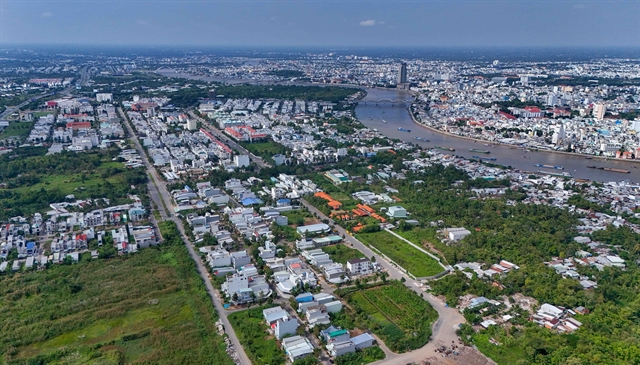 |
| An aerial view of Cái Răng Ward in Cần Thơ City.— VNA/VNS Photo |
By 2026 the introduction of new land price frameworks aligned with market values and mandatory property identification systems has further reinforced transparency.
These changes are marking the beginning of a new cycle in which real estate is driven by actual value rather than speculative trading.
In terms of investment outlook, Đỗ Công Nguyên, general secretary of the Cần Thơ Real Estate Association, projected potential price growth of 5–15 per cent depending on liquidity improvements and global geopolitical stability.
The market would favour projects with clear legal status, well-developed infrastructure and strong liquidity, he said.
Concerns over capital costs remain, particularly as interest rates have fluctuated.
But financial expert Huỳnh Hoàng Nghĩa noted that rates have begun to ease following early-year pressures.
The ongoing digital transformation in banking is also reducing transaction costs and improving system safety, prompting some banks to extend loan tenures and offer more favourable terms.
This creates opportunities for investors to access high-value assets without excessive financial strain, he pointed out.
Phạm Văn Luận, deputy chairman of the city Real Estate Association, highlighted the impact of public investment strategies.
As transport infrastructure becomes increasingly integrated, administrative boundaries are losing significance, allowing suburban areas to rise alongside urban centres, according to Luận.
The planned Cần Thơ Bridge 2, with both a road and high-speed rail, and comprehensive upgrades to Trần Đề Port at a cost of US$12 billion, will be a strong foundation for broader regional development.
Looking ahead, experts say property prices in the delta will remain steady or increase by a modest 5-8 per cent in 2026 and 2027.
Locations near expressway interchanges and transit-oriented urban developments are likely to emerge as the most promising investment destinations. — VNS
Economy
 Economy
 Economy
 Economy
 Economy
 Economy
 Economy
 Economy
 Economy
 Economy
 Economy
 Economy
 Economy
 Economy
 Economy