 Economy



Việt Nam, China seek stronger substantive parliamentary cooperation
1.
|
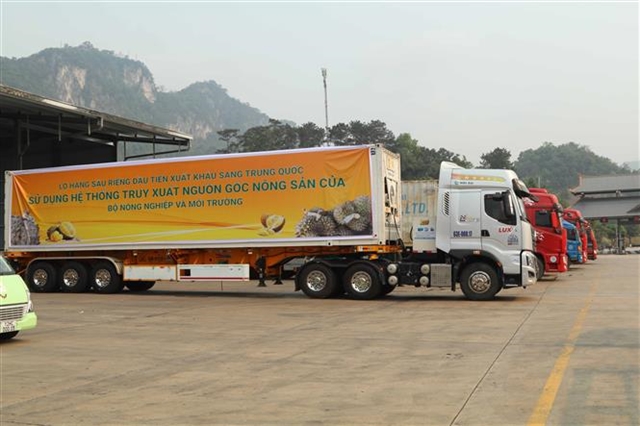
| Containers of fresh Vietnamese durian for export are subject to a full-chain traceability system. — VNA/VNS Photo |
LẠNG SƠN — The first batch of fresh durians exported under a newly applied “green lane” process was cleared for shipment to China via the Hữu Nghị International Border Gate in the northern province of Lạng Sơn on April 10.
The consignment, comprising two containers of around 14,000 durians, packed in 10kg and 18kg cartons, was sourced from growing areas in Bảo Lộc Ward, Lâm Đồng Province.
Jointly organised by the Ministry of Agriculture and Environment, in coordination with NETACOM and technology partners, the shipment marks the debut of a modern, transparent and fully digitalised agricultural management model that meets the most stringent international standards.
Under the “green lane” process, quality control begins at the cultivation stage, including soil sampling and monitoring and continues through harvesting and processing, with traceability labels attached to trees and applied to fruit at the time of picking. It also allows plant quarantine procedures and the issuance of certificates of origin (C/O) directly in the localities where the orchards are located.
This helps ensure the highest quality of fresh produce, significantly reduces customs clearance time at border gates, and minimises the risk of congestion.
According to Lieutenant Colonel Đỗ Phi Long, director of the Anti-Counterfeit Stamp and Materials Centre under the Ministry of Public Security’s Department of Security Industry, for this batch of durians, each fruit will be affixed with a QR-code-based electronic traceability label acting as a “digital ID”, provided by the centre.
Each label is encrypted, activated and authenticated in connection with specific data of the shipment, from the growing area with the application of traceability labels on each fruit during harvesting to packaging.
According to the Ministry of Agriculture and Environment, the harvesting process was conducted under strict supervision, with traceability labels attached directly to the fruit stems at orchards participating in the pilot programme.
Nguyễn Quang Tín, deputy head of the Ministry of Agriculture and Environment’s Department of Science and Technology, said traceability is not only a technical requirement of importing markets but also a commitment to the quality and credibility of Vietnamese agricultural exports.
The successful rollout of the model is expected to pave the way for broader application across other agro-forestry-aquaculture products, towards a more transparent, responsible and sustainable agricultural sector.
The shipment is scheduled to arrive at a logistics hub in Pingxiang City, China, on April 11, shortening the total time from harvest to border clearance to six days, compared to the usual 8–11 days under traditional procedures. — VNA/VNS
Economy
 Economy
 Economy
 Economy
 Economy
 Economy
 Economy
 Economy
 Economy
 Economy
 Economy
 Economy
 Economy
 Economy
 Economy