 Economy


Carlsberg Asia and Grab Make Beer Pairing Discovery Effortless with Brewmaster-curated Dining Experiences
1.
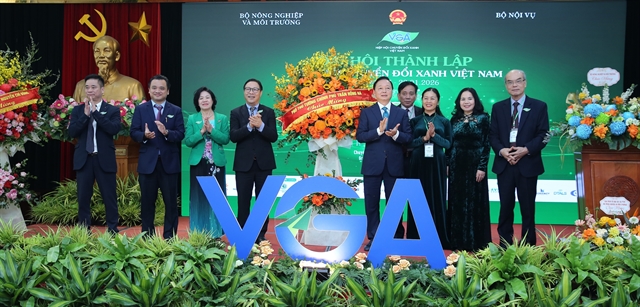 |
| Vietnam Green Transition Association is established to connect businesses, scientists and social organisations to share experience, technology and solutions for green transition. — VNA/VNS Photo Diệp Trương |
HÀ NỘI — The Vietnam Green Transition Association (VGA) has officially been launched, creating a new industry body to help businesses play a larger role in the country’s green transition and green economy as Việt Nam moves to turn sustainability commitments into action.
Speaking at the association’s first convention for the 2026–30 period in Hà Nội, Deputy Prime Minister Trần Hồng Hà said the world had travelled a long journey from awareness to action on environmental protection, evolving from early ideas of safeguarding nature to embedding green growth, sustainable development, the circular economy and low-carbon models into socio-economic planning.
In Việt Nam, the concepts of the green economy and circular economy were first highlighted at the 13th National Party Congress and have since been clearly reflected in resolutions of the 14th Congress, Deputy PM Hà stressed.
The establishment of VGA, he said, marked a shift from awareness to action on green transition at a time when the Government is reviewing policies related to sustainable development.
He noted that the most pressing challenge facing countries today was not only climate change, natural disasters or global uncertainties, but the choice of a development pathway.
“With rapid population growth and the depletion of traditional natural resources, traditional growth models are no longer viable,” he said, adding that carbon-related technical barriers are becoming increasingly evident, with sectors such as aviation and maritime transport expected to face carbon taxes in the coming period.
Continued reliance on fossil fuels would therefore seriously undermine competitiveness, he said.
Meanwhile, the global green economy has reached a scale of more than US$5 trillion and is expanding rapidly each year. This is an irreversible trend, he said, emphasising that green and digital transitions offer a pathway for countries like Việt Nam to greater self-reliance and autonomy.
The Deputy PM said green transition should not be confined to the energy sector but extended to transport, agriculture, tourism and other industries to achieve sustainable development across the economy.
“VGA should serve not only as a meeting point but also as a hub for pooling intellect and resources, connecting Việt Nam with the international community and turning challenges into opportunities,” he said.
Highlighting two major issues confronting Việt Nam’s green transition, policy and regulatory bottlenecks and technology, he urged VGA to work closely with ministries, sectors and businesses to review and propose solutions to remove policy obstacles. He noted that once regulations are clarified, issues related to finance, technology and investment efficiency would be unlocked.
He expressed hope that VGA would quickly develop a practical action programme and effective working mechanisms closely linked to concrete projects.
In response, VGA said the association was established to connect businesses, scientists and social organisations to share experience, technology and solutions for green transition while promoting responsible production and business aligned with environmental protection and sustainable socio-economic development.
The association will focus on applying digital technology solutions to optimise green transition processes, developing and scaling up circular economy and emissions-reduction models in businesses and communities and supporting enterprises in improving productivity, quality and competitiveness to integrate more deeply into global value chains.
Specifically, VGA aims to attract at least 2,000 members and establish chapters in 34 provinces and cities, provide direct support to 2,000 enterprises and cooperatives in ESG reporting, emissions inventories and access to green markets, provide training to 10,000 corporate staff in ESG, net-zero and circular economy standards and roll out 1,000 community-based green models tailored to local conditions. — VNS
Economy
 Economy
 Economy
 Economy
 Economy
 Economy
 Economy
 Economy
 Economy
 Economy
 Economy
 Economy
 Economy
 Economy
 Economy