Economy



Việt Nam, Belgium seek to deepen bilateral cooperation
1.
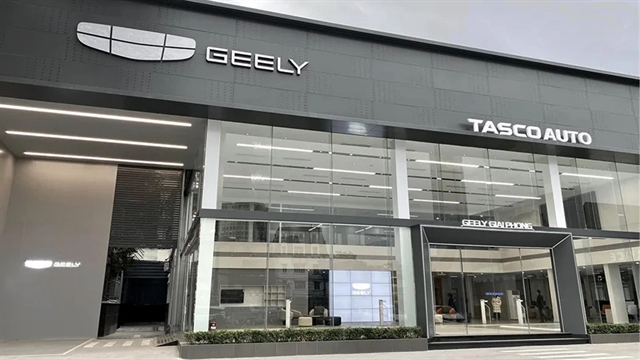 |
| Geely Giải Phóng dealer in Hà Nội. Geely is one of Chinese car brands in Việt Nam. —Photo vov.vn |
HÀ NỘI — Việt Nam’s imports of Chinese automobiles have surged in the year-end months, while traditional suppliers such as Indonesia and Thailand are recording slower growth.
Data from the General Department of Customs show that in November, Việt Nam imported around 18,350 completely built-up (CBU) vehicles worth more than US$455 million. This marked a 12.3 per cent increase in volume compared with October and represented the highest monthly total since August.
Analysts say the rise indicates that enterprises have proactively stepped up imports to build inventory for the year-end consumption peak and the Lunar New Year holiday.
Over the first 11 months of 2025, Việt Nam imported more than 190,000 CBU vehicles, with total import turnover approaching $4.3 billion, up almost 20 per cent in volume year on year. Passenger cars with fewer than nine seats remain the dominant segment, with about 143,000 units accounting for nearly 75 per cent of total CBU imports. This category reflects strong consumer demand for personal and family vehicles such as SUVs, MPVs, and compact multi-purpose cars.
By country of origin, Việt Nam’s CBU supply is concentrated in three Asian markets, Indonesia, Thailand and China, which together account for more than 90 per cent of imports nationwide.
Indonesia remains the largest supplier, with around 72,000 units shipped in the first 11 months, up roughly 11 per cent from the same period last year. Most are passenger cars with fewer than nine seats, particularly mass-market MPVs and SUVs, benefiting from production scale, competitive pricing, and ASEAN regional tax incentives.
Thailand ranks second, supplying about 62,000 vehicles, representing a modest 3 per cent year-on-year increase. Limited growth suggests Thailand’s role is stabilising, as competition from other markets intensifies.
The standout performer is China, which recorded the fastest growth this year. By the end of November, Việt Nam had imported about 44,000 CBU vehicles from China, up from roughly 28,000 units in the same period last year, equivalent to a growth rate of more than 50 per cent. The surge is not only in volume but also in value, reflecting an expansion in product diversity across segments, from mass-market passenger cars and SUVs to models with new technologies.
Imports from Japan, South Korea, and European countries remain small, mostly comprising specialised or high-value models that have limited impact on overall volumes.
Changes in locally-produced car market
For more than two decades, Việt Nam’s automobile market was dominated by Japanese and South Korean brands, a trend most evident in 2018, widely considered the peak of Japanese–Korean influence, reported Diễn đàn doanh nghiệp (Business Forum) magazine.
Consolidated data from the Việt Nam Automobile Manufacturers’ Association (VAMA) and Hyundai Thành Công show that total market sales reached 352,245 vehicles that year. Japanese brands accounted for over 40 per cent market share, while Hyundai and Kia held more than 26 per cent. Models such as the Toyota Vios, Innova, and Mazda3 dominated key segments, while Korean brands created a strong counterbalance with strategies focusing on rich features at competitive prices. Combined, these two countries’ brands controlled nearly 67 per cent of the market.
 |
| VinFast's Fadil cars set a sales record of more than 24,000 units in a single year during the 2019-21 period. — Photo thanhtra.com.vn |
However, this balance began to shift in 2019, when VinFast officially entered the market. In its first year, the Vietnamese automaker sold more than 17,000 vehicles, rising to nearly 30,000 units in 2020 and over 35,000 in 2021.
During this phase, VinFast competed head-on with gasoline-powered models in the mass and mid-range segments, with the Fadil leading the charge and once setting a sales record of more than 24,000 units in a single year.
If the early years demonstrated VinFast’s ability to join the market, its decision to fully transition to electric vehicles from 2022 set the company on an entirely new trajectory.
Rather than competing purely on products, the Vietnamese automaker positioned itself in a race focused on vision, ecosystem development and long-term user experience.
In 2023, VinFast sold more than 34,800 electric vehicles. In 2024, with the introduction of more affordable models such as the VF 5 and VF 3, sales surged nearly 200 per cent to around 97,000 units.
The growth momentum continued into 2025, with sales reaching approximately 147,000 units by November alone, equivalent to nearly 30 per cent of the entire market.
VinFast’s rapid rise has triggered a major shift in market share across the industry. Many Japanese and Korean models that once led the market now face increased competitive pressure, particularly in mass-market segments, where consumers are more sensitive to pricing and total cost of ownership.
In this context, traditional automakers have been forced to adapt. Aggressive incentive programmes, including support for registration fees, direct price cuts ranging from tens to hundreds of millions of đồng and bundled insurance or accessories, have been rolled out continuously. — VNS
Economy
 Economy
 Economy
 Economy
 Economy
.jpg) Economy
Economy
 Economy
 Economy
 Economy
 Economy
 Economy
 Economy
 Economy
 Economy
 Economy