 Economy


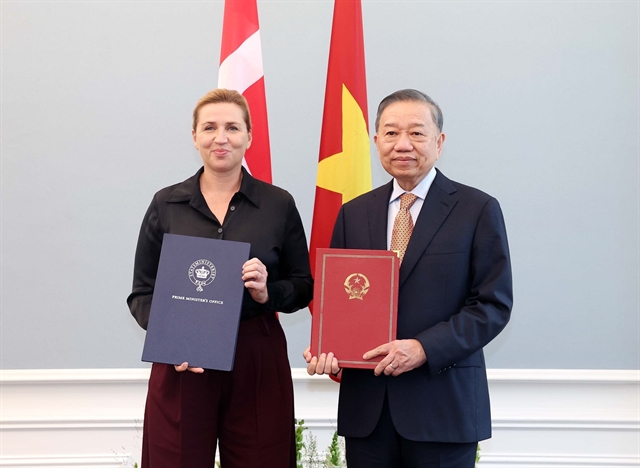
Việt Nam, Denmark elevate ties to Comprehensive Strategic Partnership
1.
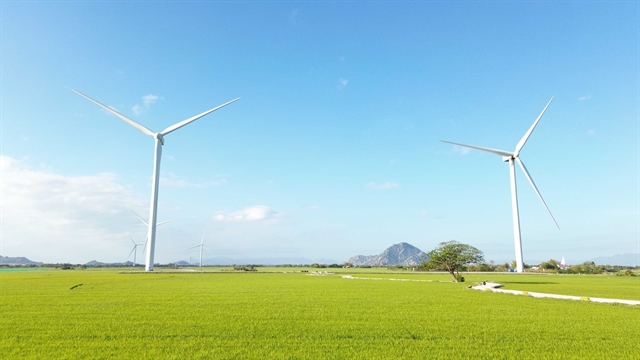 |
| A wind farm in Khánh Hòa Province. It is pressing for Việt Nam to revise its national energy master plan as the country targets double-digit economic growth in 2026-30. — VNA/VNS Photo Nguyễn Thành |
HÀ NỘI — Việt Nam must urgently revise its national energy master plan as the country targets double-digit economic growth in the 2026–30 period amid rising energy demand and pressure to pursue green growth, officials said at a workshop in Hà Nội on Thursday.
Deputy Minister of Industry and Trade Nguyễn Hoàng Long said the revision is more pressing than ever as the plan must respond to fast-increasing demand and adapt to major institutional and policy changes as well as global development trends.
Long said the revision must follow three key pillars.
The first is the Government’s target of at least 10 per cent economic growth in 2026–30 under Resolution 306/NQ-CP, which requires the energy system to maintain high reserve capacity and the ability to respond quickly to surging demand.
Secondly, administrative mergers require a reassessment of major energy projects to ensure their suitability for new development spaces.
Thirdly, the plan must ensure consistency with major directions of the Party and the Government, including conclusions on the oil and gas industry and resolutions on science and technology, digital transformation, international integration, legal development and private sector development.
He noted that Việt Nam’s energy sector is confronting five global trends: volatility in international energy markets, higher energy-security requirements, shifting technology costs, a rapid transition to cleaner energy sources and greater urgency around climate adaptation.
Nguyễn Ngọc Hưng, head of the Energy Economics Department under the ministry’s Institute of Energy, said global energy demand is forecast to continue rising while international markets remain unstable and unpredictable.
Rapid electrification requires Việt Nam to develop a resilient and sustainable power infrastructure strategy, Hưng said.
Scenarios under the revised plan must safeguard energy security while accelerating the transition to sustainable, low-carbon energy, he added.
Findings from the Institute of Energy and the Việt Nam Petroleum Institute showed Việt Nam’s primary energy supply reached 116 kilotonnes of oil equivalent (KTOE) in 2024, up 4.9 per cent in 2021–24.
Coal and renewables grew at average rates of 5.9 per cent and 7.8 per cent a year, respectively, signalling positive progress in energy transition, although the overall supply mix remains insufficiently diversified.
Primary energy remains heavily import-dependent. Imported fuel accounted for 41.9 per cent of primary energy in 2024, the highest level to date, a trend requiring close attention to long-term energy security.
Long said the first draft of the revised national energy master plan is expected to be released in the coming days.
He added that the revision, following enforcement of the amended Law on Planning and the approval of the revised Power Development Plan, is a strategic step for Việt Nam as it seeks to balance rapid economic expansion with sustainable development while aiming for double-digit growth in 2026–30 and net-zero emissions by 2050. — VNS
Economy
 Economy
.jpg) Economy
Economy
 Economy
 Economy
 Economy
 Economy
 Economy
 Economy
 Economy
Economy
Economy
 Economy
 Economy
 Economy
 Economy