 World
World
Top leader’s visit to open new chapter in Việt Nam–Denmark relations
1.
|
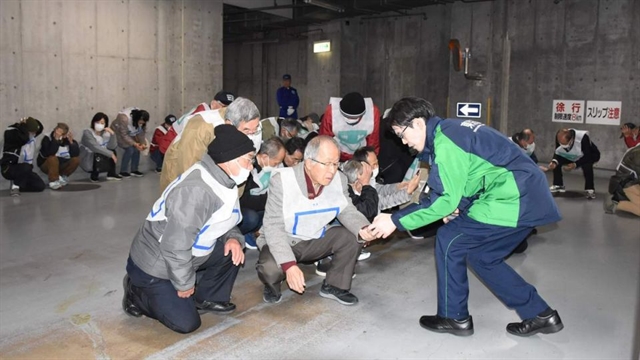
| Participants in a drill evacuate to an underground parking lot and crouch low in preparation for armed attacks on Feb 4 in Edogawa Ward, Tokyo. — Photo The Yomiuri Shimbun/ANN |
TOKYO — In a bid to protect the public from armed attacks by foreign countries, the government plans to make more use of underground facilities as temporary emergency shelters, according to a draft basic policy to be compiled by the government.
With North Korea’s nuclear and missile development and the intensifying Iran war in mind, the government is accelerating its efforts to establish a system to be ready for unforeseen contingencies. Underground facilities are believed to be safer than those above ground.
Measures to secure emergency shelters are conducted based on the Civil Protection Law. To protect people from the blast waves of missile attacks, the government is asking prefectures and other relevant authorities to designate robust buildings that can shelter people for a few hours as temporary emergency shelters.
As of April 2025, there were 61,142 shelters across the nation. Of this number, only 4,233, or seven per cent, were underground facilities. About 90 per cent of the designated shelters were public facilities such as schools and government office buildings. Securing private underground facilities is a challenge.
To address the situation, the draft includes a measure to use private underground facilities such as subway stations, underground shopping arcades and underground parking lots as emergency shelters. Specific measures to gain cooperation from the operators of these facilities include incentives such as relaxing floor area ratio restrictions for large-scale buildings and the creation of awards.
The percentage of the population covered by emergency shelters is traditionally calculated at the prefectural level. However, the draft changes this to the municipal level, which is the level of local government most familiar to residents, and sets a target of 100 per cent coverage for all municipalities.
Urban areas have a higher population during the day than at night because people go there for work or school. The population coverage rate based on the daytime population is said to be less than 50 per cent in some areas in Tokyo, such as Minato Ward, Shibuya Ward and Chiyoda Ward, prompting a call to use underground facilities as evacuation shelters.
The government is accelerating efforts to secure emergency shelters due to concerns over threats posed by China, which is rapidly expanding its military capabilities, and North Korea, which has repeatedly launched missiles. During the US- and Israel-led attacks on Iran that began on Feb 28, reports showed people across the Middle East rushing to shelters to escape missile strikes and retaliatory attacks.
In Japan, the government is working to enable residents to evacuate quickly in emergencies by sharing information via private disaster apps and raising awareness of emergency shelters. The government also will start research on shelters capable of withstanding nuclear attacks by referring to initiatives in Israel and other countries.
The government will approve the draft at a Cabinet meeting before the end of this month. — THE YOMIURI SHIMBUN/ANN
World
 World
World
 World
World
 World
World
 World
World
 World
World
 World
World
 World
World
 World
World
 World
World
 World
World
 World
World
 World
World
 World
World
 World
World