_med.jpg) Sports
Sports

Young people’s mental health: We need to listen – and act
1.
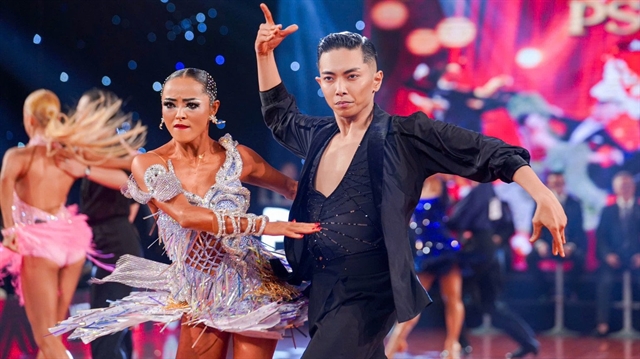 |
| Dancesport duo Phan Hiển and Thu Hương - a perfect match on the dance floor. — Photo langsontv.vn |
HÀ NỘI — Recent Vietnamese dancesport performances in Rome show national prowess for international glory. This has the local industry dancing like there's no tomorrow, with whirling energy to forge investment in long-term training and development.
Dancesport master Nguyễn Khánh Thi said the sport has athletes with the potential to go further, but sustained progress would depend on giving them the right conditions throughout their careers.
The Vietnamese team recently competed at the WDSF GrandSlam in Rome from October 2-4, an event featuring many of the world's leading dance couples.
Thi said the GrandSlam is one of the most competitive events in Dancesport. While the number of representatives from each country is limited at the World Championships, GrandSlam events can include several strong couples from the same country.
For athletes, rising through rounds and ranks for global standing points is key, with Vietnamese dancers hot to fox trot on this.
Progress on the international floor
Phan Hiển and Đặng Thu Hương recorded Việt Nam's best result in the Grand Slam, reaching the quarter-finals and finishing 25th among 101 couples.
The result was the pair's best at a Grand Slam. A year earlier, they finished in the top 48. Their improvement came after a period of regular training, competition and exposure to high-level international events.
Ngọc An and Lê Tố Uyên finished 52nd, moving closer to the top 48. For the young pair, the result provided further experience against a strong international field.
Nguyễn Hoàng Ngọc won silver at the WDSF World Championship Solo Female Under 21 Latin. She is the reigning Asian champion in the event and has also won a world bronze medal at adult level.
This event was also included in the World Championships for the first time, giving Ngọc’s silver medal particular significance. She later added another silver in the open adult category.
Thi said the results should not be viewed simply through individual rankings. Hiển and Hương's move into the Grand Slam top 25, An and Uyên's progress towards the leading group, and Ngọc’s Asian title and world U21 silver all show that Vietnamese athletes can close the gap when they have suitable training and competition opportunities.
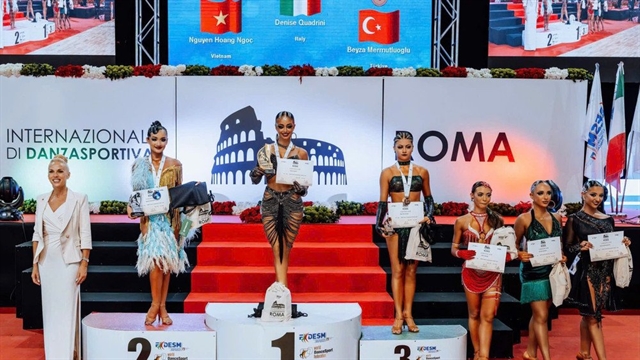 |
| Nguyễn Hoàng Ngọc (second left) wins the world silver medal in the U21 women’s solo latin category. — Photo langsontv.vn |
Building a longer-term pathway
The challenge now, according to Thi, is to turn such results into sustained progress and develop a stronger pool of athletes for the future.
“Vietnamese dancesport does not lack talent. The issue is creating an environment where athletes can develop continuously, from their early years of training to high-performance competition,” she said.
Dancesport requires years of preparation. Athletes need specialised training, camps and regular international competitions to gain experience and ranking points. The costs of costumes, travel, accommodation, entry fees and other professional requirements can also be substantial.
Thi said promising young athletes were emerging, but they needed a stable pathway to remain in high-performance sport over the long term and avoid interruptions caused by factors outside their training and competition.
This has also been behind her efforts in recent years to work with the World DanceSport Federation to bring international competitions to Vietnam. For one event, she personally paid the costs of organising the competition to create more opportunities for domestic athletes.
Hosting major events at home can give Vietnamese athletes the chance to face strong international opponents without the same travel burden. Coaches can observe international standards, while younger athletes can gain experience of high-level competition. Such events also help Việt Nam build experience in hosting international tournaments.
Việt Nam is scheduled to host the Dancesport World Championships this December. Thi hopes the event will allow Vietnamese athletes to compete against leading dancers on home soil, gain experience and find further motivation to improve. It will also provide an opportunity to promote Việt Nam to international visitors.
After years as an athlete, coach and competition organiser, Thi believes this high-performance sport requires a long-term approach. Results at a single competition cannot be the only measure of success. Even world champions can fail to win at an individual event.
What matters, she said, is identifying talent, providing appropriate training, giving athletes enough opportunities to compete and maintaining investment over a sufficiently long period.
The results in Rome show that Vietnamese athletes can dance with the best of them on the international stage. The task now is to build conditions for progress to continue and for individual achievements to develop into a stronger generation of Vietnamese athletes, one dance step at a time. VNS
Sports
 Sports
 Sports
 Sports
 Sports
 Sports
 Sports
 Sports
 Sports
 Sports
 Sports
 Sports
 Sports
.jpg) Sports
Sports
 Sports