 Society
Vietnamese scientist wins ASEAN-US Science Prize for Women
1.
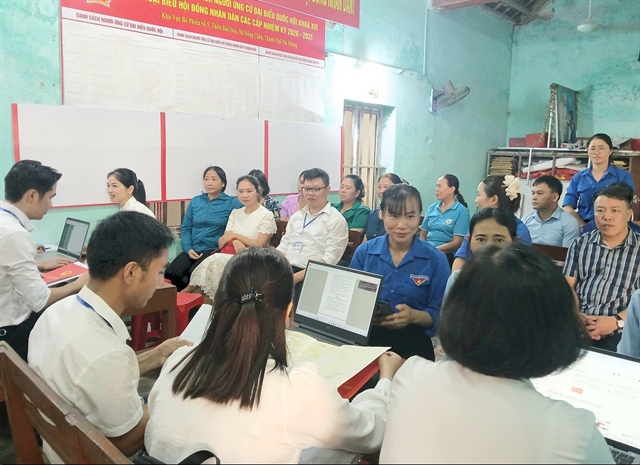 |
| Civil servants at the Hồng Châu Commune Public Administrative Service Centre help residents with administrative procedures. — Photo haiphong.gov.vn |
HÀ NỘI — Respecting local residents, developing an intimate understanding of the communities they serve and recognising both the strengths and weaknesses of their officials have been key to the successful implementation of Việt Nam's two-tier local government model over the past year.
In the northern port city of Hải Phòng, one year after the nationwide rollout of the new system, residents of Hồng Châu Commune often see the Party Secretary and the Chairman of the People's Committee arriving at the office together at 6am each day.
The commune's two top heads lead by example, inspiring a new generation of young officials through their work ethic and willingness to innovate.
"The team of officials in the commune is now operating smoothly and professionally," said secretary of the commune’s Party Committee Hà Cảnh Dương.
Challenges remain, but the pressure is no longer overwhelming, he said, adding that any difficulty can be overcome if they remain united and committed to their common goal.
For Dương, unity begins with leaders sharing the same vision and working in close partnership with everyone.
Dương and chairman of the local People's Committee Phạm Quang Hùng sit down every morning at 6am to review the previous day's work and agree on a plan for the day ahead, before presenting it to the wider leadership team for discussion.
When the pair were appointed to lead a predominantly agricultural commune, rich in traditional culture and long-established rural customs, Dương and Hùng agreed on a phased development strategy, covering everything from personnel management and infrastructure development to policies tailored to the commune's distinctive characteristics.
Dương said local leaders must know their communities "like the back of their hand" if they are to govern effectively.
The commune was formed through the merger of the former communes of Văn Hội, Tân Quang and Hưng Long, all long-established farming communities in the former Ninh Giang District of the former Hải Dương Province.
Residents maintain strong village ties, family clan networks and deeply rooted cultural traditions.
Following the merger, the commune has 43 Party cells with more than 1,500 Party members.
While the Party network is extensive, each community retains its own traditions and working culture.
Every village has its own customs and cultural identity.
“While certain principles must always be upheld, leadership also needs to be flexible in assigning work and directing implementation if we want to achieve the desired results," Dương said.
Working alongside Dương, Hùng said he believes that capable officials remain the foundation of effective governance.
As soon as the new administration began operating, Hùng and Dương conducted a comprehensive review of its workforce, assigning officials according to their professional expertise while minimising overlapping responsibilities.
Recognising that leaders must take the lead in tackling difficult tasks, the commune's administration has fostered a workplace culture with little distinction between senior and junior staff.
Officials at every level are encouraged to put forward ideas and policy proposals during meetings, Hùng said.
"As the old saying goes, employing people is like selecting timber. Placing the right person in the right position is essential to making the most of their abilities," Hùng noted.
The reforms have inevitably brought new pressures, particularly for those in leadership positions, while placing considerable demands on officials in the administration.
To help staff settle into their roles, the leadership quickly established a communal dining facility, installed air conditioning and hired a cook to support officials who commute long distances.
"A united team creates tremendous strength," Hùng said.
The results have been striking.
After one year under the new system, the commune's Public Administrative Service Centre has received and processed more than 16,000 administrative applications, with 99.96 per cent completed ahead of deadline.
As of the end of May, the commune had recorded no complaints or petitions from organisations or citizens regarding administrative procedures on the National Public Service Portal.
Public and business satisfaction with administrative services reached 100 per cent, while the commune has emerged as one of Hải Phòng's top-performing communes by successfully resolving numerous longstanding administrative bottlenecks.
"In the past, when we encountered problems, we often didn't know who to turn to. Now all we have to do is call the commune's hotline and someone comes to help. When the administration treats people this well, we'll support whatever it does," said local resident Nguyễn Thị Hồng.
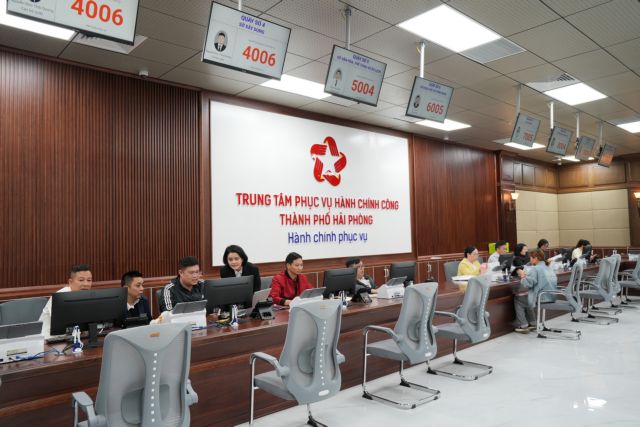 |
| Officials working at the Public Administration Centre in the northern city of Hải Phòng. —VNA/VNS Photo Tiến Vĩnh |
Putting people first
In the northeastern province of Quảng Ninh, when Bùi Hoàng Giang was appointed secretary of the Party Committee of Yên Tử Ward, he arrived as an outsider unfamiliar with the area.
He quickly concluded that before he could stabilise the administration and promote sustainable economic development, he first needed to understand the ward's history, culture and traditions.
By day he focused on administrative work and by night he immersed himself in studying Yên Tử's historical legacy and cultural heritage.
Convinced that putting people first is the defining quality of effective leadership, Giang ensured that every major initiative was preceded by public consultation to better understand residents' concerns and aspirations.
As a result, land clearance, often regarded as a major challenge elsewhere, has proceeded smoothly in the ward.
In many cases, residents have voluntarily offered to donate land for road construction after understanding the administration’s plans.
"Transparency is the only way to build trust. Once people support a policy, even the most difficult task can succeed," Giang said.
Guided by that philosophy, he and the ward leadership developed the five-securities framework, comprising social security, secure livelihoods, happiness and wellbeing, prosperity, and public security and safety.
By prioritising social welfare, preferential policies for people with meritorious service, job creation and income growth, the administration has earned the confidence and support of local residents.
Advantages of decentralisation
In Hà Nội, Tây Hồ Ward has emerged as one of the standout performers under the new governance model.
Since the reforms were carried out, the ward has processed 8,730 administrative applications, all completed on time, with 95 per cent submitted online.
It has consistently ranked among the city's top-performing localities for services delivered to residents and businesses.
Secretary of the ward’s Party Committee Nguyễn Đình Khuyến said expanded decentralisation has enabled ward-level authorities to make decisions more independently, organise implementation more effectively, and assume greater responsibility for matters within their jurisdiction.
"The greatest advantage is that leadership and administration have become faster, more responsive to local realities and more effective,” he said.
Issues arising at the local level are identified and resolved immediately, instead of being allowed to accumulate.
This enables the Party committee and local administration to focus more closely on people's livelihoods, urban management, construction management, environmental sanitation, social welfare and administrative reform, he added.
Trương Quốc Việt, deputy dean of the Faculty of Public Administration at the National Academy of Public Administration and Governance, said institutional reform provides only the necessary framework. Ultimately, success depends on the capacity of those responsible for implementation, particularly local leaders.
"The gap between regulations on paper and real-world outcomes is bridged by the mindset, competence and implementation culture of public officials," he said.
Under the same decentralisation framework, localities whose leaders view delegated authority as an opportunity to innovate, accept responsibility, empower subordinates and identify clear development priorities are far more likely to unlock local resources and deliver tangible improvements.
Conversely, a reluctance to make decisions or assume responsibility can prevent even the best-designed institutions from achieving their intended impact.
For that reason, the results achieved during the first year of operating the two-tier local government model provide perhaps the clearest measure yet of the leadership, governance and implementation capabilities of local authorities across the country. — VNS
Society
 Society
 Society
 Society
 Society
 Society
 Society
 Society
 Society
 Society
 Society
 Society
 Society
 Society
 Society