 Society

Hà Nội adorned in red ahead of Liberation Day
1.
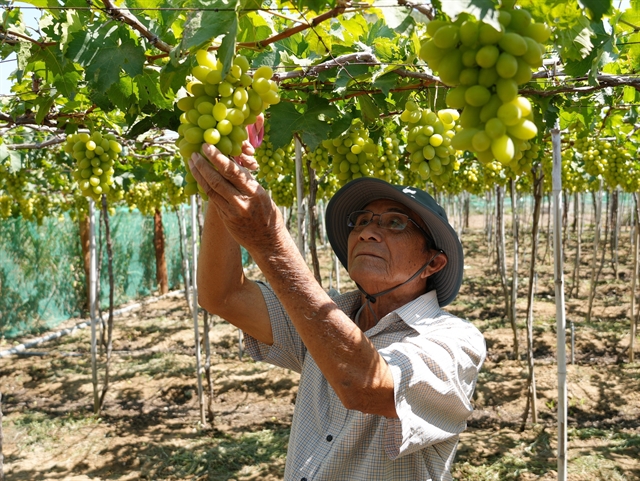 |
| Farmer Nguyễn Văn Mọi tends his NH01-48 green grapes grown to Vietnamese good agricultural practice (VietGAP) standards in Khánh Hòa Province’s Ninh Phước Commune. — VNA/VNS Photo Nguyễn Thành |
KHÁNH HÒA — Khánh Hòa Province is promoting high-tech agriculture to increase value, adapt to natural conditions and expand markets, including abroad.
Support policies, technology transfer and digital transformation are gradually laying the groundwork for a modern, sustainable agricultural sector in the province.
Located in the south-central coastal and Central Highlands regions, the province has a dry, hot climate in its southern part, which has traditionally hindered farming but is now being turned into an advantage through technology.
Many farmers, co-operatives and businesses have invested in greenhouses, net houses, drip irrigation systems, and sensors to control temperature and humidity.
They are also embracing quality standards such as Vietnamese and global good agricultural practices (VietGAP and GlobalGAP).
A clear example is the shift in key crops such as grapes, jujubes, asparagus, and honeydew melons. Better control of growing conditions has helped crops develop more consistently, with higher yields and improved quality.
Some models have delivered strong returns.
Grape cultivation generates profits of VNĐ1–1.2 billion (US$38,000–45,600) per hectare per year, while jujube brings VNĐ160–267 million ($6,000–10,100).
Water-saving irrigation systems, biological products and integrated pest management are helping raise yields while reducing environmental impacts.
At the same time, producers are investing in processing to increase added value.
Nguyễn Văn Mọi, owner of Ba Mọi grape farm in Ninh Phước Commune, said the farm is growing 13 grape varieties, including 10 for eating in fruit form.
Alongside traditional green and red grapes, new varieties such as mẫu đơn, black finger grapes and candy grapes have been introduced.
“The farm’s grapes have entered supermarket systems, helping affirm product quality and building consumer trust in local produce,” he said.
The province is implementing a range of policies to support the development of high-tech agriculture.
It has nearly 5,600ha of crops certified as organic under standards such as the US Department of Agriculture National Organic Programme, Japanese Agricultural Standards and EU standards.
It has also issued 170 growing area codes covering more than 3,540ha, including 65ha for export. Two packing facilities for mango and durian have been granted export codes for the EU and Chinese markets.
Beyond technical applications, the province is strengthening links with research institutes, universities and businesses to transfer new varieties, production processes and post-harvest technologies.
Models such as greenhouse grape cultivation, Y-shaped trellises, water-saving irrigation, biological traps, and intercropping with legumes are being widely applied, helping improve efficiency and soil quality.
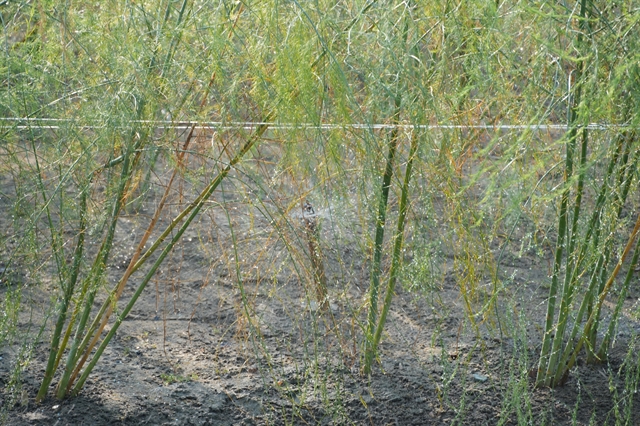 |
| Water-saving irrigation technology is applied to a green asparagus field grown on sandy soil during the dry season in Khánh Hòa Province’s Phước Dinh Commune. — VNA/VNS Photo Nguyễn Thành |
Trịnh Minh Hoàng, deputy chairman of the province People’s Committee, said high-tech agriculture not only brings economic benefits but also supports sustainable production.
The province plans to attract more businesses, develop concentrated farming areas linked with processing and promote agricultural tourism to increase land-use efficiency and product value, he added.
In the 2026–30 period, it will focus on digital transformation, technology application and value chains as key drivers to restructure agriculture towards sustainable production and climate adaptation.
During this period, the agricultural extension programme will aim to create concentrated farming areas, expand high-tech models and improve farmers’ knowledge.
Support activities will include not only technical transfer but also product traceability, growing area codes and stronger production–consumption links with businesses to meet domestic and export demand.
Promoting e-commerce
In Khánh Hòa’s mountainous areas such as Khánh Sơn and Khánh Vĩnh communes, farmers are gradually adopting e-commerce and shifting to market-oriented farming.
Many products are now sold on e-commerce platforms, helping improve incomes.
Co-operatives and producers are adopting digital technologies to promote and sell their products.
Cao Thị Thanh Huyền of the Phước Chính Agriculture – General Services Co-operative in Bắc Ái Commune said that in recent years the co-operative has sold large volumes of products such as rice, dried bamboo shoots and green beans through social media platforms including Facebook and Zalo.
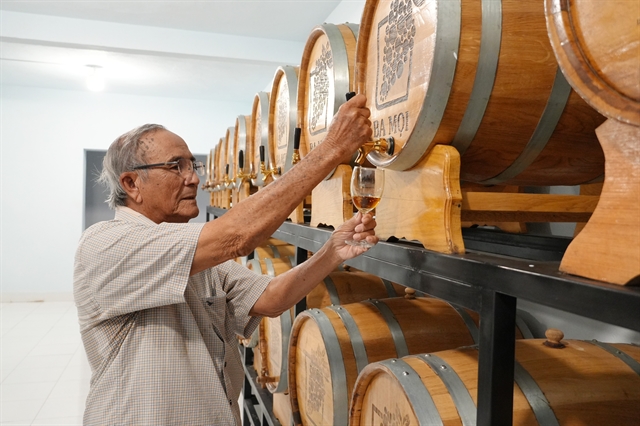 |
| Wine made from grapes at Ba Mọi grape farm in Khánh Hòa Province’s Ninh Phước Commune. — VNA/VNS Photo Nguyễn Thành |
Under the national target programme on socio-economic development in ethnic minority and mountainous areas in the 2021–25 period, the province Farmers Association has assisted people with shifting from small-scale farming to commodity production and forming specialised farming areas for key crops and livestock.
One of the key focuses is helping farmers access digital transformation. They are trained to promote products online, livestream sales and understand consumer trends to adjust production plans.
Lê Quốc Toàn, deputy chairman of the association, said products such as durian and green-skin and pink-flesh grapefruit are now available on e-commerce platforms, helping expand markets and increase value.
“When products are sold on e-commerce platforms, people not only sell more goods but also understand market signals and consumer demand, allowing them to adjust production and improve product value.” — VNS
Society
 Society
 Society
 Society
 Society
 Society
 Society
 Society
 Society
 Society
 Society
 Society
 Society
 Society
 Society